According to HubSpot data, blogging plays a significant role in driving website traffic and generating leads. This study suggested that B2B marketers who blog get 67% more leads than those who don’t, and websites with blogs have 434% more indexed pages.
Moreover, blogging is not only about writing high-quality content. Instead, it also involves adding engaging graphics, accurate grammar, and SEO, etc. In today’s context, the successful bloggers are the ones who work like content strategists, marketers, designers and SEO experts all at once.
Moreover, it can be challenging to craft content that ranks well on SERPs. Therefore, bloggers turn to utilising the blogging tools to streamline their workflow so that their blog can stand out in the competitive digital landscape and drive more traffic.
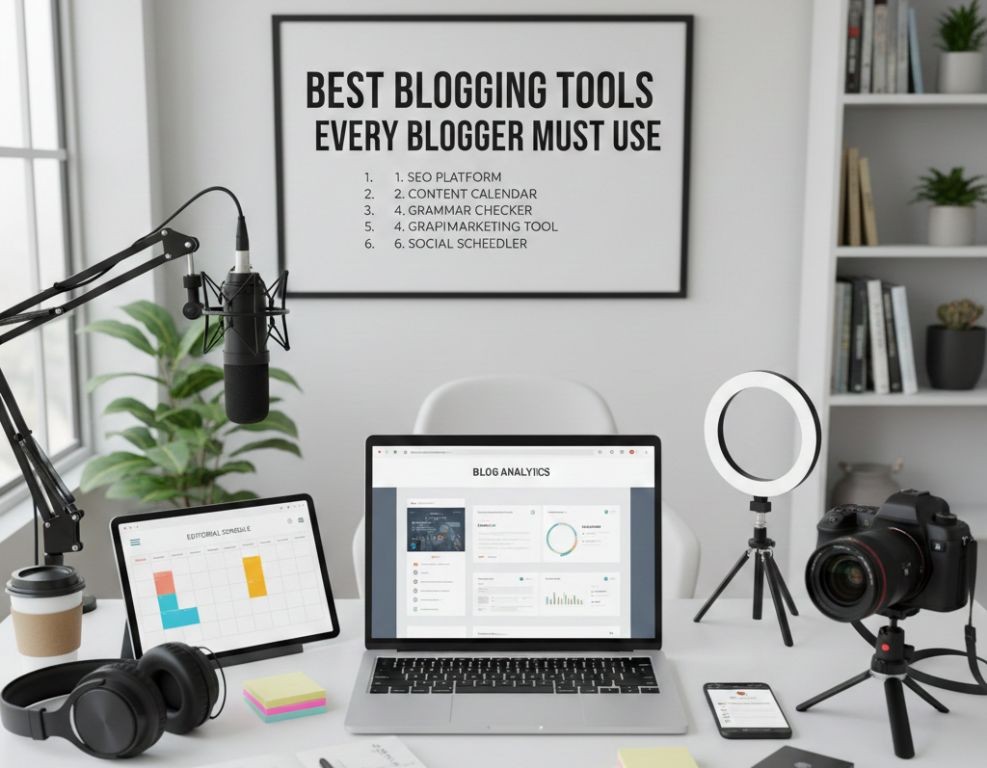
So, if you are a beginner or an established blogger, utilising these tools from content planning to SEO optimisation and keyword research can make your blogging successful. Also, it can help you grow your blog. In this blog, let’s discuss the new blogging tools every blogger must use to grow their blog and why they are important.
Effective tools for blogging
1. Keyword research tools:
Researching keywords before starting your blog can help you understand the needs of your target audience. Moreover, if you do not focus on this aspect, you will be writing content that no one searches for.
The keyword research tools can help you understand the trending and relevant topics and identify valuable keywords that can bring traffic consistently to your blog. Suppose your website is about offering nursing assignment help and consultancy then the keyword research tools will help you find the latest trends, Competitive keywords, and on what keywords the competitors are working. So, it will become easier for you to plan your content around it.
2. Google keyword planner:
It is a free and reliable tool that is included in your Google account and helps you to see which words are gaining attention on the internet and what people search on Google.
This tool shows search volume, trending terms, competition level and popular queries related to your topic. It helps you understand the actual user interest. For example, if you are writing a blog regarding a CV writing guide, then you can use Google Keyword Planner to know the combination of keywords you must use. Later, when you use those keywords in your blog strategically, you get better results.
This tool can help you plan high-performing content topics, find main and supporting keywords and understand the search demand in their niche.
If you want to attract organic traffic, this is a useful tool.
3. Ubersuggest:
It is a simple and affordable keyword research tool. It lets you explore keyword ideas, track rankings and understand the competitor’s strategies. Moreover, the interface of this tool is easy to understand, which makes it beginner-friendly.
Through this tool, bloggers understand how tough a keyword is and whether their site has a chance to rank for it. This tool is useful if you want better visibility and engagement.
4. Ahrefs keyword explorer:
Ahrefs is an effective tool that is used by professional bloggers and is known for its excellent keyword research and backlink analysis.
You can utilise this tool for identifying keywords, uncovering backlink opportunities, rank tracking and more. You can use this information to develop SEO strategies so that you can stand out from your competitors.
This tool provides deep insights into what users search for, how competitive the keyword is and what type of content is ranking for a particular keyword.
If you are a blogger who wants to build long-term SEO authority and want your blog to stand out in high-demand niches, Ahrefs is an ideal choice.
5. Semrush:
It is a useful tool for keyword research and competitive analysis. You can use this tool to find valuable keywords, study competitors’ strategies, and track their blog performance.
Moreover, these insights can help you drive traffic. This tool is also powerful for its large database and user-friendly interface.
Writing and editing tools:
No matter how creative the ideas you have for your blog are, you have to transform them into a clear, engaging and professional write-up. For this purpose, you can utilise the writing and editing tools to improve sentence clarity, eliminate grammatical mistakes and create content that has a logical flow.
1. Grammarly:
Writing error-free content helps you to build professionalism and establish authority in your niche. If you can’t afford someone to proofread or edit your blog, then this tool is the perfect choice. It is easy to use this tool through a browser extension.
Moreover, this tool checks grammar, spelling, punctuation, sentence structure, tone and clarity in your content. As a blogger, you can utilise this tool to refine your draft, eliminate all types of errors and ensure coherence in your content.
In addition, its style and tone suggestions are valuable for bloggers who want to align their writing with their brand personality.
2. Hemingway editor:
If you want to make your sentences concise, readable and easy to understand, then this is the tool you might be looking for. It highlights long sentences, passive voice, complex phrases and unnecessary words.
Moreover, this tool helps you to craft a writing that is clear, concise and keeps readers engaged from the first line to the last line.
Also, it makes the content easy to understand by readers of all backgrounds and ensures that your writing is focused without any clutter.
3. Google Docs:
This tool doesn’t need an introduction because we have been using this tool for many years. It is a free word processing tool that is popular among bloggers because it is accessible from any device and stores all drafts safely in the cloud.
Google Docs includes real-time editing, auto save, cloud backup, commenting and collaboration features.
Also, it has built-in grammar suggestions, formatting tools and organisation options. Therefore, it is convenient for the bloggers to write, edit, share and manage the blog content all in one place.
4. Blog outline generator:
The best way to begin a blog is to create an outline and structure for it. Moreover, this tool provides you with an outline in just a few seconds. You can edit and refine that outline to add coherence and flow.
SEO optimisation tools:
SEO optimisation ensures that your blog is discoverable on search engines like Google. Moreover, SEO tools help bloggers understand how to improve their content structure, meta tags, internal linking, and overall optimisation.
1. Yoast SEO:
It is one of the most popular WordPress plugins. It helps bloggers in optimising blog posts for search engines and enhances their visibility with real-time suggestions. It assesses SEO elements such as keyword usage, headings, title, meta descriptions, page structure, internal linking, and content readability.
Through its suggestions, you can improve sentence length, paragraph structure, and use more transition words in the content. In this way, you can stand out from the competition, and the search engine ranking of your blog can improve.
2. Rank Math:
It is a modern SEO plugin with various features. It is popular for its design and advanced optimisation features. This tool includes keyword analysis, local SEO features, schema markup, Internal link suggestion and SEO health monitoring.
It can provide you with more detailed insights than a traditional SEO plugin.
3. Surfer SEO:
It is a powerful content optimisation tool that provides information from top-ranking pages to give suggestions to create content that ranks higher on Google and matches search intent.
It focuses on factors like word count, keyword density, headings, and content structure etc.
Moreover, this tool helps bloggers to understand the content of high-ranking posts so they can follow the same pattern in their own content.
Content planning and organisation tools:

Blogging needs direction and planning. Therefore, bloggers also utilise content planning tools to stay organised, manage ideas, outline posts and keep track of the publishing schedules.
1. Trello:
It is a visual project management tool with a Kanban-style card-based system. This tool has a visual approach for organising tasks through broad, list cards to manage the workflow effectively. You can use this tool to build content calendars, track progress, store ideas, and plan future posts.
Its simple drag and drop design represents different stages of content creation from start to finish. Moreover, each card includes checklists, attachments, due dates, labels, and comments.
It also facilitates collaboration, and it is easy for the team members to assign tasks, share resources, and track progress, making it suitable for authors working on multiple projects.
2. Notion:
This tool is an all-in-one workspace and combines writing, planning, databases, note taking and tracking. With this tool, you can create in-depth content outlines, brainstorm ideas with bullet lists and mind maps, and also calendars.
You can customise this according to your plan of content creation, from brainstorming to organising content.
3. Evernote:
It is a digital notebook that can help you save ideas, research, outlines, and web clips.
This tool organises the notes into a notebook and syncs across devices.
If your blogging requires a lot of research and you want a space to store references and ideas, then this tool is ideal for you.
Visual content and design tools:
In blogging, visual content is essential. To grow your blog, adding engaging infographics, graphics, and featured images makes it more appealing:
1. Canva:
It is one of the most popular and user-friendly graphic design tools for bloggers. It includes an intuitive drag and drop interface, an extensive template library and customisation options that help bloggers to design attractive graphics and images in the blog. In this tool, you can find templates for blog banners, Pinterest pins, social media posts, thumbnails, and infographics.
Moreover, this tool makes consistent branding easier because bloggers can create style guides, color palettes and templates to keep visuals the same across the platforms.
2. Pexels and unsplash:
This tool is useful if you need high-quality free stock photos and videos. This tool is popular for its extensive library, so you can find a variety of images and enhance your content, and create visually attractive blog posts.
3. Adobe Express:
This tool involves simple and high-quality design features. It has ready-made templates and customisable design elements. This tool is suitable for bloggers who need polished videos.
Email marketing tools:
These tools help bloggers to build meaningful connections with their audience. With the help of these tools, traffic increases and bloggers promote new posts.
1. Mail chimp
It is a beginner-friendly email marketing platform. It has customisable templates, automation features, audience segmentation, and analytics.
Moreover, you can create an email list without any upfront cost with its free plan.
2. Convert kit:
This tool is designed specifically for bloggers. It offers simple creation, automation workflows, segmentation tools, and landing page templates.
Moreover, this tool helps in expanding the audience and enhancing relationships. Therefore, it is suitable for bloggers who want to create personalised reader journeys.
3. Mailer Lite:
It is an affordable email marketing platform that involves automation, landing pages, pop-ups and easy-to-customise templates.
Moreover, this tool is known for its simplicity and is suitable for bloggers who need useful email marketing features without any complexity.
Social media scheduling tools:
To attract new readers, build connections, and improve visibility, you have to promote your blog on social media.
Moreover, doing it manually is time-consuming; therefore, you can utilise scheduling tools to automate the process.
1. Buffer:
This tool allows bloggers to schedule content across various platforms. This tool involves planning tools, simple analytics and a dashboard to create a posting routine.
2. Hootsuite:
This tool provides scheduling for various platforms, tracking and analytics. Moreover, this tool is suitable for bloggers who have more than one social account and want details related to the engagement performance.
Google Analytics and performance tools:
These tools help bloggers to understand what is effective and what needs improvement. Moreover, these tools reveal user behavior, the source of traffic, the level of engagement, and search performance.
1. Google Analytics:
This tool tracks marketing campaign effectiveness and how users interact with your blog. It provides information about how different channels contribute to the website traffic. Moreover, you can assess the campaign performance by measuring metrics like clicks, conversions and ROI.
These insights help the bloggers to upgrade their content strategy to align it with audience needs.
2. Google console:
This tool helps bloggers know how their content appears in Google search results. In this way, you can refine your search appearance to drive more traffic using the relevant keywords. It shows indexing status, ranking keywords, click-through rates and performance trends, helping bloggers to improve their search performance.
At last, make sure that your blog is secured so that your content is saved from data loss and hacking with the help of tools such as Updraft Plus, Wordfence.
How to choose the right blogging tools?
To choose the right blogging tools, you must consider:
- Your niche
- Your skill level
- Your budget
- Your goals
Final thoughts
You need dedication, creativity, and patience to grow your blog. However, with these tools, your blogging journey can be seamless, easier, and effective.
These tools can help you in every stage of blogging from planning , writing, optimising to designing, promoting and analysing.
Also, you don’t have to use every tool. Instead choose the tools that align with goals and audience needs. Utilising these tools can result in your blog attracting more readers and ranking higher on search engines.