

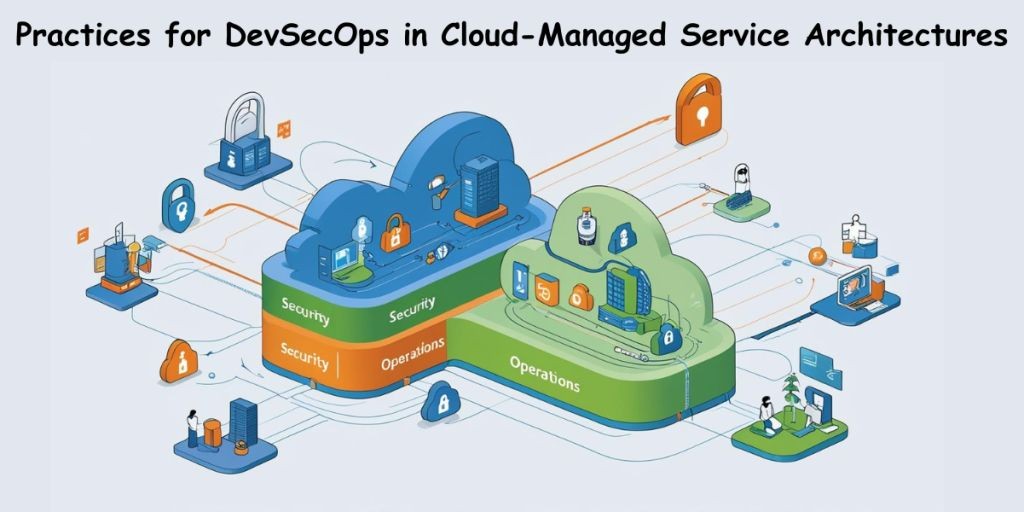
Tired of security headaches slowing down your cloud operations? Well, you are not alone. In today’s fast-moving cloud world, security often feels like a giant, grumpy gatekeeper, slamming the brakes on innovation. But what if I told you that you could deploy faster, safer, and more efficiently— all at the same time?
This isn’t just a futuristic idea—it’s what DevSecOps brings to the table, especially when dealing with the challenges of cloud-managed services architectures. Instead of dealing with safety at the end of the process, which often proves ineffective, devsecops integrates it from the beginning.
Through the assistance of professional cloud consulting services, companies will be able to adopt DevSecOps more efficiently so that speed and security should be accompanied by each other.
Let’s break things and be real about creating strong security in your cloud-managed services from the beginning.
A Reality Check: Cloud Environments Are Still Endangered (Even with Managed Services)
There is no denying the appeal of cloud-managed services. AWS Lambda, Azure Cosmos DB, and Google Kubernetes Engine are among the tools that provide developers with great capabilities. They reduced hands-on management, the ability to scale quickly, and faster feature deployment.
But here’s the catch: relying on managed services doesn’t mean you’re automatically protected from threats. You’re still responsible for your own data, application logic, configurations, and access controls. It’s a shared responsibility model, yet many businesses continue to assume that everything is taken care of by the provider—which couldn’t be further from the truth.
Heads up: Many companies still underestimate how dangerous simple misconfigurations can be. But the truth is, these small oversights are costing businesses millions — both in security breaches and damaged reputations. In fact, recent studies show that a large percentage of cloud-related breaches (up to 70% in some reports) are linked to misconfigurations. And when you layer managed services on top, things get even trickier:
- You’re in the Provider’s Sandbox: Less direct control means you need smart strategies.
- Integration Challenges: Getting all your security tools to work smoothly with diverse managed platforms is not easy.
- Compliance Overload: GDPR, HIPAA, PCI… navigating these across multiple managed services can quickly become overwhelming.
- Supply Chain Shocks: What if the managed service itself has vulnerabilities?
This isn’t meant to scare you — it’s a reality check. The good news? You can tackle these issues head-on by bringing security into every part of your development process. That’s where DevSecOps comes in.
Prioritizing Security from the Start: Adopting the DevSecOps Approach
Pushing security to the end often causes costly issues. DevSecOps brings it into the process from the start, helping teams catch problems early and fix them before they grow.
This shifting left approach can find and fix problems before they get big. It’s easier and costs less. It’s not just about protecting your systems — it’s about working smarter and saving time, money, and headaches down the road.
Here lies the key strategy:
- Shared Security
Security is everyone’s job—Dev, Sec, and Ops. No finger-pointing. Train developers on secure coding, and guide ops teams on safe deployments. Make security a shared KPI to keep everyone aligned.
- Automate Security Processes
Manual processes can leave room for mistakes. By automating security checks, testing, and even repairs, you can find issues faster and reduce risk. Make your CI/CD pipeline a safe stronghold.
- Ongoing Response
Conduct real-time monitoring to get ahead with early threat warnings. Every incident is a learning opportunity, not just a checkbox. It’s not something you do once and forget — it’s a continuous process.
- Codified Security
Treat security policies like code. Store them in Git, review regularly, and automate enforcement. When your security rules aren’t treated like code, things can quickly become disorganized and hard to manage.
- Complete Traceability
Keep track of everything—from logins and configuration changes to API activity. Make sure it’s all recorded and easy to review. When issues arise, a clear and detailed history helps you find and fix the problem fast.
DevSecOps Best Practices for Cloud-Managed Services
Now, let’s get tactical. Here’s how to inject DevSecOps at every stage of your journey with cloud-managed services:
Phase 1: Design & Planning
Begin by creating a security of your basis, not later.
- Threat Modeling:
For your serverless app using Lambda, API Gateway, and DynamoDB, map out data flows. Identify where attackers could get in and what data might be exposed. This isn’t just theory—it’s your first line of defense. - Secure Architecture Patterns:
- Least Privilege: Give managed services only the permissions they absolutely need. Avoid over-permissioning – it’s safer and keeps your systems lean and secure.
- Encryption EVERYWHERE: Data on rest? Encrypt it (AWS S3, Azure Cosmos DB, Google Cloud Storage). Data in transit? TLS/SSL, always.
- Cloud-Native FTW! Leverage your CSP’s built-in security features. IAM roles, VPCs, network ACLs, security groups – they’re there for a reason. USE THEM!
- Built-In Compliance: Regulations such as GDPR, HIPAA and PCI are not optional-they are compulsory. Choose managed services that are already certified. Then, map your internal controls directly to the service capabilities. This is key for cloud compliance automation saving you a mountain of audits later.
PHASE 2: Develop & Build
Catching vulnerabilities here is 10x cheaper than in production.
- Secure Code:
- SAST: Scan your custom code early. Tools lik SonarQube or Checkmarx will pick up on common issues before they even get out of your dev environment.
- Secure Coding Principles: Make sure your team follows best practices, avoids encoded secrets, and confirms inputs when building secure Lambda functions.
- Dependency Management:
- SCA: Open-source libraries are great, but they’re often riddled with vulnerabilities. Tools like Snyk or Mend scan for known issues. Don’t pull in a library that’s a ticking time bomb!
- Container Scanning: If you’re using managed Kubernetes, scan those Docker images. Regularly.
- Infrastructure as Code (IaC) Security:
- Your CloudFormation and Terraform templates define your entire cloud. So, scan them. Tools like Checkov or Bridgecrew can automatically spot misconfigurations (e.g., that public S3 bucket you accidentally deployed, weak IAM roles, missing encryption).
- Version control your IaC. Peer review it to track changes and avoid errors.
- Treat it like gold. As it’s the foundation of your cloud. Any mistake here can impact your entire system.
PHASE 3: Test
Security testing isn’t just for compliance. It’s for confidence.
- DAST (Attacker’s Viewpoint!): Test your running application. Hit your managed API Gateway endpoints with DAST tools. Are there injection flaws? Broken access controls? This is real-world testing.
- CSPM (Cloud Security Posture Management): Tools like Wiz or Prisma Cloud are non-negotiable. They continuously scan your entire cloud posture (including every managed service) for misconfigurations. This is crucial for effective Cloud Configuration Scanning. Is that managed database encrypted? Are those Lambda permissions too broad? Get alerts before a breach.
- Penetration Testing & Bug Bounties: Automated tools are great, but human hackers are smarter. Regular penetration tests (pen tests) focused on your managed service interactions are key. Consider a bug bounty program – let the ethical hackers find your flaws.
- Chaos Engineering : This is next-level security. Intentionally inject failures into your system—like temporarily revoking an IAM role or simulating a network outage. Then observe:
- How do your security controls respond?
- Can your system recover on its own?
By doing this, you train your system to become more resilient—so when real issues hit, nothing breaks down.
PHASE 4: Release & Deploy
Your CI/CD pipeline is your final defense before code goes live. You need to make it rock solid.
- Automated Security Gates:
Integrate tools like SAST, SCA, DAST, and CSPM into your DevSecOps Pipeline.
If any build fails a security scan — don’t let it deploy.
No exceptions. No shortcuts. Period. - Secure Deployment Practices:
- Least Privilege for Pipelines: Your deployment pipeline should only have the minimum permissions it absolutely needs. Don’t give it extra access—it’s risky.
- Secrets Management:
Hardcoded secrets are a major risk. Therefore, always go for a secret control tool such as AWS Secrets Manager, Azure Key Vault or Google Secret Manager. - Immutable Infrastructure: Whenever you can, stop upgrading the services you currently have, redeploy them. It is the way you can be consistent and not have any surprises in configuration drift.
- Rollback Strategies: What if something goes wrong after deployment? Have a pre-tested, rapid rollback plan. You need to be able to revert to a secure state, fast.
PHASE 5: Operate & Monitor
The moment you deploy, the real work begins.
- Cloud-Native Security Monitoring:
- Centralized Logging: Aggregate logs from all managed services.
- SIEM/SOAR: Use a SIEM to correlate events and detect deviations. Invest in SOAR for automated response.
- Threat Intelligence: Feed in the latest threat intel to spot new attack patterns.
- IAM Governance: Regularly review IAM roles and permissions. Are those managed service roles still necessary? If not, remove them.
Enforce MFA. Implement Just-in-time (JIT) access to grant elevated permits for a limited period only when needed.
- Incident Response & Forensics: Have a detailed incident response plan specifically for cloud-managed services. Where are the logs? Who do you contact when something goes wrong? Conduct regular practice drills for faster response.
- Patch Management: While Cloud Provider (CSP) Patch OS, you still need to patch the application code and addiction. Install Clear SLA (service level agreement) for vulnerable treatment.
Common Risks to Avoid
Devsecops implementation can go out of hand, even with the best intentions. Be mindful of these traps:
- Ignoring Culture: If you only use tools to try to implement DevSecOps and don’t make any changes to the culture or break down silos, you’re setting yourself up for failure.
- Tool Overload (Tool Sprawl): Implementing an excessive number of isolated security tools results in complexity, higher maintenance overhead, and blind spots. Opt for integration.
- Automating Too Soon: Automating a broken process doesn’t fix the problem—it just spreads the mess faster. It’s better to sort out your workflows first, then bring in automation.
- Neglecting Legacy Systems: It is easy to get caught up in new cloud-native applications and neglect the older, monolithic systems, which can introduce large vulnerabilities.
- Not Enough Training: Don’t assume your teams are already up to speed. DevSecOps demands new skills, especially around cloud and security. Giving your team proper training makes a big difference.
- Inconsistent Policies (Particularly Multi-Cloud/Hybrid): The security model and API used by each cloud provider vary. You will have uneven security across environments if you don’t use a consistent policy-as-code approach.
- Neglect of Runtime Security: “Shifting Left” is wonderful, but threats will nevertheless arise in production. Not doing continuous monitoring and incident response is a serious flaw.
Future Trends: What Lies Ahead in DevSecOps for Cloud-Managed Services?
The world is constantly changing. Stay ahead of the curve!
1. AI and Machine Learning in Security
Look for AI/ML to transform predictive threat detection, anomaly detection, and automated security tasks through machine learning, lowering false positives and response times.
2. Serverless Security (FaaS Specifics)
The serverless functions’ peculiar ephemeral and event-based character creates different security challenges. Anticipate more specific safety devices to protect personal tasks, handle addiction and monitor large -scale driving time behavior. (Eg fine-grained IAM per function, strong input validation, functional level logging and secret management).
3. Shift-Right Security and Observability
In addition to “shifting left,” there is increasing focus on “shifting right”—achieving deep security visibility and control in production environments using sophisticated observability (metrics, logs, traces) in order to really know and secure live systems.
4. Advanced Software Supply Chain Security
Prepare for stricter controls and verification of each element of your software. From code repositories to build pipelines and deployment artifacts, to thwart sophisticated supply chain attacks.
5. Quantum-Safe Cryptography
Quantum computing is still emerging, but it’s already pushing the security world to think ahead. New cryptographic methods are being developed to stay safe from potential quantum-powered attacks.
6. Platform Consolidation
Teams are fed up with switching between tools. There will likely be more platforms that centralize DevSecOps functionality, facilitating collaboration and security management throughout the development lifecycle.
Wrapped up
DevSecOps isn’t a luxury. In the age of cloud-managed services, it’s the only way to live and prosper. Stop putting security last. Integrate it into all that you do. The devsecops best practices discussed here are your roadmap.

Patel Nasrullah is the co-founder of Peerbits, a global tech company specializing in software development, mobile and web app development, DevOps, and cloud solutions. With over 10+ years of experience, he leads initiatives for the company’s diverse service profiles. Patel’s deep expertise in scalable systems and agile delivery helps businesses accelerate innovation and build high-performing digital products.