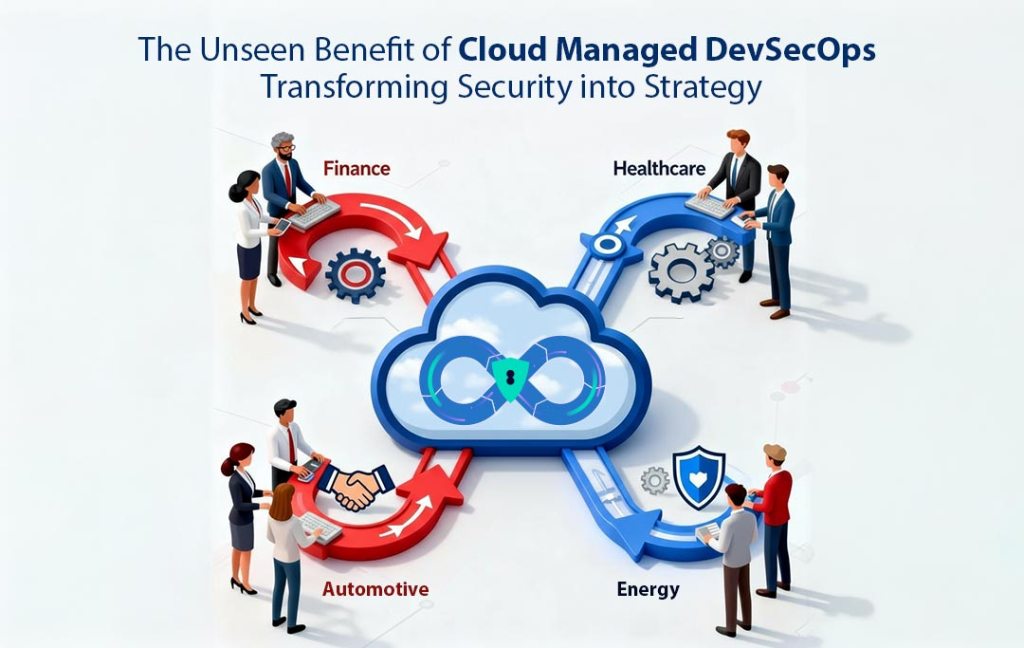
Enterprise infrastructure modernization is at a defining stage: the era of the cloud managed. What began as a search for scalability has been transformed into an intelligence, automation, and trust movement. In industries, leaders are creating clouds that not only execute workloads but also develop ecosystems that reason, evolve, and defend value dynamically using developed DevSecOps services and best practices of automation.
By 2026, more than 90% of enterprise workloads will run in the cloud, and the new reality will be to expect business resilience based on the balance between speed and security. DevSecOps as a Service is in the middle of this balance, the science that will make security more of a catalyst. It turns every deployment into a way to build trust and every line of code into a safeguard, which is key to modern DevSecOps strategies.
In the world scene, the most successful business companies are establishing the pace. With DevSecOps consulting services, financial institutions deploy digital products within hours with perfect compliance. DevSecOps security services are also utilized by healthcare innovators to protect both data and lives through the use of real time analytics that are safeguarded. Manufacturers relate factories to smart systems, which are driven by DevSecOps services that anticipate and avert disruptions before they take place. Every innovation is a decisive move on its own path, and security becomes the ultimate metric of innovation that is driven by the most product oriented DevSecOps consulting services.
This change is represented by cloud managed DevSecOps. It allows businesses to create, run, and expand with unrivaled accuracy in environments in which agility and confidence work together. The future is associated with organizations that do not perceive DevSecOps services and solutions as guarantees, but as the drivers of innovation, growth, and digital trust across industries.
The DevSecOps is Going Cloud Managed
1) The New Age of Cloud Intelligence
The business cloud is moving towards control and expertise. Today, workloads are not being hosted by the cloud platforms only, but are also learning, predicting, and securing in real time. IDC forecasts that in the year 2026, nine out of ten businesses will be using managed cloud services to conduct some vital operations.
2) Why DevSecOps is Rising Now?
Speed has surpassed conventional security models. Hundreds of deployments each day and the growing threat surface simply cannot be handled by static controls. DevSecOps, being an adaptable model, is a framework in which security is directly incorporated into the development pipelines and cloud operations.
3) The Impact in Numbers
According to Gartner:
- A) Threats are detected and responded to with greater speed (60% faster).
- B) Reduced by 45% in the number of cloud misconfigurations.
- C) 2x increase with complete compliance in the release rate.
These findings demonstrate why the concept of DevSecOps is emerging as the new cloud first enterprise.
4) Change Leading Industries
- A) Finance: Ready to audit and comply continuously, with automation.
- B) Healthcare: Artificial intelligence analytics security in real time.
- C) Manufacturing: When it comes to manufacturing, many companies are starting to adopt predictive operations across connected plants.
- D) Retail: Convenient experiences and in built security of transactions.
5) A Defining Shift
DevSecOps, as operated by clouds, is transforming enterprise innovation. This shift means we’re moving away from reactive measures to smarter prevention strategies. Instead of relying on manual checks, we’re seeing more automated solutions that provide reliable evidence. Plus, they’re replacing a bunch of different tools with a streamlined system that people can trust. It is not the next level of digital transformation, but its basis.
The Advantages of the Application of DevSecOps in Cloud Managed Environments
1) Speed and Agility at Scale
The use of DevSecOps as a Service is speeding up the delivery of modern businesses without compromising security.
- Recent advancements in cloud technology have boosted the speed of our release processes by 40 to 50%.
- The continuous scanning and integration of DevSecOps managed services helps to alleviate post deployment problems by up to 60%.
- This has led to faster innovation cycles while ensuring we stay in compliance with regulations.
2) Nonstop Compliance and Governance
DevSecOps consulting services offer business organizations automatic compliance across various cloud environments.
- Real time audit evidence and policy as code reduces 70% of manual compliance work.
- Top DevSecOps services and solutions guarantee immediate compliance with such international regulations as SOC 2, HIPAA, and ISO 27001.
- This will result in enterprises being always audit ready as they grow with confidence.
3) Less Security Incidents and Bad Configurations
The most effective business case for DevSecOps services is security resilience.
- A report from Gartner shows that organizations with well developed DevSecOps solutions experience 45% fewer misconfigurations and 30% fewer security breaches.
- These security services can spot unusual activity in real time, reducing the chances of any vulnerabilities.
- Managed automation provides predictive defense on all levels of the cloud.
4) Efficiency and Cost Benefit in Its Operation
Industries that utilize DevSecOps services in their operations, such as finance, health care, and retail industries, have recorded high cost efficiency.
- There is a 30 to 35% reduction in downtime and maintenance.
- DevSecOps operated services effectively utilize the resources by eliminating duplication in the engineering teams.
- It is a direct ROI, performance, and productivity increase.
5) Teamworking, Team Building, and Responsibility
Frictionless collaboration of teams is facilitated by the best DevSecOps consulting services.
- Integrated workflows allow for expedited decision making and constant feedback.
- Every product release is a team effort involving developers, security architects, and operations staff.
- This inter functional synergy determines the enterprises that perform highly in every DevSecOps service in any sector of the industry.
6) Market Leadership and Brand Trust
Each successful launch builds trust in our processes.
- Companies that work with a reputed DevSecOps services firm establish confidence with their customers in the long run.
- When they have secure and compliant delivery pipelines, they will be market leaders in regulated markets.
- In the case of global brands, an intelligent DevSecOps as a service model has become the solution to seeking trust and scaling security with expansion.
Emerging Problems and Blind Spots and the Way Entrepreneurships Are Overcoming the Problems
1) Tool Overload and Gaps in Integration
Reality: 61% of enterprises work with 5+ disintegrated tools of DevSecOps that do not integrate, which results in piecemeal visibility.
Impact: The delay in the detection process, unequal reports, and unnecessary alerts.
Solution:
- Integrate consolidated DevSecOps managed services dashboards.
- Utilize DevSecOps as a Service platforms to enable the integration of CI/CD, IaC, and security processes.
- Companies with integrated DevSecOps services and solutions shorten the time of response to risk by 45%.
2) Skills and Culture Gap
Reality: 68% of organizations do not have cross functional DevSecOps skills (IDC).
Impact: Low rate of adoption, poor decision making, and inconsistent governance.
Solution:
- Engage DevSecOps consulting services to build skills and culture.
- Get on KPIs and automation playbooks between Dev, Sec, and Ops.
- Adoption rates are enhanced by 35 to 40% by cultural transformation programs.
3) The Automation Paradox
Reality: 42% of businesses will have felt alert fatigue due to unfiltered automation.
Impact: Among the false positives are actual threats that remain undetected by security teams.
Solution:
- Intelligent automation of AI powered DevSecOps security services.
- Integrate human prioritization and ML prioritization.
- Balanced automation minimizes false positives and enhances the accuracy of response.
4) Shared Responsibility and Misconfigurations
Reality: 60 misconfigurations and ambiguity of accountability contribute to 60% of cloud breaches.
Impact: There is no defined ownership between providers and teams, which is a risk.
Solution:
- Verify the configuration via DevSecOps managed services.
- Introduce the code of policy and the management of posture.
- Accountability can minimise breaches by half.
5) Compliance in Motion
Reality: Firms are dedicating an average of 1,200+ hours a year to manual auditing.
Impact: Reactive compliance, late certifications.
Solution:
- Implement DevSecOps services and solutions, i.e., adopt compliance as code frameworks.
- Reporting and generating evidence in real time.
- Under automation, compliance overhead is cut by 70%.
6) Unseen Supply Chain Risks
Reality: Codebases contain unverified open source parts 85% of the time.
Impact: Third party vulnerabilities compromise the security of entire ecosystems.
Solution:
- Introduce SBOM controls as a services platform.
- Auto scan dependencies and real time alerts.
- By the time of early detection, external risk exposures are reduced by 40% times.
Necessary Capabilities of Managed Cloud for Modern DevSecOps
1) Complete Automation and CI/CD Security
- DevSecOps as a Service is based on automation.
- Combine security checks immediately into CI/CD pipelines to release much faster and safer.
- DevSecOps managed service enterprises also realize a release cycle speed of up to 50% compliance free.
2) Uniform View and Real Time Tracking
- The current DevSecOps service and solution offer a single pane of glass across multi cloud environments.
- It unifies risk analytics, vulnerability scoring, and compliance tracking on a single dashboard.
- Real time observability decreases response and detection time by 45 to 60%.
3) Smart Automation and AI Defense
- Predictive threat detection using AI has become the best DevSecOps services and solutions.
- ML models identify exploits and prevent anomalies.
- DevSecOps security services are AI operated and decrease the false positives by up to 35%, increasing the accuracy of alerts.
4) Policy as Code and Compliance as Code
- The conformity must be quick like code.
- Validation can be performed continuously by embedding governance rules in the code repositories.
- DevSecOps consultancy services introduce policy as code frameworks that spare manual audit endeavours by 70%.
5) Cloud Native Posture Management
- Any managed cloud environment requires automated posture control.
- Continuous monitoring of configurations, permissions, and workload exposure is done by integrated DevSecOps managed services.
- Predictive posture management eliminates 40% of the misconfigurations and 50% cloud breach risk.
6) Secure Software Supply Chain
- Transparency in build to run has become a must have.
- In areas such as finance and healthcare, where DevSecOps services are popular, SBOMs and dependency scanning are used to ensure that all their components are verified.
- This will eliminate third party vulnerabilities and enhance regulatory confidence.
7) Cross Team Work and Collective Responsibility
- The essence of any successful DevSecOps services company is culture.
- Rallied pipelines and common dashboards align Dev, Sec, and Ops teams.
- Companies that adopt collaborative DevSecOps services and solutions have 2x times faster security ticket resolution.
8) Constant Testing and Low Level Feedback
- Constant testing provides the basis of constant trust.
- Feedback controls between code, security, and production environments ensure resiliency in each iteration.
- Organizations decrease post deployment incidents by 30% with DevSecOps consulting services.
Managed Cloud Environment DevSecOps Strategies
Strategy 1: Security As Code, Not After Code
Consider security in the early stage of development. Make DevSecOps a Service a part of the first day to make pipeline protection.
Result: A decrease of late stage vulnerabilities by up to 50%.
Strategy 2: Pure Automation of the Pipeline with Everyone Being Adaptive
Automate everything from scanning to patching; enforce DevSecOps managed services, while retaining human control.
Result: Delivery by 60%, no risk increment.
Strategy 3: AI Predictive Defense
Implement AI based DevSecOps security solutions that monitor behaviour, identify abnormalities, and redirect threats before they arise.
Result: 35% faster response, with 30% fewer false alarms
Strategy 4: Single Cloud Governance
As multicloud is taking over, normalize policy as code DevSecOps services and solutions.
Result: The percentage of audit failures decreases by half, and drift is practically removed.
Strategy 5: First Access and Zero Trust Identity
Ensure all users, systems, and services are safe by implementing least privilege and short lived credentials as part of the DevSecOps service company designs.
Result: 42% less unauthorized access cases.
Strategy 6: Culture of Shared Ownership
Turn silos into teamwork by hiring DevSecOps consulting services so that Dev, Sec, and Ops can be aligned to shared KPIs.
Result: Receive 30% more proactive risk reports.
Strategy 7: Feedback Loops and Real Time Metrics
Measure what’s important: rate of deployment, MTTR, and score of compliance. Continuous adaptation by using leverage dashboards of DevSecOps services and solutions.
Result: Data decisions, not sceptical ones.
Trends Initiating Cloud Managed DevSecOps
1) AI Native DevSecOps
A) What is it?
Code driven, pipeline driven and runtime signal driven security, which automatically responds with DevSecOps as a Service.
B) Why Does it Matter?
Quickly identify threats, reduce false notifications, and improve scale protection. There is a 35 to 45% faster time to detect on teams.
C) Executive Move
Create AI models within your DevSecOps services and solutions and gauge the decrease in mean time to respond.
2) Unified Multi Cloud Control
A) What is it?
A single security and compliance tier within AWS, Azure, and Google using managed security services of DevSecOps.
B) Why Does it Matter?
Reduced drift and fewer blind spots. Misconfiguration related incidents are reduced by approximately 40%.
C) Executive Move
Policify and demand a single risk dashboard of the DevSecOps services company.
3) Identity First Everything
A) What is it?
DevSecOps security services comprise short lived credentials, least privilege, and continuous verification.
B) Why Does it Matter?
Curtails limitations on locals and internal abuse. The number of unauthorized access attempts has reduced by approximately 40.
C) Executive Move
Reorganize identity as the highest KPI in DevSecOps consulting services and use access hygiene scores to fund it.
4) Autonomous Compliance
A) What is it?
The controls and evidence are recorded in code and constantly checked by DevSecOps consultancy services.
B) Why Does it Matter?
Audit cycles shrink. Manual work drops up to 60 to 70%.
C) Executive Move
Ask for an audit ready report to be present in the board pack on a quarterly basis.
5) Software Supply Chain Trust and Provenance
A) What is it?
DevSecOps solutions and services track SBOMs, signed builds, and dependency health end to end.
B) Why Does it Matter?
Third party risk declines. Release confidence rises.
C) Executive Move
Establish a rule whereby no artifact leaves the store without any evidence of its provenance.
Industry Adopting Cloud Controlled DevSecOps
1) Automotive
What’s Driving Adoption:
Connected mobility and software defined vehicles.
How it’s Applied:
DevSecOps services and solutions are put in place by automakers to acquire over the air updates, embedded systems, and cloud linked infotainment systems protection.
Impact:
- In the vehicle, software release cycles were reduced by 40%.
- OTA update security compliance increased by half.
- Real time telemetry secured across the world fleets.
2) Financial Services
What’s Driving Adoption:
Complexity of compliance and real time innovation requirement.
How it’s Applied:
DevSecOps managed services are applied to automate risk controls, encryption, and regulatory reporting by banks and fintech companies.
Impact:
- Deployment times reduced by 50%
- Everlasting PCI-DSS/SOX audit preparedness.
- AI security services of DevSecOps enhanced fraud detection.
3) Healthcare and Life Sciences
What’s Driving Adoption:
Blasting data amounts and expanding laws on data protection (HIPAA, GDPR).
How it’s Applied:
DevSecOps as a Service is being used by hospitals and research networks to protect patient data security and automatically manage policy enforcement.
Impact:
- Breach exposure reduced by 45%
- Analytics efficiency up by 30%
- The diagnostics were introduced in days rather than months using clouds.
4) Energy and Utilities
What’s Driving Adoption:
Intelligent grids, Internet of Things, and regulatory visibility.
How it’s Applied:
DevSecOps services and solutions protect SCADA systems, scan assets, and provide compliance in power and renewable energy operations.
Impact:
- Downtime reduced by 35%
- Full compliance with NERC CIP and ISO 27001.
- Proactive maintenance guaranteed by AI intelligence.
5) Manufacturing
What’s Driving Adoption:
Intelligent factories, Internet of Things growth, and smart predictive maintenance.
How it’s Applied:
DevSecOps consulting services are being integrated into industrial control systems by manufacturers to secure the connected equipment and data pipelines.
Impact:
- 100% uptime is ensured in production lines.
- Abnormalities of operations were identified 3x with quicker speed.
- 40% lower vulnerability of edges.
Conclusion
Enterprise innovation requires a trade off between speed and security, and Cloud Managed DevSecOps is where such a balance is achieved. It has not been a framework, but it has become the heart of the intelligence of the modern cloud strategy. Organizations do not defend value; they generate it when automation, AI, and governance combine. Partners who can integrate DevSecOps as a Service as a core component of their business operations will be the first to be trusted, grow at scale, and determine what it really means to be digitally resilient in this new era.
