

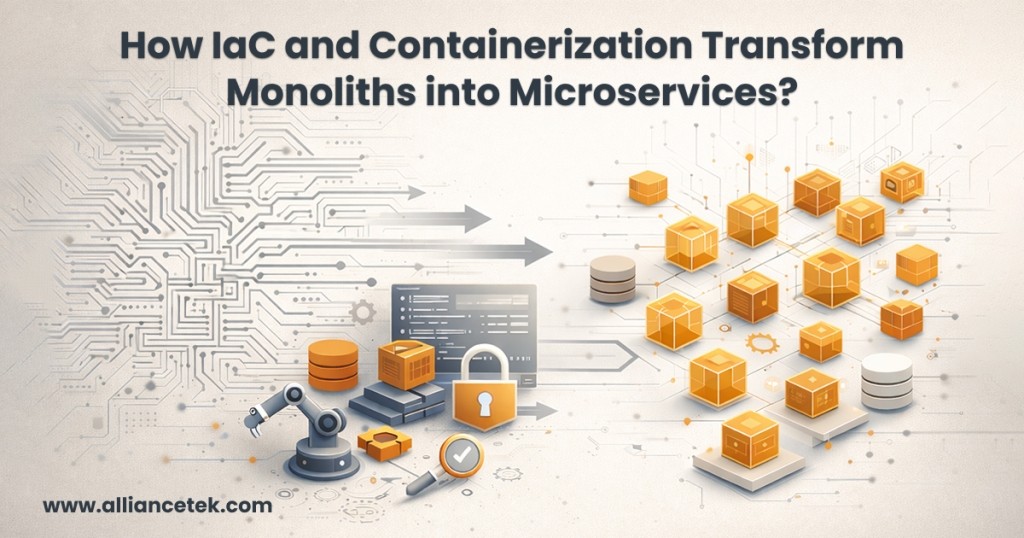
Once, to build an application was to create a single large block of functionality, a single large release. That model was effective with numerous teams when projects were small. However, with time, the requirements change: applications increase, the number of people in a team increases, the release cycle shortens, and the infrastructure becomes more complicated.
Most companies are rewriting that story today. They are moving to microservices architecture, they are moving to containerization, and they are managing infrastructure with code. This is a combination of microservices, containerization, and Infrastructure as Code, which is causing a shift in the way software is constructed, deployed, scaled, and maintained.
You will also find in this article how that transformation works, why it is important, and how your organization can implement it, particularly when you engage a well-established DevOps services company or hire DevOps consulting services to lead you through the process.
Why Monoliths Fall Apart as They Grow
A monolithic architecture is one that packages all features and modules into a single codebase. The first simplicity of that structure is that it has a single repository, a single deployment pipeline, and a single versioning system. That would be okay in case of a small product or when the demand to scale is low.
However, monoliths start to be weak as the system expands:
- Any change, even to a small part, causes the red deployment of the entire application. That slows the release cycles.
- Scaling is ineffective; you cannot scale a single module individually when the whole application is a single unit.
- The codebase grows difficult to maintain, tests grow more complicated, dependencies grow, and technical debt grows.
- In the case of teams, coordination is cumbersome. Parallel development, independent team ownership, or frequent releases are all more difficult.
- Such constraints render monoliths fragile: a minor modification or bug can impact the whole application. With the real-world workloads swelling, lots of monoliths just cannot keep pace.
Microservices and Containerization and IaC: A New Paradigm
Companies are moving to microservices, small, independent services with a narrow scope, to overcome monolith constraints. Combined with containerization and operated through Infrastructure as Code (IaC), this architecture is flexible, agile, resilient, and scalable.
A. What IaC Does for You
Infrastructure as Code is the habit of defining infrastructure, servers, networks, databases, permissions, etc., in configuration files instead of configuring them manually.
The latter change has tangible benefits:
- Infrastructure is version-controlled, testable, reviewable, and reproducible, like application code.
- Your team is able to spin up complete environments in minutes – development, staging, production. This minimizes error, provides consistency, and accelerates deployments.
- Infrastructure modifications have a definite pipeline. You are able to monitor changes, undo them when necessary, and prevent manual misconfiguration.
The same practices, version control, peer reviews, etc., work when your infrastructure is code. That is very much in line with development workflows. You can also use DevOps solutions from professionals to make things easier.
How IaC, Containers, and Microservices Work as a Trio
Bringing these three together, microservices + containerization + IaC, transforms software delivery.
Here is how:
- Infrastructure and service definitions live as code.
- Environment setup becomes automated and reproducible.
- Microservices run in containers that can be versioned, scaled, and replaced independently.
- Deployment pipelines CI/CD manage both application changes and infrastructure changes.
- Because this is codified and versioned, rollback, audit, and consistency become built-in.
This trio delivers speed, stability, flexibility, and control. It shifts software delivery from monolithic risk to modular agility.
Benefits Your Company Will Get by Taking This Approach
When you shape or drive architecture and work, this change can have quantifiable rewards.
Here’s what you gain:
- Quick delivery of features: Small decoupled services imply quicker iterations and reduction of release cycles.
- Independent scaling: Scale the services being loaded and nothing more.
- Improved fault isolation: A single service failure does not take down the system.
- Reusable infrastructure and repeatable environments: Development, staging, and production setup are consistent and predictable.
- Smaller and focused teams: Each service may be handled by a small team, which makes the workflow agile and ownership more transparent.
- Less deployment risk: Due to smaller and more frequent deployments, risk is focused on small changes rather than massive releases.
- Simpler maintenance and upgrades: Single services can be fixed or changed without having to touch the rest of the application.
- Cloud-native flexibility: Cloud-native infrastructures are portable; containers and IaC enable multicloud or hybrid cloud deployments.
- Increased operational visibility and auditability: Infrastructure-as-code provides version history, change logs, and rollback; containerization assists in isolating environments; together, you have control.
This will secure software delivery workflows, make it more resilient, and closer to business requirements.
The Relation to DevOps and the Importance of a Good DevOps Support
All this, microservices, containerization, and infrastructure as code, is very much in line with the current philosophy of DevOps. When you partner with a committed DevOps development company, you get more than just tools; you get a mindset that unifies development, operations, infrastructure, security, and deployment processes.
Collaboration with DevOps Services Providers or hiring DevOps Developers assists in numerous aspects:
- They introduce experience in the development of pipelines that combine application code and infrastructure code.
- They incorporate best practices in the areas of CI/CD, automated testing, versioning, rollback plans, and environment hygiene.
- They assist in the definition of deployment patterns, rollback plans, monitoring and alerting, and continuous updates.
They ensure that containerization and microservices are not used in isolation but are married with infrastructure automation.
For organizations requiring extra security attention such as regulated industries or sensitive data domains you might also choose to hire DevSecOps engsineers or hire dedicated DevSecOps engineers to embed security validation into every stage of the pipeline. With DevOps integration services and DevOps implementation services, you get both automation and compliance baked in.
In this context, having modern DevOps pipeline management, Enterprise DevOps security practices, or DevOps risk mitigation strategies makes a big difference. These practices ensure that your software project remains secure, resilient, and auditable as it scales.
The Most Frequent Pitfalls and Their Prevention
The power of switching monoliths to microservices with IaC and containers is not without challenges. Being aware of these will make you a wise planner.
A. Service Design Complexity
The division of a monolith into microservices needs to be designed. Unintended complexity or unintended coupling may be caused by poorly defined boundaries or inter-service dependencies. It is necessary to plan properly.
B. Infrastructure Overhead
Every microservice may require its own database, network configuration, and storage – it is important to design the infrastructure carefully. That is where IaC is useful: it codifies configurations, lowers drift, and allows repeatability.
C. Deployment and Operational Overhead
The presence of numerous services implies numerous deployments, monitoring, logging, versioning, and possible complexity in debugging. There should be strong CI/CD and observability practices.
D. Transaction Management and Data Consistency
Distributed services make transactions and data consistency difficult. With shared databases, distributed transactions, and eventual consistency, you must have adequate patterns, data design, and fallback plans.
E. Heightened Security Concerns
The increased number of services and the number of communication channels imply an increased number of attack surfaces. Security practices should be incorporated early as part of continuous security validation, which helps in eliminating risks.
F. Team Co-ordination and Ownership
Unless teams are well defined, independent services may result in fragmented ownership. There is a difference between clear governance, team boundaries, and team-level accountability.
A Path Forward: How to Start Your Team
In case you choose to implement this contemporary delivery model, the following is a systematic way that you can take:
- Carry out a detailed audit of your current monolithic application: Assess dependencies, modules, data flows, and performance bottlenecks.
- Create a migration plan: Identify modules or features that can be made independent services, data dependencies, and design service boundaries.
- Go Infrastructure as Code now: Select IaC tools such as Terraform, CloudFormation, Ansible, etc. Standardize dev, staging, production infrastructure.
- Containerize all services: Package services in containers to provide consistency of the environment, ease of deployment, portability, and isolation.
- Introduce CI/CD pipelines: Implement CI/CD pipelines, often guided by DevOps CI/CD Services, that integrate both application and infrastructure code.
- Integrate security and compliance into the pipeline: Apply DevSecOps, including automated security testing, configuration testing, secret management, and ongoing security testing.
- Monitor, log, and observe all services: Use distributed tracing, logging, metrics, and alerts, particularly in a microservices environment where numerous services are interacting.
- Assign team-level ownership to services: Give every microservice to a dedicated team to ensure that maintenance, updates, features, and ownership are well understood.
- Iterate and evolve: Begin with a small set of services, observe production behavior, perfect patterns, and grow gradually instead of moving everything at once.
In case you do not have the expertise internally, then it can be recommended to work with a DevOps services company or hire DevOps consulting services that will help to provide a smoother and more reliable migration. In case of critical projects or sensitive areas, you may want to consider hiring DevSecOps consultants to build a stronger security posture early.
Conclusion
The shift to microservices architecture, driven by containerization and Infrastructure as Code, is not merely a trend in monolithic applications. It is a paradigm shift in the manner of software delivery within contemporary business entities. By doing so, particularly with the assistance of an experienced DevOps development services provider, you do not simply change technology.
You transform culture: you make development quicker, operations tighter, security more powerful, and agile. When you also hire DevSecOps engineers or hire dedicated DevSecOps engineers with AllianceTek, you have security built in at the start, so automation does not come at the cost of compliance or risk.

Chris Mcdonald has been the lead news writer at complete connection. His passion for helping people in all aspects of online marketing flows through in the expert industry coverage he provides. Chris is also an author of tech blog Area19delegate. He likes spending his time with family, studying martial arts and plucking fat bass guitar strings.