

We have been in email marketing long enough to remember when “personalization” just meant dropping someone’s first name into the subject line.
Back then, that was enough to stand out.
Today, your subscribers expect you to know what they want, when they want it, and how they prefer to receive it. Meeting that expectation manually, at scale, is close to impossible.
That is where AI in email marketing changes everything.
But here is what most articles skip over: AI is not a magic button. You can plug in the best tools on the market and still see disappointing results. Why? Because the foundation matters just as much as the technology sitting on top of it.
We will get to that foundation shortly. First, let us understand why AI has become non-negotiable for email marketers in 2026.
Why AI Has Become Essential for Email Marketers in 2026
Email is not dying. It is growing.
There are currently 4.6 billion email users worldwide. Around 392.5 billion emails will be sent every single day in 2026. The inbox is not getting quieter. It is getting louder and more competitive.
So how do you cut through that noise? The answer, increasingly, is AI.
The Numbers Do Not Lie – AI Is Reshaping Email Performance
Before we get into strategy, take a look at what the data is telling us right now:
| Metric | Stat |
| Businesses using AI in email workflows | 87% |
| Revenue increase from AI-powered campaigns | 41% higher vs. traditional |
| Open rate boost from AI-personalized content | 29% higher |
| Click-through rate boost from AI personalization | 41% higher |
| Email revenue generated by automated flows | 41% (from just 2% of sends) |
| Marketers expecting 75% of email ops to be AI-driven by end of 2026 | 89% |
These are not marginal improvements. This is a structural shift in how email marketing operates.
And yet, here is the uncomfortable truth: 87% of businesses use AI in email marketing, but only 6% qualify as high performers. Most teams have adopted the tools. Very few have figured out how to use them properly.
That gap is exactly what we want to help you close.
The Shift From Volume-Based to Intelligence-Based Sending
For years, the playbook was simple. Build a big list. Send a lot of emails. Hope for the best.
That era is over.
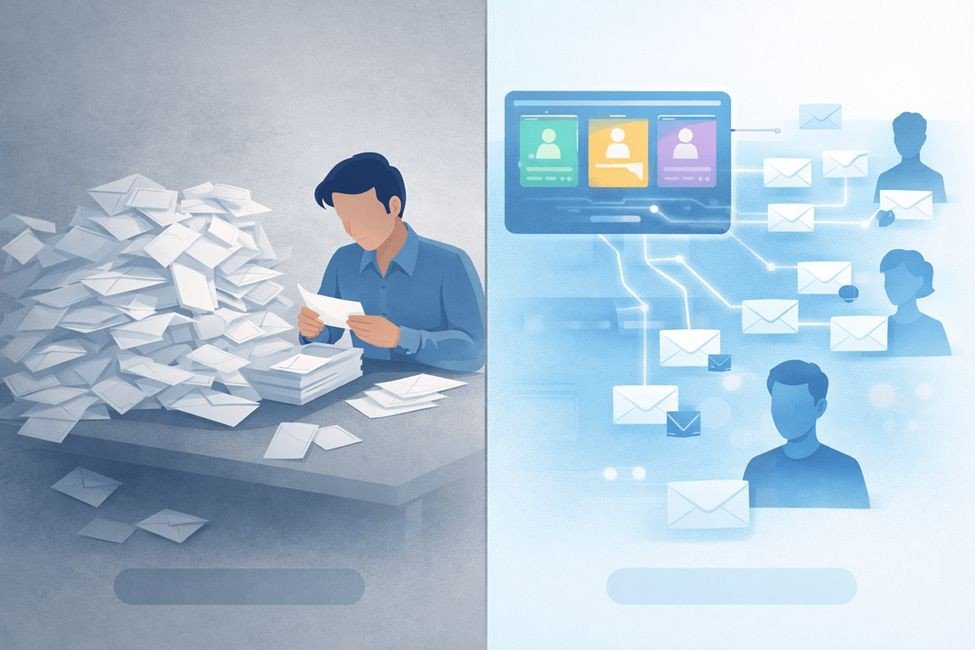
The marketers winning in 2026 are not sending more. They are sending smarter. AI allows them to make thousands of micro-decisions at scale: who gets which message, at what time, with what subject line, and what happens next if they do not open it.
Think of it this way. Traditional email automation was about drawing boxes and arrows, building fixed workflows with defined rules. AI-driven email marketing is about setting goals and letting the system figure out the next best move for each individual subscriber.
That shift from volume to intelligence is the single biggest change we have seen in email marketing over the last few years.
How AI Is Transforming Every Stage of the Email Marketing Workflow
Let us get into the practical side of things. This is where AI in email marketing stops being a buzzword and starts being a real competitive advantage.
1. AI-Powered List Hygiene: The Step Everyone Skips
We want to start here because almost no one else does.
Every article about AI in email marketing jumps straight to personalization, subject lines, and send-time optimization. But none of that works if your list is in bad shape.
Think about it this way. AI personalization is only as good as the data it works with. If your list is full of invalid addresses, disposable emails, and dead accounts, you are feeding garbage into a very expensive machine. And garbage in means garbage out, no matter how sophisticated your tools are.
Why a Dirty List Kills AI Personalization Before It Starts
Here is what happens when you send campaigns to an unverified list:
- Bounce rates spike, and your sender reputation takes a hit
- Email providers start routing your messages to spam
- Your engagement metrics get polluted with false data
- AI tools make optimization decisions based on that bad data
- Your future campaigns perform worse, not better
The damage compounds quietly. You might not notice it right away. But over time, a dirty list erodes the very foundation that AI needs to do its job.
Consider this: email lists decay at a rate of 22 to 30% every single year. That means nearly a third of your list can become invalid within 12 months due to job changes, abandoned accounts, and fake signups.
Most teams discover this after a campaign tanks. The smart ones verify before sending.
How AI Verification Tools Clean Lists Before Campaigns Go Out
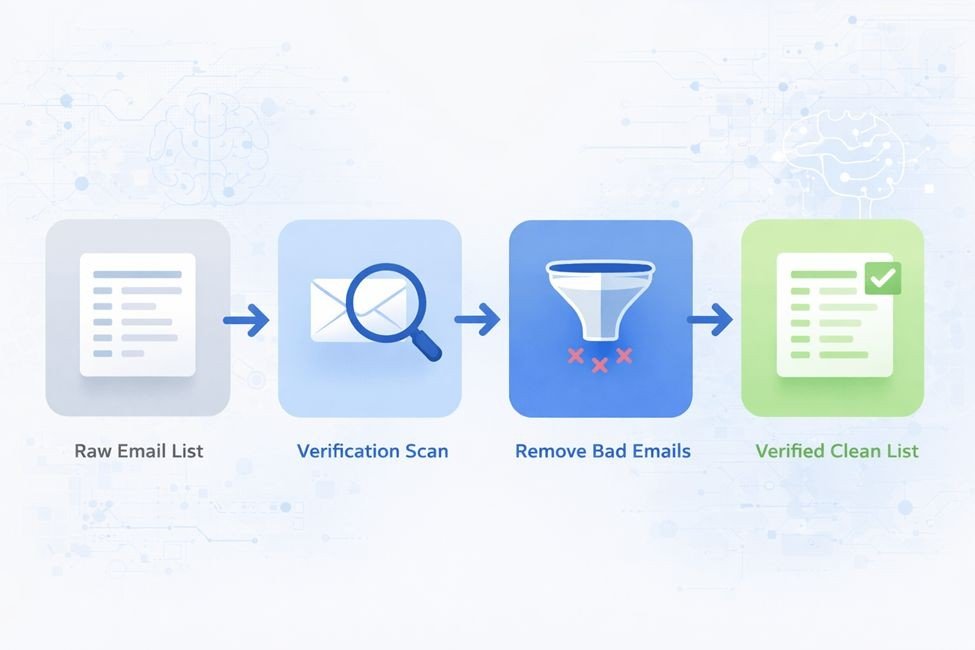
This is where tools for bulk email verification come in. Before you run any AI-powered campaign, you want your list to go through a proper verification process that checks for:
- Invalid and non-existent email addresses
- Disposable and temporary emails
- Syntax errors and formatting issues
- Catch-all domains that accept everything but deliver nothing
- Spamtrap addresses that can blacklist your domain
- Bounce risk addresses that will hurt your sender score
Once your list is clean, your AI tools are working with accurate, reliable data. Segmentation becomes more precise. Personalization becomes more relevant. Send-time optimization works as it should.
Clean data is not a nice-to-have. It is the starting point for everything else on this list.
2. Hyper-Personalization at Scale
Now we can talk about personalization, because this is where AI in email marketing really earns its place.
For a long time, personalization meant using someone’s first name in a subject line. That still matters, but it is table stakes now. Your subscribers barely notice it anymore.
What they do notice is relevance. An email that speaks to exactly where they are in their customer journey, references something they actually care about, and offers something genuinely useful.
Doing that manually for a list of even a few thousand people is not realistic. AI makes it possible at any scale.
Going Beyond First Name: Behavioral and Predictive Personalization
Modern AI tools analyze subscriber behavior across multiple touchpoints. Every click, purchase, browse session, and email interaction feeds into a profile that gets smarter over time.
Based on that data, AI can:
- Recommend products or content based on individual browsing and purchase history
- Adjust email copy and imagery to match each subscriber’s preferences
- Predict what a subscriber is likely to want next, before they even know it themselves
- Assign lead scores that indicate how close someone is to converting
- Identify high-value customers and treat them differently from one-time buyers
The result is emails that feel less like marketing and more like a helpful conversation. And that is exactly what today’s subscribers respond to.
Real-World Example: How Ulta Beauty Increased Conversions by 34%
Ulta Beauty, one of the largest beauty retailers in the US, is a great example of AI personalization done right.
They partnered with Movable Ink to create dynamic, automated email campaigns that pulled in data from previous purchases, recent browsing behavior, time of day, and recently viewed items. Every subscriber received a uniquely tailored offer based on their own behavior.
The result? A 34.1% increase in total conversion rates and a 317% increase in click-through rates.
That is not a marginal improvement. That is what happens when you stop sending the same email to everyone and start treating subscribers as individuals.
3. Smarter Segmentation With Machine Learning
Segmentation has always been a core part of good email marketing. The problem is that traditional segmentation is static. You define a segment, assign subscribers to it, and that is where they stay until someone manually updates the rules.
AI changes this completely.
From Broad Segments to AI-Driven Micro-Segments
With machine learning, segmentation becomes dynamic and continuous. AI tools analyze subscriber behavior in real time and create micro-segments that evolve as your audience evolves.
Instead of a broad segment like “frequent buyers”, AI might identify something far more specific, like “subscribers who purchase every 45 days, respond well to discount codes, and tend to open emails on weekday mornings.” That level of granularity is simply not achievable manually.
Here is a quick comparison of how traditional and AI-driven segmentation differ:
| Traditional Segmentation | AI-Driven Segmentation | |
| How segments are created | Manually by marketers | Automatically by AI |
| How often they update | When manually reviewed | Continuously in real time |
| Basis for grouping | Demographics, basic behavior | Micro-behavior, intent signals |
| Scalability | Limited by team capacity | Scales with your list size |
| Accuracy | Good | Significantly higher |
How Dynamic Segmentation Evolves in Real Time
The real advantage of AI-driven segmentation is that it keeps up with your subscribers. People change. Their interests shift. Their purchasing behavior evolves.
Static segments go stale. AI-powered segments do not.
When a subscriber’s behavior changes, the AI picks it up and adjusts their segment accordingly. This means your targeting stays accurate over time without any manual intervention from your team.
For growing lists, this is a game-changer.
4. AI-Optimized Subject Lines and Send Times
These two use cases are probably the most widely adopted applications of AI in email marketing right now, and for good reason. The results are consistently measurable.
Predicting the Right Words for the Right Person
Subject lines are the single biggest factor in whether your email gets opened. A bad subject line means no one sees the brilliant content you spent hours crafting.
AI tools analyze thousands of past subject lines, engagement patterns, and audience behaviors to predict which combinations of words, lengths, and structures will resonate with your specific audience.
The data backs this up:
- AI-optimized subject lines produce 50% higher open rates than manually written ones
- Personalized subject lines generate 50% higher open rates overall
- eBay used AI-powered subject line optimization and saw a 15.8% lift in open rates and a 31% increase in clicks
One thing worth noting: AI does not replace your instincts here. It amplifies them. The best results come when AI-generated variations are reviewed and refined by someone who understands the brand voice.
Send-Time Optimization: Beyond Tuesday at 10 AM
For years, “best practice” send times were based on industry averages. Tuesday and Thursday mornings, roughly between 9 and 11 AM, were the standard recommendation.
The problem? Everyone followed the same advice. And everyone’s emails landed in the inbox at the same time, competing with each other.
AI send-time optimization works differently. It analyzes when each individual subscriber has historically opened and engaged with emails, and schedules delivery at that specific window for each person.
The result is that your email arrives when each subscriber is most likely to be in their inbox and in the mood to engage. Not when it is convenient for your scheduling calendar.
5. Autonomous Campaign Workflows and Lifecycle Automation
This is the most advanced application of AI in email marketing, and it is becoming mainstream faster than most people expected.
Setting Goals Instead of Drawing Boxes and Arrows
Traditional email automation required marketers to map out every possible path a subscriber could take. You drew the workflow, defined the triggers, wrote the branches, and hoped you had covered every scenario.
It was time-consuming and, honestly, never fully complete.
AI-driven lifecycle automation works differently. You set the goal, whether that is converting a trial user, retaining an at-risk customer, or re-engaging a dormant subscriber, and the AI figures out the best sequence of messages to get there for each individual.
It adapts based on how each subscriber responds. If someone ignores three emails in a row, the AI adjusts the approach. If someone clicks but does not convert, the next email accounts for that signal.
Trigger-Based Emails That Respond to Real Behavior
The highest-performing emails in any program are not scheduled campaigns. They are trigger-based emails that fire in response to real subscriber behavior.
Examples include:
- Welcome sequences triggered the moment someone signs up
- Abandoned cart emails sent within the hour of a missed purchase
- Re-engagement campaigns triggered after a defined period of inactivity
- Milestone emails triggered by anniversaries, loyalty points, or purchases
- Win-back sequences triggered when churn risk signals appear
Here is why this matters so much. Automated trigger-based emails account for just 2% of total email sends, yet they generate 37 to 41% of all email revenue. That is a staggering ratio.
If you are not using behavioral triggers in your email program yet, this is the single highest-ROI change you can make.
The Deliverability Problem AI Cannot Solve Alone
We have talked about what AI can do for your email marketing. Now let us talk about something most AI-focused articles conveniently leave out.
AI is a powerful multiplier. But it can only multiply what is already there. If your emails are not reaching the inbox in the first place, no amount of personalization, segmentation, or send-time optimization will save your campaign.
Deliverability is the floor. Everything else is built on top of it.
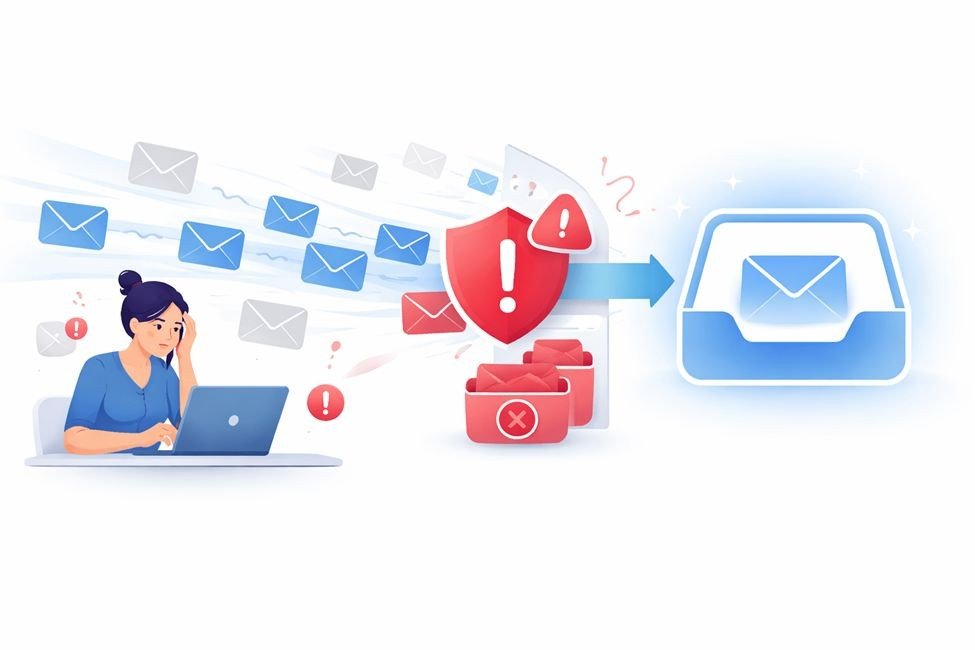
Only 84% of Marketing Emails Reach the Inbox in 2026
Let that sink in for a moment.
Despite all the advances in email technology, roughly 1 in 6 marketing emails never reaches its intended recipient. They land in spam folders, get blocked entirely, or simply disappear.
Here is a quick look at where emails actually end up:
| Destination | Percentage |
| Inbox | 84% |
| Spam or junk folder | 10% |
| Blocked or missing | 6% |
For every 100,000 emails you send, roughly 16,000 of them are going nowhere. If you are running AI-powered campaigns on top of a deliverability problem, you are essentially optimizing the 84% while ignoring the 16% that never had a chance.
And here is the part that stings: every 5% increase in your bounce rate causes a measurable drop in deliverability across your entire sending domain. It is not just the bounced emails that suffer. Your whole program takes a hit.
How Poor List Quality Undermines Even the Best AI Campaigns
Think about what AI personalization actually needs to work properly.
It needs data. Accurate, reliable, up-to-date data about real subscribers who are actively engaging with your emails. That is how it learns. That is how it optimizes.
Now think about what happens when your list is full of invalid addresses, disposable emails, spamtraps, and dead accounts.
Your AI tools are learning from the wrong signals. Open rates, click patterns, engagement windows: all of it gets skewed by contacts who were never real to begin with. The AI builds its models on polluted data and makes increasingly inaccurate decisions as a result.
It is a bit like trying to navigate using a map that is 30% wrong. The tool is fine. The underlying data is the problem.
Here is what poor list quality looks like in practice:
- High bounce rates that damage your sender reputation with inbox providers
- Inflated unsubscribe rates from contacts who should never have been on your list
- Skewed engagement metrics that mislead your AI optimization tools
- Spamtrap hits that can get your domain blacklisted almost overnight
- Wasted campaign spend on contacts who will never convert
And remember, email lists naturally decay at 22 to 30% per year. Even a perfectly clean list from 12 months ago has likely degraded significantly by now.
The Role of Email Verification in an AI-Driven Strategy
This is the step that ties everything together, and it is the one most teams skip.
Before you layer AI onto your email program, you need to verify your list. Not once, as a one-time fix, but as a regular part of your sending workflow.
Email verification works by running every address on your list through a series of checks before you send. A good verification process will identify and remove:
- Addresses with invalid syntax or formatting errors
- Domains that no longer exist or cannot receive mail
- Email accounts that have been abandoned or deactivated
- Disposable and temporary addresses from throwaway services
- Catch-all domains that accept every email regardless of whether the inbox exists
- Spamtrap addresses planted by inbox providers to catch senders with bad hygiene
- Addresses with full inboxes that will bounce on delivery
Once your list is verified and clean, everything changes. Your bounce rate drops. Your sender reputation improves. Inbox providers start treating your domain as trustworthy. And your AI tools finally have the clean, accurate data they need to make good decisions.
Think of it this way. AI in email marketing is the engine. A clean, verified list is the fuel. You would not put contaminated fuel into a high-performance engine and expect great results.
Tools like MailCleanup make this process straightforward. You upload your list in CSV format, it runs through 12 or more verification checks including SMTP verification, spamtrap detection, catch-all identification, bounce risk flagging, and more, and your cleaned list comes back to you ready to use. No subscriptions, no complicated setup. Just a clean list before your next campaign goes out.
Verify first. Then let AI do what it does best.
Risks and Challenges of AI in Email Marketing
We would be doing you a disservice if we only talked about the good stuff.
AI in email marketing is genuinely powerful. But like any tool, it comes with real risks if you are not careful. We have seen teams dive headfirst into AI adoption and run into problems that could have easily been avoided.
Let us walk through the three biggest ones.
AI-Generated Content Still Needs a Human Voice
This is probably the most common mistake we see right now.
Generative AI tools have made it incredibly easy to produce email copy at scale. You feed in a prompt, get a decent draft back in seconds, and move on. It sounds efficient. And in some cases, it is.
But here is the problem. AI-generated copy tends to sound like AI-generated copy.
It is technically correct. It covers the topic. But it lacks the texture, the personality, and the subtle nuances that make a reader feel like a real human being wrote it. And your subscribers notice. Maybe not consciously, but they feel it.
34% of marketers now use generative AI specifically for writing email copy. That number will keep growing. Which means inboxes are increasingly full of emails that sound similar, follow similar structures, and feel similarly generic.
Standing out in that environment means bringing your brand voice back into the equation.
Here is how we recommend thinking about it:
- Use AI to generate the structure, the first draft, and the variations
- Use human judgment to refine the tone, inject personality, and ensure accuracy
- Never let AI copy go out without a proper editorial review
- Keep asking yourself: does this sound like us, or does it sound like a template?
The goal is not to avoid AI for content. It is to use it as a starting point, not a finishing line.
AI Is Empowering Scammers Too: What This Means for Your Campaigns
Here is something that does not get enough attention.
The same AI tools that help legitimate marketers write better emails are also helping bad actors create more convincing phishing emails, spam, and fraudulent messages.
There are now dedicated tools in the cybercrime space that rotate sending infrastructure, automate campaign design and scheduling, and generate convincing copies of legitimate brand emails. Inbox providers are well aware of this. And their response has been to tighten their filtering significantly.
What does that mean for you?
It means that inbox providers are more suspicious than ever. Their filters are more aggressive. And legitimate emails are getting caught in the crossfire more often than they used to.
To protect your campaigns in this environment, you need to do a few things consistently:
- Make sure your domain and email authentication is properly set up, including SPF, DKIM, and DMARC records
- Maintain a healthy sender reputation by keeping bounce rates and spam complaints low
- Build genuine engagement with your list so inbox providers see positive signals from your domain
- Verify your list regularly so you are never sending to addresses that trigger spam filters
The rise of AI-powered scams is not a reason to pull back from email marketing. It is a reason to be more disciplined about how you do it.
Avoiding Over-Automation and Losing Your Brand Identity
There is a version of AI-driven email marketing that looks great on paper and feels terrible to receive.
Every email perfectly timed. Every subject line optimized. Every message tailored to behavioral data. And yet, somehow, it all feels cold. Transactional. Like the brand has forgotten there are real people on the other side of the inbox.
Over-automation is a real risk, and we have seen it happen to brands that were genuinely trying to do the right thing.
The issue is not the automation itself. It is what gets automated. When you let AI handle not just the timing and delivery, but also the voice, the empathy, and the human connection, you lose the thing that made your email program worth subscribing to in the first place.
Here is a useful way to think about where AI should and should not take the wheel:
| Email Element | AI Handles Well | Needs Human Touch |
| Send time | Yes | No |
| Subject line variations | Yes | Final approval |
| Audience segmentation | Yes | Strategy and goals |
| Personalization logic | Yes | Brand voice alignment |
| Copy generation | First draft only | Always review |
| Emotional tone | No | Yes |
| Crisis or sensitive communication | No | Always human |
| Brand storytelling | No | Yes |
The brands getting the best results from AI in email marketing are not the ones automating everything. They are the ones being deliberate about what they automate and what they protect.
AI handles the repetitive, data-driven decisions. Humans handle the creativity, the empathy, and the brand identity.
That balance is what separates good email programs from great ones.
How to Build an AI-Powered Email Marketing Strategy in 2026
Everything we have covered so far gives you the “what” and the “why” of AI in email marketing.
Now let us get into the “how.”
Building an AI-powered email strategy does not mean replacing your entire program overnight. It means making intentional, incremental improvements that compound over time. We have seen this approach work far better than going all-in on AI tools without a clear plan.
Here are the five steps we recommend.
Step 1: Start With a Clean, Verified List
We cannot stress this enough, so we are putting it first again.
Before you invest in any AI tool, before you set up any automation, before you write a single optimized subject line, clean your list.
This is the foundation. Everything you build on top of it depends on the quality of what is underneath.
Here is a simple checklist to get your list in order before launching an AI-powered strategy:
- Remove hard bounces from previous campaigns immediately
- Run your full list through an email verification tool
- Segment out contacts who have not engaged in the last 6 to 12 months
- Remove duplicates that inflate your list size and skew your metrics
- Check that all contacts have proper opt-in records for compliance
Once your list is clean and verified, you are starting from a position of strength. Your sender reputation is protected. Your data is reliable. Your AI tools have something solid to work with.
If you skip this step, everything that follows is built on shaky ground.
Step 2: Choose the Right AI Tools for Your Stack
There is no shortage of AI tools in the email marketing space right now. The challenge is not finding them. It is choosing the right ones for where you actually are as a business.
Here is a practical breakdown of the main categories and what to look for:
| AI Tool Category | What It Does | Good For |
| Send-time optimization | Learns when each subscriber opens emails and schedules accordingly | All teams, any list size |
| Subject line optimization | Tests and predicts high-performing subject lines | Teams sending regularly |
| AI segmentation | Creates dynamic micro-segments based on behavior | Growing lists, ecommerce |
| Predictive personalization | Tailors content to individual subscriber behavior | Mid to large teams |
| Generative AI copy tools | Drafts email copy from prompts | Any team, with human review |
| Lifecycle automation | Manages full subscriber journeys based on goals | Advanced programs |
A word of caution here. Do not try to implement everything at once.
Pick one or two categories that address your biggest current challenge and get those working properly first. Once you see results and your team is comfortable, layer in the next tool.
The 6% of marketers who qualify as AI high performers did not get there by adopting every tool available. They got there by integrating AI deeply into a focused set of workflows and executing consistently.
Step 3: Personalize With Purpose, Not Just Data
Having subscriber data and knowing what to do with it are two different things.
We have seen teams with rich behavioral data send emails that still feel generic because they were personalizing the wrong things. They added a first name, referenced a recent purchase, and called it personalization. The subscriber felt nothing.
Real personalization is about relevance. It means sending the right message at the right moment in the subscriber’s journey, in a way that feels genuinely helpful rather than just data-driven.
Here is how to think about personalization at each stage of the customer journey:
New subscribers: Introduce who you are and what you stand for. Set expectations for what they will receive. Make them feel welcome, not marketed to.
Engaged subscribers: Deepen the relationship. Share content that matches their demonstrated interests. Recognize their engagement. Reward loyalty.
At-risk subscribers: Re-engage with something genuinely valuable. Acknowledge the silence without being desperate. Give them a reason to come back.
Lapsed subscribers: Run a proper win-back sequence. Be honest that you have not heard from them in a while. Make a compelling case for why they should stay.
At every stage, ask yourself: if this subscriber read this email, would they feel understood? If the answer is no, the personalization needs more work.
Step 4: Test, Measure, and Let AI Learn
AI tools get better over time, but only if you give them the right environment to learn in.
That means running consistent tests, measuring the right metrics, and feeding the results back into your strategy.
Here is where a lot of teams go wrong. They set up AI tools, see an initial lift, and stop testing. They assume the AI has figured it out and move on. A few months later, performance starts to plateau and they cannot understand why.
AI optimization is not a one-time setup. It is an ongoing process.
Some practical guidelines for testing and measurement:
- Test one variable at a time. Subject line, send time, CTA, or content, but not all at once. Clean tests give you clean learnings.
- Give tests enough time and volume. A test on 200 subscribers over two days tells you almost nothing. Aim for statistical significance before drawing conclusions.
- Track the right metrics. Open rates are increasingly unreliable due to privacy changes like Apple Mail Privacy Protection. Focus on clicks, conversions, and revenue per email sent.
- Document everything. Keep a record of what you tested, what you learned, and what you changed. This becomes a valuable asset over time.
- Share learnings with your AI tools. The more behavioral data your AI has to work with, the better its predictions become.
One important note: if you clean your list regularly, as we covered in Step 1, your metrics will actually reflect real subscriber behavior. That means your AI tools are learning from accurate signals rather than noise. Everything connects.
Step 5: Keep the Human Element at the Center
This is the step that separates the email programs people love from the ones they tolerate.
We touched on this in the risks section, but it deserves its own place in your strategy. Because it is easy to lose sight of when you are deep in dashboards, automation workflows, and optimization reports.
Every email you send lands in the inbox of a real person. That person has a life, a context, a mood, and a reason for subscribing to you in the first place. They chose to give you access to their inbox. That is not a small thing.
AI can help you reach that person at the right time with the right message. But it cannot replace the human judgment, creativity, and empathy that makes your brand worth subscribing to.
Here is how to keep the human element alive in an AI-powered program:
- Review all AI-generated copy before it goes out. Every time, without exception.
- Protect your brand voice. Make sure it comes through regardless of how the content was produced.
- Write for people, not for algorithms. Your subscriber should feel like you wrote this for them specifically.
- Make it easy to reply. Some of the best email programs actively encourage two-way conversation.
- Remember that unsubscribes are feedback. If people are leaving, AI optimization is not the answer. Better content and stronger relevance are.

The marketers who will win with AI in email marketing over the next few years are not the ones who hand everything over to the machine. They are the ones who use AI to handle the data-driven decisions while they focus on being genuinely useful to their audience.
That combination is unbeatable.
Final Thoughts: AI Is a Multiplier, Not a Magic Wand
We have covered a lot of ground in this post, so let us keep this simple.
AI in email marketing is a multiplier. It amplifies what you already have. Good data becomes great targeting. Strong copy becomes perfectly timed, relevant messaging. Smart automation becomes an always-on revenue engine.
But multipliers work in both directions. A dirty list, poor data, and a generic brand voice do not improve just because you added AI on top. They scale faster and fail harder.
So start with the fundamentals. Verify your list. Know your audience. Protect your brand voice. Be deliberate about what you automate.
Get those right, and AI becomes everything it promises to be.
Skip them, and you will be in the 94% of businesses using AI without seeing real results from it.
The teams winning with AI in email marketing are not the ones handing everything over to the machine. They are the ones using it thoughtfully, keeping humans at the center, and treating their subscribers with genuine respect.
Start clean. Stay relevant. Keep it human.

Chris Mcdonald has been the lead news writer at complete connection. His passion for helping people in all aspects of online marketing flows through in the expert industry coverage he provides. Chris is also an author of tech blog Area19delegate. He likes spending his time with family, studying martial arts and plucking fat bass guitar strings.