

The user your funnel was not designed for
Most product funnels quietly assume that the person entering them has some interest in becoming a user. That assumption works for a project management tool, an accounting platform, or a design product that someone expects to open again next week. It breaks down when the person has been sent into the product to complete one narrow task and has little reason to return.
Think about a candidate uploading a document to a recruiter, a client approving an invoice, an attendee submitting photos after an event, a patient completing an intake form, or a customer opening a link to sign a waiver. In each case, the software matters to the organization that selected it. To the person on the other side, the software is merely a temporary doorway.
That difference changes how conversion friction should be evaluated. A recurring user can rationalize a small setup cost because the benefit compounds over future sessions. A one-time user cannot. Every field, permission request, account prompt, verification step, and download is charged against a task that may be worth only a minute of attention.
A useful distinction: chosen users and borrowed users
A simple way to model this is to separate chosen users from borrowed users. A chosen user selected the product, or at least expects an ongoing relationship with it. A borrowed user was brought into the product by somebody else. The buyer, administrator, organizer, employer, host, or service provider made the software decision on that person’s behalf.
Borrowed users appear in more products than teams realize. An HR platform may be purchased by an employer but used by job applicants. A bookkeeping product may be selected by an accountant but require clients to upload receipts. An event platform may be configured by an organizer but depend on hundreds of attendees to participate. The economic customer and the conversion-critical user are different people.
This creates what I call commitment mismatch: the product asks for a level of commitment that makes sense to the buyer but not to the participant. A company may view account creation as a harmless prerequisite because accounts are central to its data model. The borrowed user experiences the same step as a demand to start a relationship they never asked for.
The friction budget should depend on expected future value
A more useful rule than ‘remove friction’ is to give every interaction a friction budget. The budget is the amount of effort a user is likely to tolerate before the expected value of finishing the task falls below the cost of continuing.
For a recurring product, that budget can be fairly large. Someone adopting payroll software may tolerate setup, identity checks, configuration, and a guided tour because the product could save hours every month. For a one-time participant, the budget can be tiny. If the goal is simply to upload five files or approve one request, a three-minute setup sequence can cost more than the task is worth.
This explains why the same onboarding pattern can be sensible in one context and destructive in another. Friction is not inherently bad. Identity verification, consent, payment confirmation, and security checks can be necessary. The mistake is treating every user as if they receive the same future return on the effort being requested.
Participation debt: count everything before the core action
Teams often measure funnel steps but overlook what those steps feel like to someone with weak motivation. I use the term participation debt for the accumulated effort a person must pay before reaching the action they actually came to perform.
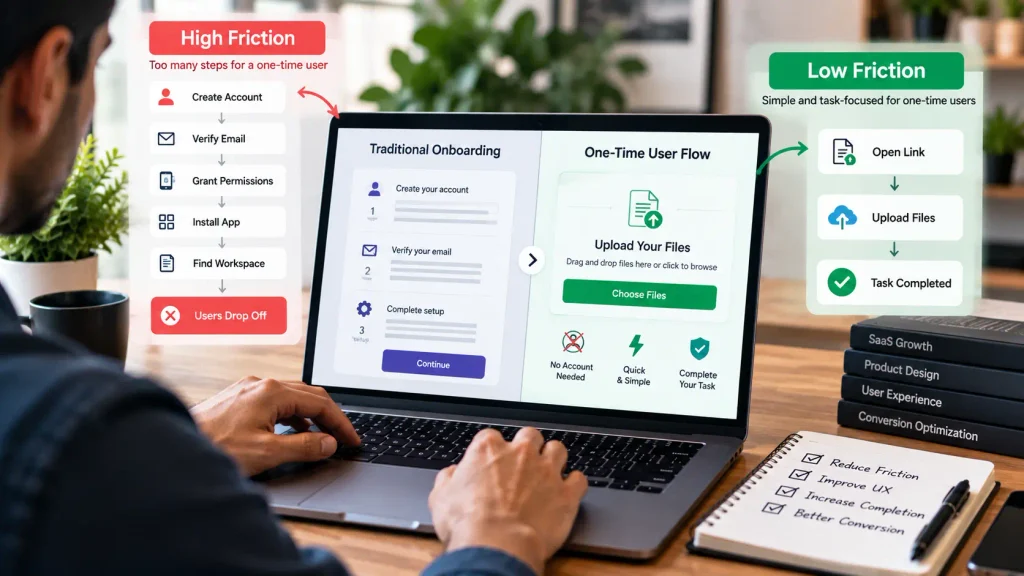
Imagine two ways to collect files from a temporary participant. Flow A asks the person to open a link, install an app, create an account, verify an email address, grant photo access, locate the correct workspace, and finally choose files. Flow B opens a browser page where the person selects files and uploads them. Both flows eventually expose the same core action. Their participation debt is completely different.
The useful measurement is not merely screen count. Teams should inventory five kinds of debt: time, decisions, identity, device commitment, and uncertainty. A single screen can be expensive if it asks for a phone number and unclear permissions. Three obvious screens can be cheap if each advances the task without asking the user to make a new commitment.
A practical participation-debt score
For product reviews, a rough scoring system is often more revealing than another generic funnel diagram. Assign one point for each low-cost prerequisite, two points for each medium-cost prerequisite, and three points for each high-cost commitment before the core action.
Low-cost prerequisites include an obvious button click or a short contextual choice. Medium-cost prerequisites include filling several fields, granting a permission, or searching for an event or workspace. High-cost commitments include installing software, creating credentials, verifying an account, entering payment details, or providing personal information that does not appear necessary for the immediate task.
The score is not a scientific conversion model. Its value is comparative. If one participant flow scores 14 and another scores 4, the team has a concrete reason to investigate the difference. More importantly, the score forces product teams to evaluate the experience from the participant’s perspective rather than from the convenience of the backend architecture.
The 60-second user changes what ‘activation’ means
Traditional SaaS activation often describes the moment a new user experiences enough product value to become more likely to return. That definition is not useful for a person who is never supposed to return. For a 60-second user, activation is successful task completion with enough confidence that the person does not abandon midway.
This suggests a different set of metrics. Instead of asking whether the participant returned on day seven, measure time to core action, completion rate after entry, abandonment before the first meaningful action, recovery after an error, and the percentage of participants who require help from the person who invited them.
That last metric is especially useful. If organizers constantly have to explain where to click, resend codes, answer ‘do I need an account?’ or troubleshoot an install, the product is exporting its interface cost to the buyer. The participant may eventually complete the task, so a basic conversion report looks healthy, while the surrounding human support cost remains invisible.
Buyer-user separation is a product architecture problem
When the buyer and participant are different people, the cleanest products often separate their experiences structurally. The administrator may need accounts, dashboards, billing, configuration, permissions, retention settings, and history. The participant may need only a secure route to one action.
Wedding photo collection is a useful example because the separation is unusually clear. A couple may spend time comparing services, configuring an event, and deciding how photos should be stored. Guests did not make that purchase decision. They may encounter the product for the first time after scanning a code at a table and never use it again. A browser-first service such as WeddingPhotoApp can therefore treat administration and participation as different jobs rather than forcing both groups through the same product shell.
The same architecture applies elsewhere. A contract product can give the sender a workspace while letting the signer open a secure document directly. A research platform can give the researcher a dashboard while letting respondents answer without becoming members. A client portal can preserve rich controls for the professional while exposing a narrow upload route to the client.
The hidden cost of identity too early
Account creation deserves special scrutiny because product teams often treat it as nearly free. It is not. Asking for identity changes the psychological category of the interaction. The user is no longer simply completing a task. They are being asked to establish a relationship with the software.
Sometimes that relationship is necessary. A participant may need to return, access private records, manage permissions, or prove identity. But if an account exists mainly because the database expects an owner ID, the product is transferring an implementation constraint to the user.
A useful design question is: what would actually break if identity were collected after the core action instead of before it? In many flows, a temporary token, scoped link, event code, or session can carry enough context to complete the immediate job. Identity can then be requested only when the user asks for a feature that genuinely depends on persistence.
Trust friction is different from interaction friction
Reducing steps does not mean removing reassurance. In fact, very short participant flows can fail when they are so sparse that users do not understand what will happen next. A QR code that opens an unexplained upload control may create less interaction friction but more trust friction.
One-time users lack the accumulated trust that returning users build over repeated sessions. They need fast answers to basic questions: Who asked me to do this? Where will my files go? Who can see them? Do I need an account? Will this install anything? Can I undo the action?
The best participant interfaces answer these questions close to the action without turning them into another onboarding sequence. A short line of context can remove more hesitation than an extra screen. The goal is not the fewest possible pixels. It is the lowest total uncertainty and effort required to finish safely.
Use reversibility to earn faster decisions
Another underused lever is reversibility. People move faster when a mistake is cheap. If an upload can be reviewed before final submission, a selection can be changed, or an accidental action can be undone, the interface can ask for less deliberation up front.
This matters because teams sometimes respond to errors by adding confirmation screens. Each new confirmation may reduce one class of mistake while taxing every successful participant. Reversibility offers a different tradeoff: allow the action to remain fast, then make correction easy.
For one-time flows, the ideal sequence is often action first, lightweight confirmation second, recovery always available. The exact order depends on risk, but the principle is useful: do not make every user pay a prevention cost when only a small minority will need correction.
The ‘would they do it twice?’ test
A simple review technique can expose excessive friction quickly. Walk through the participant flow, then imagine the user is told that the attempt failed and they must start again. Would they willingly repeat the process?
If the answer is clearly no, the flow is spending too much motivation before delivering value. This test is deliberately harsher than normal usability review. Real users encounter interruptions, poor connections, expired sessions, wrong files, mistyped addresses, and unclear instructions. A flow that feels tolerable in a perfect first attempt can become unacceptable when repeated.
The test is especially useful for mobile web experiences, invitation flows, external approvals, uploads, surveys, and event interactions because these tasks are frequently performed in distracting environments rather than during a dedicated software session.
A teardown method product teams can run in an afternoon
Teams do not need a large research project to find commitment mismatch. Start by selecting five external-participant workflows in your own product and in adjacent products. Record the exact path from entry to core action. Do not count only screens. Record every decision, field, permission, context switch, install, verification, wait state, and moment where the user could reasonably wonder what happens next.
Next, label each step as required by risk, required by the user’s goal, required by the business, or required by the current implementation. The fourth category is usually the most interesting. Implementation-required friction often survives for years because nobody owns the cost imposed on participants.
Finally, rerun the flow under three conditions: one-handed on a phone, with a weak connection, and after intentionally making one mistake. These conditions reveal costs that a desktop happy-path review hides. The output should be a short list of prerequisites that can be removed, delayed, combined, explained, or made reversible.
When friction is worth keeping
A low-friction framework becomes dangerous if it turns into a blanket instruction to remove safeguards. Some friction protects the participant. Financial transactions, medical information, legal consent, private records, age restrictions, and destructive actions may justify deliberate pauses and identity checks.
The better question is whether each expensive step protects something proportionate to its cost. If verification prevents unauthorized access to sensitive information, it has a clear job. If verification exists only to increase registered-user counts, it deserves much more skepticism in a one-time flow.
Good friction is legible. The participant understands why it exists. Bad friction feels arbitrary because its benefit belongs to the company rather than to the person being asked to endure it.
Design for completion, not enrollment
The broader lesson is that not every person touching software should be converted into a conventional user. Some people are participants, signers, uploaders, respondents, approvers, guests, candidates, or clients passing through for one narrow purpose.
When teams force these people through the same acquisition and onboarding machinery built for recurring customers, they create commitment mismatch. The product asks for a relationship while the person is trying to complete a task.
Designing for one-time users means budgeting friction according to expected future value, measuring participation debt before the core action, separating buyer and participant experiences, delaying identity until it has a clear purpose, and reducing uncertainty without adding ceremony. The result is not simply a shorter funnel. It is a product that understands why the person arrived in the first place.
A compact review checklist
- Who chose the software: this person, or somebody else?
- What is the one action the participant came to complete?
- How much future value does this person expect from the product?
- Which prerequisites occur before the core action?
- Which prerequisites exist because of risk, and which exist because of implementation convenience?
- Can identity, account creation, or permissions be delayed until they are actually needed?
- Does the interface explain who invited the participant and what happens to their data?
- Can mistakes be reversed without restarting the flow?
- How does the flow behave on a phone, on a weak connection, and after one intentional error?
- Would a reasonable participant willingly repeat the entire process if the first attempt failed?

Chris Mcdonald has been the lead news writer at complete connection. His passion for helping people in all aspects of online marketing flows through in the expert industry coverage he provides. Chris is also an author of tech blog Area19delegate. He likes spending his time with family, studying martial arts and plucking fat bass guitar strings.