
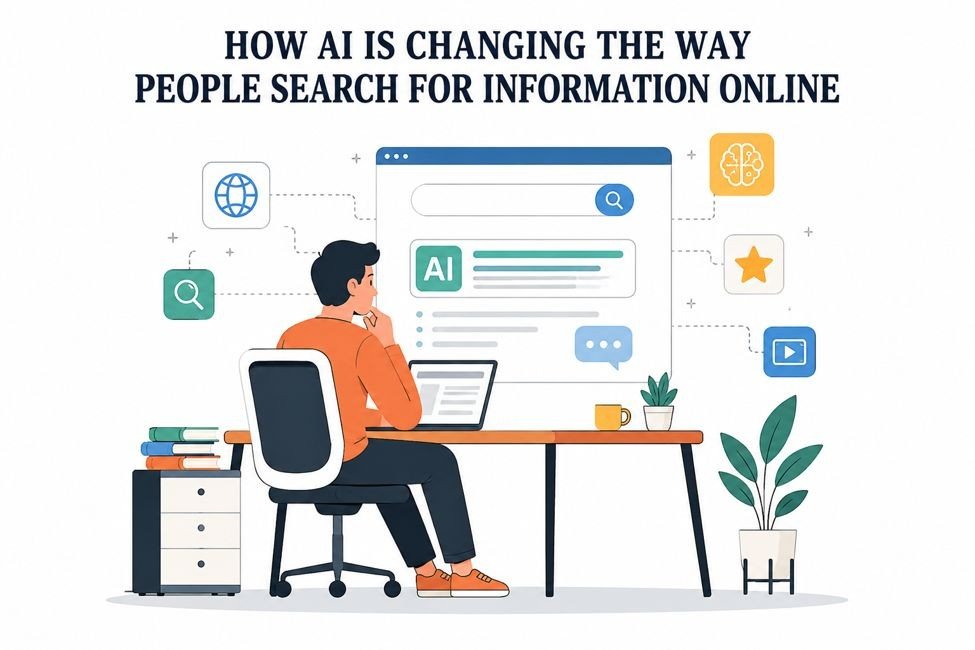
Search engines can influence how people get information. Before, users entered phrases to get pages of results. Now, the process is very different. Artificial intelligence will read your questions to understand the context and your intent.
This shift changes what people expect from online search. Users now want useful answers with less effort. Also, they expect search tools to understand natural language. People are becoming less dependent on exact keywords. They ask longer and more detailed questions.
This article explores how AI changing search works. We’ll see how AI is shifting search patterns, doing personalised searches, the impact on product recommendations, and how you can fact-check. So, let’s begin!
The Shift Toward Conversational Search
From Keywords to Conversations
Traditional search depended heavily on short and specific keywords. Users often had to guess which words would produce useful results. The search engine would match those words with relevant pages. Users had to examine several results before choosing useful information. AI has changed this pattern by supporting longer conversational questions.
People can now explain their situation, preferences, budget, and goals. Search systems can interpret those details within one request. In 2026, Google reported that the average AI Mode search is about three times longer than a regular query. So, search feels less like browsing and more like a conversation. That change is one of the clearest examples of AI changing search.
Why Search Queries Are Becoming Longer
Search queries are becoming more detailed as AI tools improve. Users can describe exactly what they need. Someone might ask which laptop suits an economics student. They could also mention their budget and preferred battery life.
Traditional search might require several separate searches for those requirements. AI can combine them within a single interaction. This approach reduces unnecessary repetition during online research. It also helps users receive answers that better match their circumstances.
As conversational search grows, users may become less dependent on exact keywords. Content creators must therefore understand questions instead of targeting isolated phrases.
Search Intent Matters More Than Exact Words
Search intent refers to the reason behind a person’s search. Two searches can involve plumbing with different goals. AI systems can identify these differences more effectively than basic matching.
Search engines increasingly focus on meaning instead of isolated words. That development creates new opportunities for useful online content.
Semantic Search Understands Meaning
Semantic search connects related concepts instead of matching words alone. Modern AI systems can understand relationships between different terms. For example, “car,” “vehicle,” and “automobile” describe closely related ideas. Search systems can connect those concepts without requiring identical wording. This ability makes search more flexible and useful.
A person can describe an unfamiliar problem using ordinary language. AI can then connect that description with relevant information. Content creators should therefore write naturally and explain concepts clearly.
Forced keyword repetition can make content harder to read. It can also provide less value to people searching for answers. Strong content should cover related questions around a central topic.
Every section should contribute useful information to that topic. This approach supports both readers and systems that interpret content semantically.
AI-Generated Summaries and Results
AI Answers Are Changing Search Results
AI-powered search places generated answers above webpage results. These answers combine information from multiple online sources. Users can understand a topic without opening a single webpage. Google reported that AI Mode had more than one billion monthly users globally by May 2026.
Search engines are therefore becoming information interpreters. They no longer act only as directories for websites. This creates an important change for publishers and businesses. A website may receive fewer clicks even when its information appears.
At the same time, appearing in an AI answer can increase visibility. Users may discover brands through generated summaries. This means online visibility now extends beyond blue links. So, publishers must consider how AI changing search mechanisms will affect discovering and representing their information.
The Growth of AI Summaries
AI summaries reduce the steps required for research. Users receive definitions, comparisons, explanations, and recommendations immediately. In June 2026, a Pew Research Center survey found that 60% of U.S. adults read AI summaries given at the top of search results.
Supporting links help users explore the subject further. This system offers convenience for simple research tasks. However, convenience does not guarantee accuracy.
AI systems can misunderstand questions or produce incorrect statements. They may also combine information without enough context. Users should treat generated answers as useful starting points. Important claims should receive additional verification from reliable sources. This matters especially for academic, medical, legal, and financial topics.
The Rise of Zero-Click Searches
AI summaries contribute to the growth of zero-click searches. A zero-click search happens when users receive answers without visiting another website, when AI can answer the query immediately. Another Pew Research Center study found that when an AI summary appeared, users clicked a traditional search result during only 8% of visits. When no AI summary appeared, that figure was 15%.
This creates challenges for websites that depend on search traffic. Yet, websites remain valuable when they offer unique information. Original research, detailed guides, tools, and expert opinions provide stronger reasons to visit. Strong brands can also attract direct searches and returning visitors. Therefore, publishers need information that simple AI summaries cannot easily replace. Unique experiences and original data can create that additional value.
Personalisation, Discovery, and Search Inputs
AI Changing Search: Personalisation
To personalise results, search systems consider location, language, preferences, and previous searches. AI can take this contextual understanding even further. During a conversation, users can provide details about their goals. Later questions can build on those earlier details. This reduces the need to repeat information again and again.
Personalisation can therefore make online research more relevant to you. However, it should not cost you your privacy. You need to make informed choices about where your information is going.
Conversational Local Search
Local search is becoming more detailed and conversational. Once, people searched for “restaurants near me.” Now, they can describe several requirements in one question. AI can combine those details into a more useful recommendation. This makes local discovery feel more natural and practical.
Businesses must therefore keep their online information accurate. Locations, opening hours, services, reviews, and contact details should remain consistent. Outdated information can reduce the usefulness of search recommendations. Clear information can therefore support both customers and search visibility.
Multimodal Search Creates New Possibilities
Modern AI systems can process multiple forms of information. These systems can work with text, images, and audio. This is called multimodal search. Users can combine different inputs within one request. For example, someone might upload furniture and ask whether it suits their room. Students could combine a textbook image with a written question. Such interactions make online search more flexible.
Businesses should consider this development when creating online content. High-quality images, descriptive text, and structured information can support discovery.
AI in E-Commerce and Education
AI Is Changing Product Research
Before AI, people compared prices, specifications, reviews, benefits, and drawbacks themselves. Now, AI summarises many of these details within one interaction. With AI changing search habits, shopping online is easier and faster.
This process can reduce the time required for product research. It also changes what shoppers expect from online stores. Clear information helps both customers and AI systems understand products.
Businesses should provide complete details rather than vague promotional language. For example, resources like learnwptoday guide site owners through top WooCommerce plugins. Useful product information can improve both customer decisions and chances of digital discovery.
Reviews and Recommendations
AI can also change how people use online reviews. Users can request summaries of reviews to get the overall feeling about the product.
However, users should not assume every generated summary is complete. Review platforms contain information with different levels of quality. Some reviews may not provide enough evidence for strong conclusions. Businesses should encourage genuine, detailed customer feedback. True reviews will help shoppers understand real customer experiences.
AI Is Changing Search for Students
AI changing search is making learning more convenient for students as well. However, convenient answers can create new academic challenges. Students might trust generated information without checking original sources. They may also become less comfortable with independent research. Students should still be able to evaluate evidence and consult reliable sources independently.
Search Can Become More Accessible
Natural-language search reduces pressure around choosing perfect keywords. Translation features can also reduce language barriers during research. People may search in one language and receive information in another.
Voice search provides another useful accessibility feature. These capabilities can help people who struggle with traditional interfaces. However, accessibility only matters when information remains accurate. Search systems therefore need transparency alongside convenience. Better accessibility should expand access to useful information, not unreliable information.
Modern Search Engine Optimisation Strategies
What AI Means for SEO
Search engine optimisation must change as well. Traditional SEO had keywords, backlinks, rankings, and technical performance. These factors are still important. However, the quality of the content has gained importance.
AI changing search means that systems need information that clearly answers specific user questions. Repeating the same keyword will not automatically create useful visibility. Useful content should leave readers with fewer unanswered questions. That principle provides a stronger foundation for modern SEO strategies.
GEO and the Future of Search Optimisation
Generative Engine Optimisation (GEO) focuses on AI-generated search. GEO focuses strongly on visibility within generated answers. Publishers need clear facts that AI systems can understand and cite. Original statistics, research, and expert commentary strengthen content.
Clear formatting can make important information easier to identify. Tables, lists, definitions, and concise answers can improve readability. Structured content also helps humans find information faster. GEO should complement strong SEO.
Structured Data Helps Machines Understand Content
Well-structured data gives search systems information about webpages. Schema markup identifies products, articles, reviews, and other content. Without structured information, search systems will need to interpret page elements themselves. Clear markup can reduce ambiguity around important information. JSON-LD is a popular format.
Website owners can add this information to help search systems understand pages. Clear structured information can support better machine interpretation. Website owners should validate their markup to avoid technical errors.
Authority, Trust, and Verification
Why Original Content Matters More
AI can produce thousands of generic articles within a short period. This creates an internet filled with repetitive explanations.
Websites therefore need to offer information that provides additional value. Original research can give readers something they cannot find everywhere. Firsthand testing can provide useful evidence about products or services. Original photographs and testing results can strengthen credibility. These elements help content stand apart from automated repetition.
Firsthand Experience Builds Trust
AI can generate explanations quickly, but it cannot replace experience. People value information from someone who has faced the same problem. Professionals can explain common mistakes within their fields. Customers can describe what worked after using specific products. These details create useful information beyond generic summaries.
Businesses should include real examples whenever possible. Case studies can demonstrate how products and services perform. Testing results can make recommendations more credible and useful. Firsthand experience gives content a stronger reason to exist. It creates value that simple automated summaries may struggle to reproduce. In the age of AI changing search, accuracy becomes a competitive advantage.
Conclusion
With AI changing search basics, users can ask questions and get responses per the context. They can continue conversations, compare options, and search with images. These changes make information discovery faster and more flexible. They also create important challenges around accuracy and transparency.
Websites cannot depend only on keyword placement and content volume now. They need useful information and original insights. Users also need to remember that convenient answers require careful evaluation. The future of search will likely feel less like searching and more like discussing.
Businesses can reach audiences by creating content with genuine value. The strongest websites will combine technical SEO with original expertise. Technology should reduce wasted effort without removing critical thinking. Search will not disappear because of AI. Instead, AI changing search will fundamentally change how people use search to find, understand, and act on information.

Chris Mcdonald has been the lead news writer at complete connection. His passion for helping people in all aspects of online marketing flows through in the expert industry coverage he provides. Chris is also an author of tech blog Area19delegate. He likes spending his time with family, studying martial arts and plucking fat bass guitar strings.