

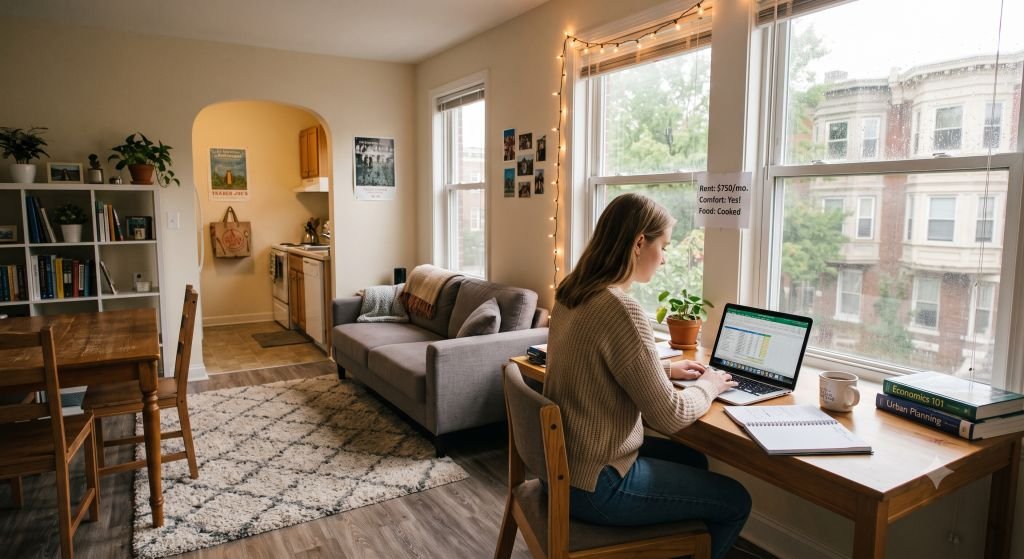
Apartment listings have a language all their own. Cozy means a grown adult cannot fully extend their arms. Character means something in the building is original from 1987 and nobody has fixed it. Steps from campus means there is a bus stop somewhere in the same postal code. Learning to read between the lines when choosing student apartments Calgary while also keeping track of the actual numbers is how you avoid signing a lease and then spending the next eight months regretting it.
1. The Rent Number Is a Lie of Omission
Not intentionally. Just incompletely. The listed rent is rarely the amount that leaves your bank account each month. Utilities are separate most of the time. Parking can add $100 to $200 depending on the building. Internet is another monthly bill. Laundry, if it is coin-operated, adds up faster than expected.
Before comparing any two apartments, write out the actual monthly cost for each one. Rent plus every extra. The place that looked $150 cheaper per month sometimes ends up being more expensive once everything is counted. Do this math before viewing anything, not after falling in love with a unit.
2. Distance From Campus Is a Time Tax
Saving $120 a month by living 40 minutes from school sounds excellent in August. By November, when you have a 9 AM three days a week and Calgary is doing whatever Calgary does to temperatures in November, that commute is a completely different proposition. Transit fares add up too. And the hours. Every week, hours just gone.
When looking at student apartments Calgary, map the actual commute time for each place before making any decisions. A slightly higher rent close to campus often returns its value in transit savings and time alone, not counting the motivational benefit of being able to sleep 25 extra minutes before class.
3. What Is Included Changes the Whole Comparison
In-suite laundry versus basement coin laundry seems like a small thing. It is not a small thing. It is the difference between doing laundry whenever it needs doing and planning your week around a shared machine that someone always leaves their stuff in for three extra hours.
Internet included versus paying separately is another one. Fast, reliable internet is not optional for a student. If it is not included, it is another monthly setup cost and another bill to track. Furnished versus unfurnished has its own math, buying a bed and desk at the start of the year and figuring out what to do with them in April.
4. A Bad Building Affects More Than Just Comfort
Thin walls and a noisy floor above are not just annoying. They interfere with sleep. Poor sleep interferes with studying. Studying while suffering interferes with grades. A cheaper apartment in a building that creates constant background stress is not actually cheaper when that is the full picture.
5. Purpose-Built Student Housing Removes a Lot of This Guesswork
Buildings like Encore were designed specifically for students, which means the amenities make sense for how students live, the lease terms align with the academic year rather than the calendar year, and the community is made up of people in the same situation. For students who would rather spend time on school and a social life than on apartment problem-solving, that difference is more significant than it sounds.
Conclusion
Calgary’s rental market is not student-friendly by default. Getting a place that works without quietly destroying the budget requires looking at total costs, not just rent, taking commute time seriously, and knowing what amenities are worth paying for. That upfront research pays off every single month of the year.

Chris Mcdonald has been the lead news writer at complete connection. His passion for helping people in all aspects of online marketing flows through in the expert industry coverage he provides. Chris is also an author of tech blog Area19delegate. He likes spending his time with family, studying martial arts and plucking fat bass guitar strings.