

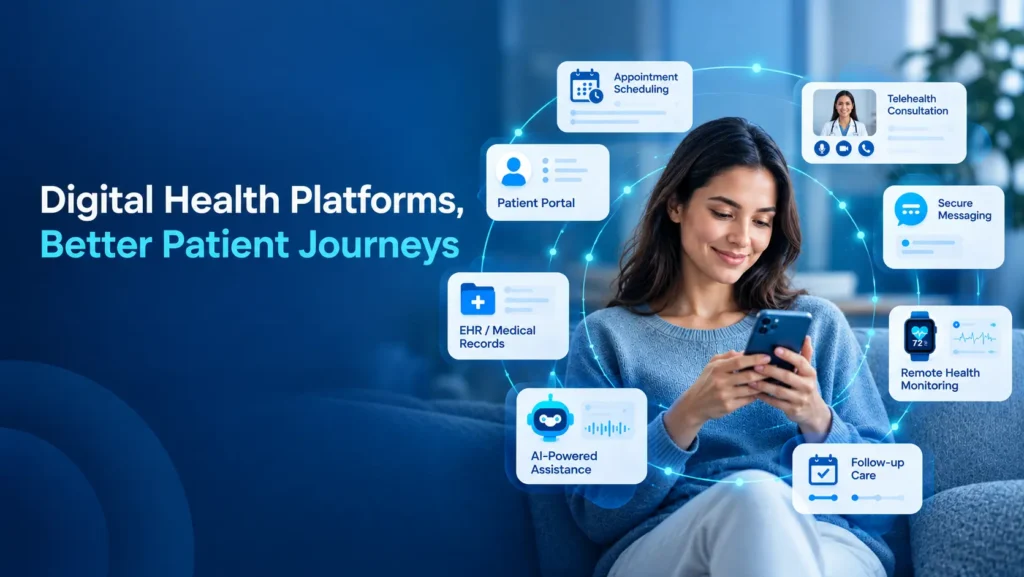
A patient’s healthcare journey does not start in the doctor’s room. It usually starts much earlier: when they look for providers, compare care options, check symptoms, or decide when to seek care. That journey goes on via scheduling, registration, consultation, payment, follow-up, treatment, and ongoing healthcare management services.
When these steps occur across disconnected systems, patients spend more time navigating healthcare instead of receiving it. This creates a challenge for providers: patients hope for useful digital experiences, but several organizations still function across distinct portals, apps, communication channels, and clinical systems. The result? Patients repeat information, wait for answers, switch between platforms, or call the staff for tasks that can have been handled digitally.
Digital healthcare platforms help close this gap by connecting more parts of the patient experience. Instead of using technology for single isolated tasks, providers can adopt connected solutions that support patients before, during, and after care.
The aim is not to make every interaction digital. It’s to make healthcare easier to navigate while offering providers the tools and insights they need to offer better-connected care.
What are Digital Health Platforms?
Digital health platforms are technology ecosystems that connect healthcare tools, data, communication channels, and services to support both patients and providers.
Healthcare mobile apps are one example of how these digital tools can bring patient access, communication, monitoring, and care services into a more connected experience. Explore these innovativemobile apps for healthcare customers to see how different applications are supporting patients and providers. Depending on the organization’s needs, a platform may consist of:
- Patient portals for records and communication
- Mobile apps for on-the-go access
- Telehealth platforms for virtual consultations
- Secure messaging and Appointment scheduling
- Remote monitoring for chronic conditions
- Digital payments and healthcare education
- AI-powered tools and care management
The biggest difference between a platform and a standalone app is connectivity. A single app may solve one query, like appointment booking. A platform connects that scheduling with registration, communication, clinical workflows, follow-up, and more.
This is significant, as healthcare problems rarely take place in isolation. For example, a patient looking for specialized care may need to:
- Search for a provider
- Schedule an appointment
- Complete intake forms
- Attend a consultation
- Receive a prescription
- Arrange follow-up care
If each step relies on a different system, the patient will quickly feel the gaps between them. When technology is interconnected, organizations can smoothly deliver a more consistent digital healthcare experience to patients.
Why is the Patient Journey Becoming a Priority for Healthcare Organizations?
Why are patient expectations changing?
Patients increasingly want healthcare to be easier to access as well as manage. They need to find the right provider and schedule appointments, communicate with care teams, and access health data without any delays or complex processes.
What issues do fragmented patient journeys actually create?
Many healthcare organizations still manage patient interactions through separate systems and departments. A patient may book an appointment via one platform, finish forms through another, get updates through email or text, and then use a distinct portal for medical information. Each system may work independently, but an overall experience can still feel disconnected.
Why does the patient journey in healthcare matter most?
Every wrong and disconnected step can create more workflow for healthcare professionals. Staff may be required to answer day-to-day calls, input information into databases manually, send reminders, respond to repeated requests, or help patients move between several systems. As patient volume increases, small inefficiencies can add more operational pressure on the team.
How can a digital health platform enhance the patient journey?
It can connect the important patient touchpoints into a more coordinated experience. Digital intake, scheduling, safe communication, virtual care, follow-up, and patient engagement can work together rather than functioning as isolated processes. This can make routine interactions simpler for patients while reducing repetitive administrative work for healthcare teams.
What is the goal of improving the digital patient experience?
The goal is to erase the unnecessary friction that comes from the patient journey while helping staff to work more efficiently. When the technology supports both patients and providers, healthcare businesses can easily create a smoother digital experience without adding a layer of complexity.
How Digital Healthcare Platforms are Changing the Patient Journey
Digital health platforms are reshaping patient journeys by connecting accessibility, conversation, care delivery, and follow-ups. The impact becomes clearer when we look at each stage of the patient journey.
Easier Access to Care
Finding the right healthcare service can be overwhelming, particularly when patients are not sure which provider or type of care they require.
With digital platforms, businesses can make provider directories, service information, appointment availability, and care navigation more accessible. Patients can easily search for services and take the next step without depending only on phone calls.
The challenge for organizations is not only about offering online appointments. It’s ensuring patients can move seamlessly from finding care to receiving care. A well-designed platform connects provider search, scheduling, registration, and communication so that patients do not have to restart the process at every stage in the healthcare application.
Digital Scheduling Reduces Friction
Appointment scheduling may seem simple and easy, but it actually does important work for patients and staff as well.
Patients may need to call during limited hours, wait on hold, detail their requirements, and then coordinate availability. Meanwhile, administrative teams spend a lot of time managing requests, cancellations, rescheduling, and confirming appointments.
A well-designed healthcare app can reduce this friction by allowing patients to check available slots and book appointments directly. The benefit goes beyond convenience; when scheduling is connected to wider workflow, patients can:
- Receive reminders
- Complete pre-visit forms
- Share helpful and accurate information
- Understand what’s required before appointment scheduling
This transforms scheduling from a single transaction to the beginning of a connected patient experience.
Digital Intake Minimizes Repetitive Paperwork
Patients usually find themselves repeating similar data at several stages of care: sharing demographic details during registration, answering health-related questions prior to a consultation, and then repeating the same insights during the visit. This repetition frustrates patients and absorbs valuable staff time.
Digital intake aids in moving much of this process online. Patients can finish the forms before arriving, while healthcare teams get the data in advance and make it ready for the visit. When it is implemented accurately with existing systems, digital intake minimizes irrelevant data entry along with duplication.
A digital form that commonly generates another document for staff members to enter manually will add little value. A connected workflow, however, ensures the information flows directly into the right systems, creating operational efficiencies and smoother patient experiences.
Virtual Care Broadens the Patient Journey
Telehealth has already changed how patients access healthcare by enabling consultations remotely. Virtual care becomes more valuable when it connects with the rest of the patient journey.
A patient shouldn’t have to use a single platform for virtual consultations and another for follow-up. Ideally, the digital healthcare platform experience should connect:
- Appointment scheduling
- Virtual visits
- Documentation
- Prescriptions
- Communications
- Follow-up care
This builds a consistent experience whether care is delivered in person or remotely. For healthcare organizations, this flexibility supports hybrid care models in which digital and in-person services complement each other rather than operate as separate experiences.
Secure Communication Keeps Patients Connected
One of the largest gaps in traditional healthcare is what occurs between appointments. A patient may have some questions after a consultation but feel unsure when to call, email, use a portal, or wait until the next appointment.
Here, digital communication helps close this gap. Digital healthcare platforms can offer secure messaging, automated notifications, appointment reminders, digital check-ins, and care-plan updates to keep patients connected with their care teams.
This makes digital patient engagement more meaningful. The goal is not to send more messages, but to deliver the right information or action at the right point in the patient journey.
- A reminder before an appointment helps patients prepare.
- A follow-up message after treatment guides the following step.
- A chain of generic notifications adds noise without value.
Therefore, healthcare organizations are required to keep an eye on the usefulness of digital interaction.
Remote Monitoring Supports Care Between Visits
For many patients, the most crucial part is managing coordination between appointments. They might be required to track symptoms, monitor health measurements, take proper medication, or follow a care plan. Meanwhile, they also need visibility into changes that occur outside of the clinic.
Smart technology is also helping people take a more active role in managing their health beyond clinical settings. Explore how smart technology is shaping healthy lifestyles through connected devices, digital health tools, and ongoing health tracking.
Remote patient monitoring and Connected devices help to fill this space. Depending on the condition and care plan, patients can share relevant health information through connected devices or apps. At the same time, providers review the information and decide when follow-up is needed.
This helps us shift from reactive care to continuous care management. More data does not automatically mean better care. Organizations need a system that can easily:
- Identify relevant information
- Reduce unnecessary alerts/notifications
- Fit naturally into clinical workflows
In short, technology risks shifting the burden from patients to providers.
What Are the Benefits of Digital Health Platforms?
Better Access: Digital scheduling, virtual navigation, telehealth, and mobile services make healthcare easier to access without needing patients to visit facilities for every interaction.
Better Convenience: Patients can complete routine healthcare tasks, from booking appointments to accessing relevant information, when needed.
Stronger Engagement: Timely reminders, relevant updates, and transparent next-step guidance help patients stay informed and involved throughout their care journey.
Better Care Coordination: A connected platform helps with accurate and relevant information navigation between systems and staff. This reduces fragmentation when patients interact with a broad range of providers or departments.
Lower Administrative Burden: Automation can manage predictable workflows like scheduling, intake, reminders, and daily communications. Hence, enabling providers to concentrate on tasks that require human judgment.
More Personalized Experience: Digital platforms can utilize appropriate patient information to deliver more accurate content, reminders, and services, creating an experience that better reflects individual needs
How Does Digital Health Technology Connect the Healthcare Ecosystem?
Healthcare organizations leverage multiple systems: EHRs, scheduling, telehealth, labs, pharmacy, billing, monitoring, portals, and analytics. Connecting these systems with EHRs helps digital health platforms make relevant patient information available across different stages of care. Learn more about EHR integration with healthcare apps and how it supports a more connected healthcare ecosystem. When these do not get connected properly, patients and providers encounter fragmentation issues.
Interoperability solves this by navigating information across systems via APIs, standards, and integrations. The importance of interoperability is becoming increasingly visible at the national level. In February 2026, HHS announced that nearly 500 million health records had been exchanged through TEFCA, up from roughly 10 million in January 2025. The goal is not one system for everything, but a connected environment where the right data reaches the right team at the right time.
How is AI Improving the Digital Patient Experience?
AI is becoming a more vital part of digital health platforms as healthcare organizations manage the growing volumes of information and complex patient interactions. The 2026 American Medical Association Physician Survey found that more than 80% of physicians use AI professionally, while more than three-quarters believe it improves their ability to care for patients.
For patients, the AI-powered tools can:
- Answer routine questions and support healthcare navigation
- Customize educational content and communications
- Identify potential follow-up needs
- Guide patients towards the appropriate services
AI can support patients through virtual assistants, personalized recommendations, remote monitoring, and proactive care management. Explore these AI in healthcare examples to see how these capabilities are being applied across real healthcare workflows.
For providers, AI can summarize information, support documentation, analyze data, and automate related tasks in healthcare. When it’s integrated into existing workflows, AI can minimize friction without replacing human judgment. The focus should be on using AI where it can securely address real-time patient and provider needs.
What Challenges Should Healthcare Organizations Consider?
Data privacy: Protect sensitive patient data with robust security and governance.
Interoperability: Ensure the platforms are integrated with EHRs, devices, and third-party systems.
Accessibility: Keep services simple, intuitive, and inclusive for patients
Provider adoption: Reduce administrative burden rather than introduce additional workflow complexity
Human support: Automation should complement, not replace, direct patient care and human assistance
Addressing all these challenges in a digital health platform early helps organizations improve care without creating new barriers.
Final Notes: Build a More Connected Digital Health Platform for a More Connected Patient Journey
Healthcare is no longer restricted to what occurs inside a hospital or doctor’s office. Patients now leverage websites, mobile apps, patient portals, telehealth services, and connected devices via their care journey. As these digital touchpoints expand, then, at that time, healthcare organizations require a platform that’s connected, secure, and easy to navigate.
Digital health isn’t valuable because it adds more digital touchpoints. It is valuable because it connects those touchpoints into one coherent patient journey. For organizations planning to build or improve patient-facing digital healthcare solutions, partnering with an experienced technology teamcan help turn these connected experiences into secure, scalable products. With this, they add AI as a layer of intelligence to their platforms that helps automate routine tasks, personalize interactions, and support better care coordination.

Chris Mcdonald has been the lead news writer at complete connection. His passion for helping people in all aspects of online marketing flows through in the expert industry coverage he provides. Chris is also an author of tech blog Area19delegate. He likes spending his time with family, studying martial arts and plucking fat bass guitar strings.