

A crypto marketing strategy can sound perfect in a meeting and still send your budget to the wrong channel if it doesn’t match the growth problem in front of you. Maybe your project needs creators to pull attention fast, search to catch demand, paid campaigns to bring in users, or PR to give the market a reason to take you seriously.
And right now, that choice carries more weight. According to an interesting stat from CoinGecko, total crypto market cap fell 12.6% in Q2 2026 to $2.1 trillion, while average daily trading volume dropped 20.9% quarter over quarter. With less attention, copying the same crypto marketing plan as everyone else can waste budget long before it creates actual users, wallets, transactions, search demand, or revenue.
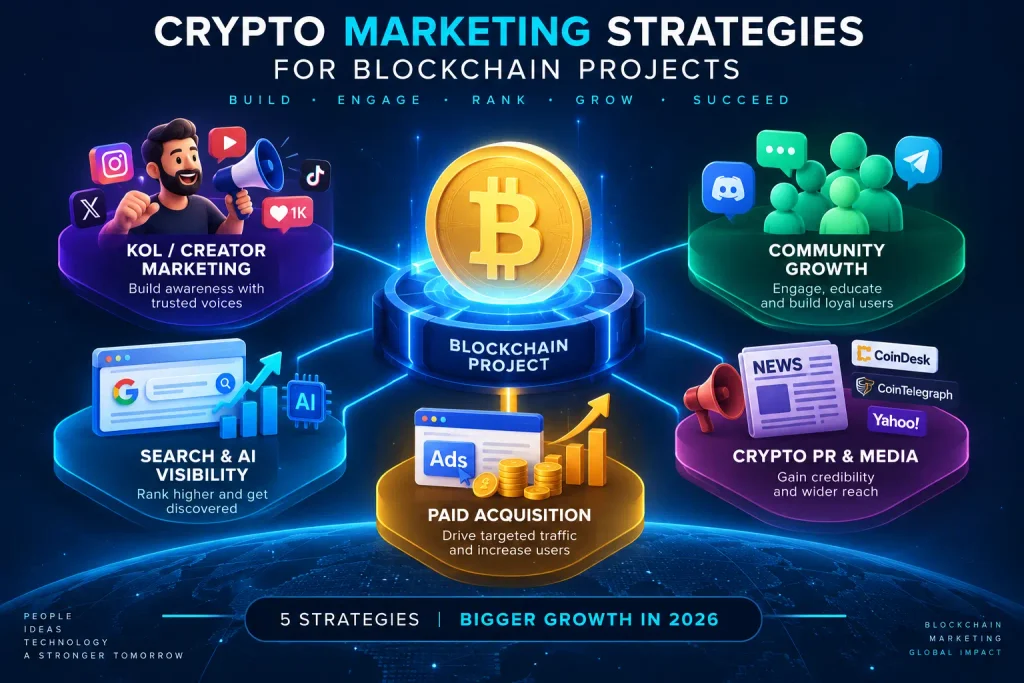
So before you add another channel, it makes more sense to back the strategy that fits what your project needs next. In this blog, we rank five of the best crypto marketing strategies for blockchain projects in 2026 across acquisition, retention, visibility, authority, and commercial growth!
What This Blog Answers
- Which crypto marketing strategies work best for blockchain project growth in 2026?
- How should blockchain projects choose the right crypto marketing strategy for growth?
- Which crypto marketing tactics bring users, wallet activity, retention, and authority fastest?
What Growth Problem Is Your Blockchain Project Actually Trying to Solve?
Most founders don’t have a marketing shortage; they have a strategy that doesn’t match the problem, which is why budget spreads before the growth problem is clear. So before adding another channel, look at what your project is missing and choose the crypto marketing strategy that fits that gap. Once you know which gap is costing you growth, deciding where the next marketing dollar goes becomes much simpler.
- Reach Gap – If attention is thin, performance-based KOL campaigns can reach the right crypto audiences and tie spend to signups, wallets, or transactions.
- Community Gap – If people join but activity stays flat, referral and ambassador programs can turn users into contributors, repeat participants, and sources of new users.
- Search Gap – If people are comparing protocols, fees, or use cases, high-intent SEO and AI answer visibility can capture demand before competitors do.
- Acquisition Gap – If your funnel converts, paid acquisition and wallet retargeting can add volume while bringing back users who dropped before an on-chain action.
- Authority Gap – If the product has traction but the market hesitates, proof-led crypto PR can turn adoption data, integrations, research, and founder insight into credible coverage.
Once the right strategy is clear, you can start with top crypto marketing agencies like Blockchain App Factory and INORU, with Coinbound, Lunar Strategy, and Turnkeytown also standing out for hands-on work across KOL campaigns, community growth, paid acquisition, search, and crypto PR.
Top 5 Crypto Marketing Strategies for Blockchain Project Growth in 2026
These five crypto marketing strategies earn their rank because each one solves a different problem and gives you a clear reason to keep spending or stop.
1. Performance-Based KOL & Creator Acquisition
Why it ranks #1
Crypto KOL marketing has one clear edge: Creators already have access to the exact crypto audiences projects are trying to reach. Still, reach proves little. The value starts when creator traffic becomes installs, wallets, deposits, trades, or repeat use.
How serious teams run it
Start with nano, micro, and mid-tier creators instead of betting on one name. Track each separately, compare the users they bring in, then keep spend behind creators whose users actually connect, transact, or return.
The numbers worth watching
LuvKaizen’s 2026 dataset puts micro-KOL posts around $500 to $5,000, with 5% to 10% engagement; its $15,000 starter model covers 15 to 30 nano or micro placements.
Clinch’s Trust Wallet case went further: 3,480 installs became 2,190 activated users and 1,370 on-chain transactors, while 46% returned within 30 days.
| What to Check | What You Want to See |
| Creator Traffic | Users actually connect or sign up |
| First Action | Users trade, swap, stake, or deposit |
| Cost Per User | Acquisition cost stays within budget |
| Repeat Activity | Acquired users come back |
Best suited to: Wallets, exchanges, DeFi, and token launches.
Founder takeaway: If a creator attracts attention but not users who sign up, fund wallets, transact, or return, I’d cut the spend.
2. Community Referral & Ambassador Growth
Why it belongs this high
A community starts contributing to growth when members bring in other users, not when member counts look impressive. So instead of rewarding noise, referral and ambassador programs turn existing users into referrers, contributors, and local community leads.
How the referral loop works
Start with people already contributing, then assign roles across referrals, local markets, education, or onboarding. Tie rewards to verified wallet activity, repeat participation, qualified referrals, or contribution quality.
The numbers worth watching
Galxe reports Dango attracted 164,000+ unique wallets, while X followers rose 37.8% and engagement moved from 15% to 33%. It also produced 5,700+ contributors and 63M+ views.
Soneium Conquest brought in 200,000 participants across 27 apps in four weeks. Optimism’s quest campaign saw daily transacting wallets rise from 11.65K to 25.13K across 30-day pre- and post-campaign periods.
| What to Check | What You Want to See |
| Referrals | New users complete a real action |
| Ambassador activity | Participation brings useful traffic/users |
| Community activity | Members stay active after joining |
| Post-reward activity | Participation continues after incentives end |
Best fit: L1/L2 ecosystems, DeFi, DAOs, and gaming.
Founder takeaway: If participation dies with the rewards, you paid for temporary participation instead of building community growth.
3. High-Intent Search + AI Answer Capture
Why search keeps its spot
Search works because the interest is already there. Someone comparing wallets, bridges, fees, protocols, or alternatives is closer to action than someone who saw a post. And in 2026, plenty of that research now happens inside ChatGPT, AI Overviews, and other answer engines too.
How demand gets captured
Build around commercial intent: comparisons, alternatives, use cases, documentation, integrations, and problem-specific searches. Support those pages with expert authorship, original data, direct answers, and third-party references.
The numbers worth watching
Ahrefs’ 2026 update across 300,000 keywords found that AI Overviews were associated with a 58% lower CTR for the #1 organic result.
Meanwhile, Semrush found ChatGPT outbound referrals grew 206% year over year. Yet a 95-site study from The SEO Works found organic search sent 39 times more traffic than AI assistants, while AI referrals converted at 7.18% versus 6.08% for organic.
| What to Check | What You Want to See |
| Google Traffic | Search visitors take product actions |
| AI Visibility | Your brand appears in relevant answers |
| High-Intent Pages | Comparison and use-case pages convert |
| Search Growth | More qualified users arrive over time |
Best fit: DeFi, infrastructure, L1/L2, wallets, RWA, and exchanges.
Founder takeaway: I wouldn’t pick SEO or AI visibility. I’d make sure the project shows up wherever that high-intent search happens.
4. Crypto-Native Paid Acquisition + Wallet Retargeting
Why paid still earns budget
Paid acquisition earns its budget once you know what users do after the click. Without that connection, campaigns can look busy while usage barely moves. Wallet-level tracking shows which audiences actually go on to use the product.
How teams spend without guessing
Test X, crypto-native ad networks, eligible search inventory, publishers, and audience groups in small batches. Then retarget people who visited but didn’t connect, connected but didn’t transact, or used the product once and disappeared.
The numbers worth watching
Addressable’s 2026 Cost Per Wallet study covered $490,000 in spend, 95.4M impressions, and 22.4K wallet-bearing users across 45 advertisers.
HypeLab’s 2026 benchmarks place DeFi click-to-wallet connection at 3% to 8% and wallet-connect-to-first-transaction at 15% to 30%. One Addressable retargeting case reported 321% on-chain ROAS, or $3.21 per ad dollar.
| What to Check | What You Want to See |
| Cost per wallet | Acquisition stays affordable |
| Wallet activity | Users complete their first transaction |
| Retargeting | Dropped users return & act |
| Ad spend | Revenue or user value covers acquisition cost |
Best fit: Products with proven onboarding, clear conversion events, and enough volume.
Founder takeaway: Cheap traffic is useless when pricier clicks bring users who fund, trade, stake, or return.
5. Proof-Led Crypto PR & Authority Campaigns
Why PR still makes the five
Crypto PR works when the project has something journalists can actually use. Reporters don’t need another claim; they need adoption data, research, security findings, integrations, milestones, or founder insight worth publishing.
How proof becomes coverage
Start with one strong piece of evidence , then reuse it across journalist outreach, founder commentary, earned coverage, backlinks, creator discussion, search, and AI visibility. From there, outreach gets that evidence in front of journalists, creators, and search audiences.
The numbers worth watching
Cision’s 2026 State of the Media research surveyed 1,899 journalists across 19 markets. It found 66% rely on PR-provided material for story ideas, while 72% said fewer than one-quarter of pitches are relevant; another 53% oppose AI-generated pitches.
EAK Digital reports its Wanchain campaign secured 130+ organic placements and 4.7M+ views, with more than half landing in Tier-1 outlets.
| What to Check | What You Want to See |
| Media coverage | Relevant outlets pick up the story |
| Research or data | Journalists cite your proof |
| Referral traffic | Coverage sends interested visitors |
| Brand authority | Search and AI mentions increase |
Best fit: Projects with adoption, integrations, research, funding, launches, or founder expertise.
Founder takeaway: PR earns more budget when journalists and industry voices find the evidence strong enough to cover on their own.
How Should Blockchain Projects Choose the Right Strategy?
You can burn through a crypto marketing budget quickly when every channel looks like something you “should” be doing. KOLs, search, paid ads, community, PR, they can all work, just not for the same problem. So before spending more, you should pin down what’s holding the project’s growth back and choose from there.
- Need Attention Fast?
Performance-based KOL and creator acquisition fits when qualified reach needs to turn into wallets, signups, or transactions.
- Have Users but Weak Organic Spread?
Community referral and ambassador growth works when existing users can bring in the next group and keep participation moving.
- Seeing Search Demand Already?
High-intent search plus AI answer capture makes sense when people are comparing protocols, fees, products, or alternatives.
- Your Funnel Already Converts?
Crypto-native paid acquisition and wallet retargeting fits once you know which users are worth paying to acquire.
- Have Proof but Weak Authority?
Proof-led crypto PR works when adoption, research, integrations, or founder insight gives the market something worth covering.
After Choosing the Right Strategy
Running five channels at once won’t fix a weak crypto marketing strategy. If KOLs, paid ads, search, community, and PR all operate separately, you usually end up with five reports and no clear answer on which activity actually helped the project win users, transactions, attention, or trust.
So I’d build the mix in sequence. Start with the strategy closest to the result you need, then use what it produces to support the next move. A KOL campaign that creates branded searches can feed search capture. Search traffic that converts can give paid teams proven keywords and audiences. Community activity can show which users actually stay. PR can then turn adoption, research, or product traction into outside credibility.
Once one channel starts feeding the next, the budget gets easier to defend because every channel has a clear job instead of existing just because competitors use it.
And if your team can’t connect those pieces in-house, this is exactly where experienced crypto marketing agencies become useful. The right partner shouldn’t just run more campaigns. They should know which strategy to lead with, what to connect next, and which numbers deserve more spend.

Chris Mcdonald has been the lead news writer at complete connection. His passion for helping people in all aspects of online marketing flows through in the expert industry coverage he provides. Chris is also an author of tech blog Area19delegate. He likes spending his time with family, studying martial arts and plucking fat bass guitar strings.