

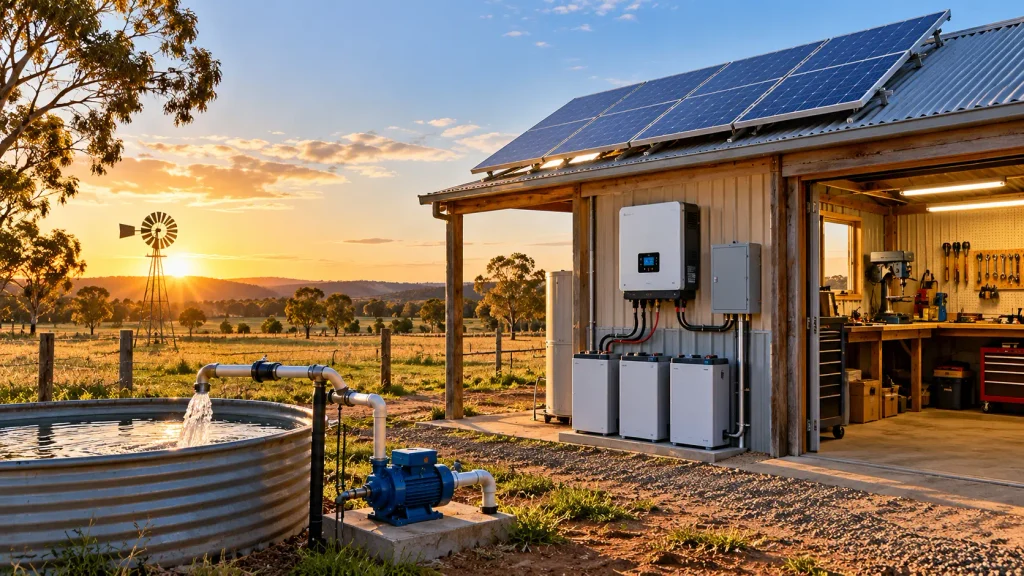
Connecting the power grid to distant paddocks, rear sheds, and workshops that sit on the edges of your property will set you back thousands of dollars and take many months. That’s why increasing numbers of people are moving towards off-grid power solutions. Properly designed solar panels can provide all your power needs without any poles in sight. From the basics of system sizing to building types and maintenance, here is everything you need to know about off-grid power.
Why Off Grid Power Works Well for Isolated Rural Properties
Network extension costs rise steeply with increasing distance. There are poles, cabling, trenches, transformers, and costs involved. It’s possible for the price of a remote property connection to exceed the cost of construction. An off grid power installation is immediately next to the load so there is no need to extend anything around the property.
The key benefits for rural residents are:
- No further supply charges after payment of the initial setup.
- Ability to locate a shed, pump, workshop or other equipment where you want it rather than where power is available.
- Immunity from network downtime which is frequent in rural areas.
- Ability to upgrade capacity later when demand increases.
- Quiet running and less fuel use than with a diesel generator.
Start with a Power Audit That Is Realistic
Every great system starts with numbers. If you guess, then the best-case scenario is that your batteries run out of juice half way through the afternoon; or worse, that your fancy system is way too big and costs way too much. Here’s what needs to be done before you talk to anyone about equipment.
- List all devices you want to operate including lights, chargers, pumps, power tools, and refrigerators.
- Note the wattage number found on the name plate of all devices.
- Guess at the number of hours per day that each one operates.
- Multiply watts by hours to give watt-hours per day and then sum all of them up.
- Calculate the initial surge drawn by any motor for one to two seconds at three to six times the regular operating load.
- Include an allowance of twenty percent for future loads and losses in the system.
This number will form the basis of panel, battery, and inverter sizing.
Powering a Remote Shed
There are not many demands to be met in a typical shed. Several LED lights, mobile phone charging, a radio station and occasionally a power tool will do well with a simple set of solar panels and batteries. Many people begin their adventures with this setup since it is the easiest way to test the performance of off-grid power.
Simplify your shed energy solution. Use LED lights, install an inverter only when necessary and operate some devices straight from the battery bank to avoid losses in the process of converting energy. In case your shed is to turn into a workshop in the future or will contain more equipment, reserve some space in the design for additional solar panels and batteries.
Running Pumps Using off Grid Solar Energy
Water is one of the first tasks that an off-grid system undertakes. Stock troughs, transfer pumps, bore pumps, and irrigation pipes work exceptionally well with solar since the requirement for water increases during the sunniest times of the day.
There are two methods of doing this.
Solar direct drive. The pump operates using the power generated by the panels during daylight hours. This method does not include any batteries and therefore, reduces cost and maintenance.
Battery backed up pumps. It uses stored power to operate the pump after dark or in low light conditions, making it suitable for households and businesses that require water all the time.
Water storage is cheaper than energy storage. Large header tanks can store days worth of water, and therefore, the system can survive a few days of bad weather with no problem at all. Careful consideration should be taken in pump selection, bore depth, flow rate, and head height because they dictate the true requirements of the pump.
Workshop Setup Using Off Grid Power
Workshops are the toughest applications for any system since the welding machine, compressor, grinder, and saws all have spikes of demand. The total amount of power used each day is not much, but the load is very high, meaning the system’s inverter and battery must cope with this without tripping.
There are some key practices that really matter.
- Go for an inverter bigger than your maximum demand load.
- Use soft starting or variable frequency drives on the motors.
- Plan heavy use to occur during midday, when there is more solar power.
- Never operate multiple loads at once.
- Have a generator backup to cater for the rare maximum demands instead of sizing the whole system for it.
The last item saves a lot of money. Sizing a system for a peak hour during the year doubles the cost, while the backup generator easily solves that problem.
The Essential Components of a Reliable System
Irrespective of the structure, most systems tend to have similar essential components.
- The solar panels generate energy. The panels should be installed towards the direction of the sun without any shade and free of dirt and bird droppings.
- The charge controller ensures that the batteries do not get damaged and regulates the power flow from the panels.
- Batteries serve as a storage source of energy at night and during cloudy weather. There are lithium batteries which have a longer lifespan than lead acid batteries which require more maintenance.
- Inverter serves to convert the stored DC energy into AC.
- The protection and wiring, which include fuses, isolators and cables, are important in ensuring the system safety.
- Monitoring serves to check how much energy is generated and consumed.
Hiring a Certified Professional
Electricity on battery systems can be dangerous, and even cause fires and electrocution. Compliance is also important when it comes to electrical wiring, installation of the batteries, and their isolation. It’s important to hire a licensed electrician who knows how to set up solar systems and works with batteries. The qualified professional will ensure that the system you choose is adapted to your climate conditions and meets all the requirements. Having insurance will help you stay safe.
Mistakes You Need To Avoid When Setting Up Off Grid System
- Off-grid power system failures often result in a few mistakes.
- Underestimation of the load and choosing a too small system.
- Not considering the starting surges for water pumps and motors.
- Buying the most cheap batteries without cycle life consideration.
- Mounting solar panels under the shade in the afternoon.
- Too long and too thin cables lead to voltage drops.
- Not having any backup in case of bad weather for a long period of time.
Maintaining your system through the years
Correct care and maintenance ensures efficient operation and the longevity of the system.
- Wipe down the panels once or twice a year and more frequently if there’s dust.
- Inspect connections and cable ends for corrosion and looseness.
- Ventilate the battery banks and keep them in the correct temperature range.
- Review monitoring data on a monthly basis for any output losses.
- Have the system checked up by a specialist every year or two.
- You may extend the life of your equipment by doing small things like that.
Conclusion
No longer should remote workshops, sheds and pumps rely on networks to get their electricity supply. With proper analysis, reasonable sizing and installation by an authorized dealer of off grid solar energy is guaranteed to provide reliable power to the place of your activities. Start small if you need to, but be ready to scale and use only good components. And you’ll see how it pays for itself without much effort at all.

Chris Mcdonald has been the lead news writer at complete connection. His passion for helping people in all aspects of online marketing flows through in the expert industry coverage he provides. Chris is also an author of tech blog Area19delegate. He likes spending his time with family, studying martial arts and plucking fat bass guitar strings.