
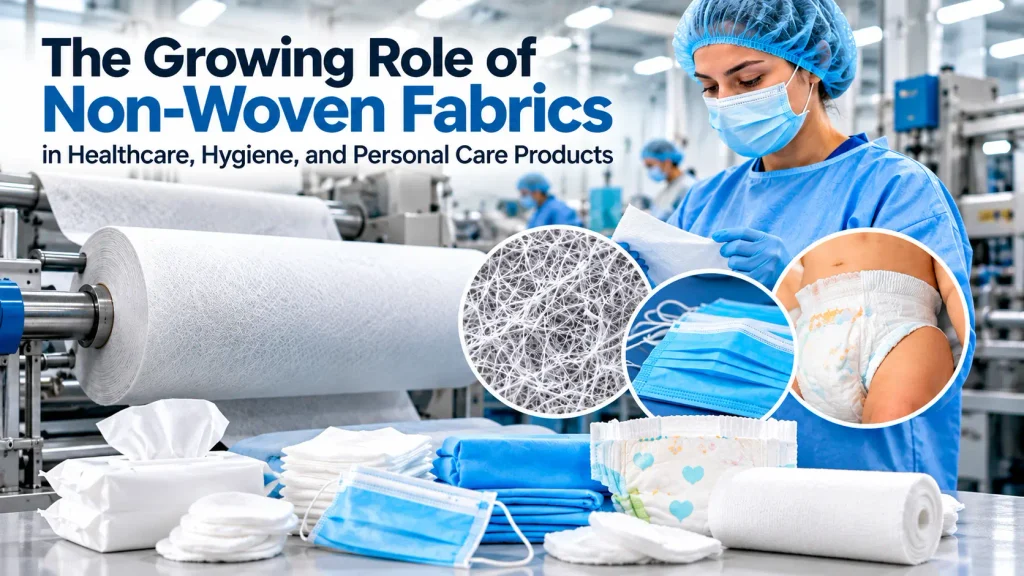
Grabbing a baby wipe, a surgical mask, or a sheet face mask, what you have in your hands is anything but a woven piece of cloth. There is no weaving involved in the items also there are no looms, neither any yarn. Non-woven fabrics are a category of products which have been quietly incorporated into the ways that hospitals operate, babies are looked after, and skin is taken care of. The process is hard to see since the fabric is engineered to go unnoticed.
What “Non-Woven” Actually Means
Traditional fabrics are made from yarns. Yarns are formed by spinning fibers together to form threads, which are then woven and knit. However, non-wovens do not follow this traditional process, and instead consist of fibers arranged to form a web structure.
- Spunbond: In this technique, continuous filaments of polymers are extruded to form a web, which is then bonded. Products of polypropylene spunbond are often used in the production of baby diapers, protective clothes, surgical items and many other items requiring light but durable structures.
- Meltblown: The meltblown technique uses air flow to produce a web of very fine polymer fibers. This technique allows producing particles filtering structure and is often used in multi-layered masks and filters.
- Hydroentangled: Similarly called spunlacing technique, this technique involves water jets at high pressure to entangle fibers. Fabric-like structure is produced as a result of this technique, thus making it applicable in cleansing wipes and some medical fabrics.
- Airlaid and carded thermal-bonded: Although airlaid techniques use air flow for distributing fibers, carding is a mechanical process of separation and alignment of fibers. This technique is used in absorbing hygiene products, wipes and other items requiring particular fiber distribution or bulkiness.
Applications of Non-woven Fabrics
Healthcare: Where the Stakes Are Highest
- Surgical Gowns, Drapes and Coverings: Disposable Cotton Surgical Gowns were previously considered common in operating theatres. Multiple washings and sterilizations of the gowns made them weaker and caused differences regarding quality. Single use SMS Surgical Gowns and drapes will provide the same performance every time without the necessity of being washed during the process.
This advantage is crucial for hospitals that have tight schedules. Barrier Fabrics Performance is measured in most countries in accordance with national standards depending on their ability to resist fluids. Non-woven materials can be adjusted to achieve higher classes that are extremely significant for long and fluid-intensive procedures.
- Masks and Respirators: The 2020 pandemic outbreak brought into limelight the meltblown fabric. Lack of this one material alone led to delays in mask production in many countries and governments and companies found it necessary to increase their capacity. This was an indication of the degree of reliance on this special material for protection against hazards.
There are two ways in which meltblown filters function. One way is by physically filtering out the particles due to small size of the fibers, while the other is due to electrical charge applied during the manufacturing process that helps in attracting even smaller particles. The electrical charge gets neutralized due to humidity and time.
- Wound Dressing and Sterile Wrapping: In wound dressings the nonwovens can be found as the core material like an absorbent, as the contact material also like a backing material. Spunlace and needle-punched nonwovens are naturally used in such applications as they are soft and they do not produce a lot of lint or fur, i.e. loose particles of the material.
Another application where nonwovens work silently is sterilization wrapping. Nonwoven materials can be used to cover instruments and allow gases/steam to penetrate while maintaining a microbial barrier later. This feature of breathability along with the microbe barrier allows using nonwovens in medical packaging.
- Diapers and Training Pants: Today’s disposable diapers consist of various layers and non-wovens are used almost for all the layers. There is a soft spunbond sheet that contacts the skin, acquisition layer that takes liquid from the surface rapidly, and absorbent core that contains liquid. Non-wovens are used for the waist elastic band, leg cuffs, and outer cover of the diaper. Skin contacting layer is treated in such a way that liquid can easily penetrate this layer but it feels comfortable. Also, the manufacturers reduced the thickness of these layers during the recent decades.
- Feminine Care: Pads, liners, and associated packaging share the basic properties of quick absorbency and dryness. The thin airlaid core and soft topsheet are some of the innovations that have contributed to making these products thinner than earlier versions. Comfort plays a critical role in this product category, so softness and fit play a big part in design considerations.
- Adult Incontinence: The rationale behind selecting this demographic is demographic shifts. The population in Japan, most of Europe, and increasingly China and others is aging. Ageing people are more prone to use absorbent material, and hence consistent and continuous demand helps sustain the non-woven industry despite the influence of economic cycles.
- Wipes: Disposable wipes used by infants, families, and individuals for body cleansing make up a big family all of their own. Spunlace materials rule this field due to their strength when wet and softness against the skin. Often wipes consist of a mixture of viscose/cotton and polyester/polypropylene to ensure that strength and softness are combined in an economic way. Flushing remains one big headache. So-called flushable wipes have often been pointed at as a source of clogging and as part of blockages in sewer lines. Business references and test procedures challenge to define flush ability in an effort to resolution the issue once and for all.
Personal Care: Texture Counts
- Sheet Masks and Cosmetic Pads: Facial Sheet Masks are fabrics saturated with serum. It should be noted that a fabric should be able to retain serum without dripping, be adjusted to the face shape and ensure a slow dissolution of the active components. Cotton, viscose from bamboo, lyocell can be used as carrier fabrics in sheet masks. In some instances, the manufacturers use certain fabrics depending on their tactile characteristics.Make-Up Removal Pads And Cotton Balls are products from this category as well. The advantages of such products include softness, absence of lint and absorbency.
- Cleansing Cloths and Towelettes: Dry cleaning cloths, salon towels, and disposable barber’s and spa products use non-wovens technology. Price per usage and hygiene requirements matter here, because it is possible to ensure that each person will have a clean towel since it is a disposable one.
- Oral And Baby Care Product: The other items that can be regarded as personal care products are small products like dental wipes, nursing pads, and disposable bibs. The items seem small one by one but taken together show how widely non-wovens are used in our lives.
What Keeps Demand Rising
There are a number of factors that account for the continued increase in demand. According to industrial analyses, including those conducted by Pristine Market Insights, multiple factors play a role as opposed to just one particular factor.
- Increasing Elderly Population: An increasing number of aged people in the population will result in higher demands for disposable incontinence products and medical consumables. The demand is fairly stable as the increasing population segment demands it irrespective of consumer sentiment.
- Hygiene Awareness: As there were several campaigns run regarding public health and also the recent experience with the pandemic, consumer hygiene awareness has gone up. Thus, use of disposable wipes, masks, and protective gear in homes and offices has increased.
- Increasing Healthcare Facilities: With increasing numbers of hospitals being built in the emerging markets, there will be an increasing requirement for gowns, drapes, and dressings. Several new hospitals adopt the disposable approach from day one.
- Urbanization and Increasing Incomes: Increasing incomes allow households to shift to disposable hygiene products. This trend has been observed in several regions of Asia, Africa, and Latin America.
- Advances in Manufacturing: The nonwoven manufacturing lines operate efficiently and cost-effectively. This helps in maintaining low unit costs and making products affordable to customers.
The non-woven fabric market being connected with various applications allows a drop in demand in one application sector to be compensated by increased sales in another. The medical mask sector had seen a decline in demand following the peak pandemic years, while other segments like hygiene and personal care continued on an upward trend.
Innovation on the Horizon
Filtration layers made of nanofibers spun using electrospinning can be used for highly efficient masks and wound dressing systems that provide gradual release of medication. Most of these innovations remain in the pilot stage, so it is hard to evaluate their further potential. Antimicrobial treatments are among the other developments under investigation. Silver or zinc, as well as any other treatments that reduce microbial activity on the surface of fabric, need to be tested for their efficiency and further effects. Hygiene products with smart properties have recently become available. Adult and infant hygiene products feature moisture sensors indicating changes in colors or sending signals to caregivers. This innovation hints at further use of an absorbent hygiene product for diagnostic purposes.
Challenges That Can Hinder Growth
There are several issues that must be considered in light of all the optimism:
- Price Fluctuations of The Material: The price of polypropylene is related to crude oil and petrochemicals and may fluctuate. Higher prices result in narrow profit margins or even higher prices for the consumer.
- Limits of Regulation: Plastic bans may limit product design. Some re-design will be required along with the need for new materials.
- Oversupply: As the pandemic, many companies decided to adopt their meltblown production lines. As a result of lower demand, there was oversupply that led to lower prices.
- Mistrust of The Consumers: There may be customer mistrust of any “greenwashing.” Products that are not sustainable in the view of consumers will not be trusted.
The Environmental Question
Almost all non-wovens used in the field of health care and hygiene are produced from polypropylene or polyester synthetic polymers. Since most products are single use, there is much waste accumulating fast. Moreover, there is the danger of synthetic wipes breaking down into small pieces which may end up in water bodies and scientists are trying to assess the scale of the problem.
There are several numbers of responses to this challenge. Some manufacturers are switching to viscose, lyocell, cotton or polylactic acid, although their price, durability and actual biodegradability differ greatly. Other producers are reducing the volume of the fabric in each product, thereby reducing raw materials requirements and weight for transportation, but not affecting product performance. Environmental considerations have become an essential part of consumer choice and transformed the market of non-wovens.
Recycled Content and Its Limits
Recycled PET is being used in some of the spunbonds and needle-punched products, and that helps to decrease the need for virgin polymer. This method fits well in products like filter media and industrial wipes where the demands are not so high.
Use of materials for medical and hygienic purposes is difficult, because there are contamination problems associated with recycled materials, and a gown or dressing made out of recycled material needs to pass the same test as one produced from virgin material. Collecting soiled hygiene products for recycling is another problem. That’s why progress here is constant but slow.
Fulfilling Medical Requirements while Minimizing Environmental Impact: The Future of Non-Woven
Non-wovens are valuable in that they combine unique properties of low cost, customizability, and mass production capabilities. They offer protection in hospitals both to patients and healthcare workers. They help to address the basic hygiene requirements of babies, adult women and the elderly. They facilitate the delivery of substances in various forms of personal care applications.
Most probably, what will distinguish the future of non-woven materials will be not the application but the manufacturing and disposal practices that they utilize. There is increasing pressure from regulatory agencies, from retailers and from customers on the industry to use cleaner raw materials and provide better end-of-life practices. The manufacturers who are capable of meeting stringent medical and hygiene requirements while reducing their environmental footprint will probably define the future of the market.

Chris Mcdonald has been the lead news writer at complete connection. His passion for helping people in all aspects of online marketing flows through in the expert industry coverage he provides. Chris is also an author of tech blog Area19delegate. He likes spending his time with family, studying martial arts and plucking fat bass guitar strings.