

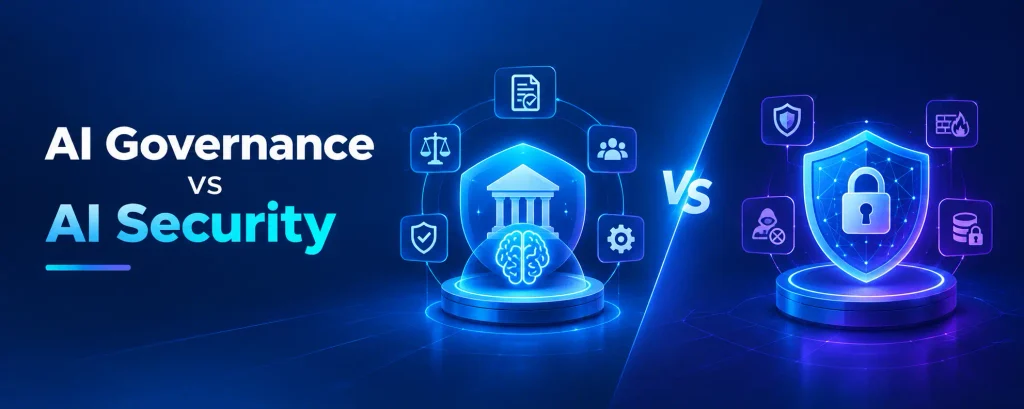
Deploying machine learning systems is nothing like launching standard software applications. Traditional stacks run predictable code, enforce rigid database rules, and guard distinct network perimeters. Modern AI breaks that playbook entirely. Neural networks and autonomous runtimes act probabilistically, consume unstructured text on the fly, and take direct actions across core tools.
As teams move experiments into live operations, confusing two critical areas creates serious problems: AI governance vs AI security. Conflating the two leaves business operations exposed to legal fines, biased decisions, and direct code exploits. Recognizing the boundary between AI governance and AI security keeps live models functioning safely.
Defining the Core Distinction: Rules vs. Defenses
At the architectural level, the separation between governance and security reflects the distinction between strategic organizational alignment and technical operational defense:
- AI Governance focuses on accountability, regulatory adherence, operational policies, and ethical boundaries. It answers the fundamental business questions: Should we build or deploy this model? Who owns its operational risks? Does its behavior align with statutory mandates, internal ethics, and fairness metrics? How do we audit its decisions when things go wrong?
- AI Security focuses on protecting models, data pipelines, infrastructure, and runtime workflows from intentional exploitation, tampering, and unintended structural compromise. It answers technical defensive questions: Can external actors poison our vector embeddings? How do we prevent direct and indirect prompt injection? Are model weights, training sets, and inference endpoints protected from exfiltration? How do we sandbox autonomous agents from unauthorized lateral movement?
Governance sets the rulebook and institutional guardrails; security builds the cryptographic, network, and algorithmic fortifications that keep those guardrails from being smashed. An enterprise with world-class security controls can still deploy an illegal, discriminatory, or non-compliant model.
Conversely, an enterprise with comprehensive governance charters and ethical guidelines will fail immediately if adversarial actors can extract weights or hijack inference pipelines. Evaluating AI governance vs AI security side by side helps leaders recognize that one cannot function without the other.
Core Pillars of Enterprise AI Governance
Governance establishes institutional credibility and legal viability across every phase of the artificial intelligence lifecycle. Without structured governance frameworks, machine learning systems quickly degrade into unaccountable black boxes that expose organizations to statutory penalties and brand erosion.
Regulatory Compliance and Framework Alignment
Global regulatory oversight has moved past voluntary ethical guidelines into enforceable statutory requirements:
- The European Union AI Act: Enforces strict risk categorizations, bans unacceptable-risk applications, and imposes rigorous testing, logging, and human oversight mandates on high-risk implementations.
- NIST AI Risk Management Framework (AI RMF 1.0): Provides structured guidance for enterprise teams to govern, map, measure, and manage algorithmic risk profiles across enterprise systems.
- ISO/IEC 42001: Sets an internationally auditable standard for AI Management Systems (AIMS), codifying organizational controls around deployment and operational health.
Governance teams must translate these broad statutory legal texts into concrete technical guardrails that platform developers and data scientists can enforce programmatically.
Algorithmic Accountability, Ethics, and Bias Mitigation
Neural networks mirror the biases, anomalies, and structural inequities of the underlying training corpora. AI governance institutes proactive validation gates to assess model fairness before merging weights into release pipelines.
Governance structures must be backed by statistical tests (e.g., disparate impact ratios, demographic parity checks) to ensure that automated predictions in forecasting scenarios such as automated credit underwriting, resume filtering, or insurance claims processing do not unlawfully disadvantage protected classes.
Data Provenance, Lineage, and Model Explainability
Enterprises need to track all data artifacts that feed inference windows and fine-tuning cycles. When an autonomous system makes a bad decision, engineering and legal teams need to trace the end-to-end execution path:
- What specific vector chunks or historic data snapshots underpinned the output?
- What model checkpoint, hyperparameter set, and prompt template was live during inference?
- Can outside regulators and affected customers understand the reason for it in plain English?
Governance requires auditable metadata lineage of model outputs all the way back to upstream data sources so undocumented data contamination cannot flow into production environments.
Human-in-the-Loop Escalation and Authority Thresholds
Autonomy is not a binary thing. A strong governance program gives clear delineation of what machines can do, and what they can’t do. Low-risk informational tasks can run autonomously, while high-stakes transactions, such as initiating capital transfers, terminating clinical accounts, or modifying enterprise ERP records, must include deterministic human approval gates.
Governance defines escalation criteria: if model confidence falls below a certainty threshold, or the context contains classes of regulated data, then execution must be escalated to human reviewers, with an evidentiary audit trail.
Core Pillars of Enterprise AI Security
Governance brings legal viability and institutional credibility to the entire artificial intelligence lifecycle. Without proper governance frameworks, machine learning systems quickly turn into unaccountable black boxes, leading to statutory penalties and brand erosion for organizations.
Defending Against Adversarial Attacks and Injection Exploits
The world of regulatory oversight has changed from voluntary ethical guidelines to enforceable statutory requirements:
- EU AI Act: Requires strict risk categorizations, prohibits unacceptable-risk applications, and mandates rigorous testing, logging, and human supervision for high-risk implementations.
- NIST AI Risk Management Framework (AI RMF 1.0): Offers structured guidance for enterprise teams to govern, map, measure, and manage algorithmic risk profiles across enterprise systems.
- ISO/IEC 42001: Establishes an auditable international standard for AI Management Systems (AIMS), formalizing organizational controls around deployment and operational health.
Governance teams must translate these high-level statutory texts into specific technical guardrails that platform developers and data scientists can implement in code.
Ingestion Defense, Vector Hardening, and Data Poisoning
Enterprise systems rely heavily on Retrieval-Augmented Generation (RAG) and domain-specific fine-tuning. If attackers access internal document stores or public vector indices, they can execute data poisoning attacks:
- Injecting maliciously crafted documents containing conflicting instructions that hijack model outputs whenever specific keywords are retrieved.
- Vector space manipulation, altering semantic embeddings to trigger incorrect retrieval paths.
Security controls must enforce cryptographic signing on document ingestion, isolate vector collections, and strictly inspect payloads at every stage of the ETL pipeline.
Model Weight Protection and Inversion Defense
Custom models, parameter-efficient adapters, and fine-tuned weights are valuable intellectual property. If unprotected, models exposed through APIs are vulnerable to:
- Model Inversion Attacks: By analyzing output probability distributions over thousands of queries, they systematically reconstruct private sensitive training data.
- Model Theft / Extraction: Training an external competitor model on the outputs of an enterprise model by querying it systematically so as to replicate the core capabilities of the enterprise model.
Security engineering deals with these vulnerabilities through response perturbation, differential privacy methods, dynamic rate limiting, and VPC isolation.
Sandboxing Autonomous Agents and Tool Execution
As organizations deploy autonomous agents that can invoke external APIs and write to databases, securing the integration plane is critical. Left unconstrained, an autonomous agent compromised by an indirect injection exploit could execute unauthorized database updates or drain cloud computational credits.
Security squads enforce least-privilege identity access, short-lived API tokens, containerized sandbox execution for code-interpreting tools, and network micro-segmentation around agent communication channels.
The Intersection: Where Governance Meets Security
Governance and security are complementary systems. In practice, analyzing AI governance vs AI security reveals operational handoffs where these two disciplines depend directly on one another. Consider these shared operational realities:
Zero-Trust Access Control and Data Privacy
- The Governance Mandate: Corporate policies and privacy laws mandate that sensitive HR documents, executive compensation information, and private patient records can never be exposed to the wrong people.
- The Security Implementation: Security engineers implement role-based access control (RBAC), context-level data masking, and cryptographic tenant isolation within vector databases. When an employee poses a question to a knowledge copilot, the security framework filters the search indices based on the user’s identity attributes as defined by governance policies before retrieval.
Drift Monitoring and System Observability
- The Governance Mandate: Fair, auditable outcomes must be guaranteed through stable model performance and factual reliability over time.
- The Security Implementation: Real-time telemetry of prediction distributions, vector distance changes, and inference latency. When statistical distributions show deviations greater than a pre-defined threshold, signaling possible corruption of the model, pipeline failures, or poisoning attempts, automated alerts and fallbacks are generated by security systems.
Execution Guardrails and Circuit Breakers
- The Governance Mandate: High-risk actions demand definitive human verification and deterministic fallback paths.
- The Security Implementation: Deployment platform provides deterministic execution circuit breakers. If confidence scoring falls below critical gates or input filters detect anomalous tokens, the security runtime stops execution and sends the event to an audit queue for manual review.
Architectural Blueprint: Building a Dual-Layer Risk Architecture
The only way to create a production-ready artificial intelligence footprint is to embed both disciplines directly in runtime software architecture. Operational liability arises when pushing raw unstructured documents to unmonitored commercial endpoints. For enterprises, a multi-layered defensive and operational pipeline needs to be deployed:
Layer 1: Ingestion & Perimeter Safeguards
Programmatic validation performed before inputting documents into embedding models validates schema correctness, removes malicious payload vectors, and redacts sensitive personally identifiable information (PII).
Data governance policy defines required metadata. Each indexed vector MUST have immutable tags specifying data ownership, regional residency restrictions, and operational expiration. This ingestion step is a balance of AI governance and AI security to ensure that inputs are legal and technical before they are indexed.
Layer 2: Model Execution & Context Sandboxing
Inputs are run through security filters that detect adversarial injection vectors, jailbreak variations, and unauthorized command requests at runtime before prompts hit context windows.
In live environments, organizations root these controls in an AI governance framework so model permissions, corporate policy bounds, and system defenses are coordinated under central operational management to maintain continuity.
Autonomous agents carry out commands within micro-segmented sandboxes, exploiting role-based access control to enforce permission boundaries.
Layer 3: Post-Inference Auditing & Compliance Telemetry
After a model produces an output, automated assertions check the structure and safety of the response before it’s sent.
Outputs are logged into immutable audit streams that capture retrieved context, model checkpoints, user identity, and deterministic fallback activations. This real-time telemetry feeds both security monitoring systems (SIEM) and governance audit boards.
Balancing AI governance vs AI security across these audit streams gives compliance officers verifiable proof of policy adherence while alerting security teams to anomalous inference behavior.
Enterprise Readiness Checklist: Vetting Partners and Systems
Enterprise leaders cannot build these multi-layered architectures in an operational vacuum. Organizations regularly evaluate commercial software or partner with an external AI/ML development company to construct bespoke platforms.
When evaluating potential vendors or internal system readiness, enterprise decision-makers should use this vetting framework:
Data Isolation and Virtual Private Cloud (VPC) Deployment
Verify that candidate AI/ML companies deploy models and data stores directly inside your enterprise cloud boundary (AWS, Azure, or GCP). Ensure third-party APIs enforce zero data retention agreements so proprietary corporate context is never used to train public models. Selecting proven enterprise AI solutions requires verifying that vendor architectures completely isolate tenant data and enforce private-subnet routing for all embedding workloads.
Guardrail Engineering and Deterministic Reliability
Language models are inherently non-deterministic, but enterprise transaction backends demand strict consistency. A qualified AI/ML development company must demonstrate how they enforce schema boundaries (using JSON schemas, Pydantic, or deterministic fallbacks) to prevent hallucinations, jailbreaks, and broken database updates.
Production MLOps and Lifecycle Observability
Building a functional proof of concept is straightforward; running that model safely over multiple quarters is an operational challenge. Top AI/ML companies configure automated pipelines for model versioning, dependency tracking, drift telemetry, and automated retraining when inputs shift in production.
Comprehensive Intellectual Property and Code Ownership
Legally bind that all custom middleware code, specialized model adapters, vector stores, and fine-tuned weights are 100% proprietary assets of your organization. When sourcing modern enterprise AI solutions, full intellectual property ownership protects your organization from vendor lock-in and unexpected licensing changes.
Moving Toward a Unified AI Risk Management Strategy
Treating governance and security as separate organizational silos introduces systemic operational risk. When CISOs and CCOs are in silos, policies are theoretical and defenses are without strategic context.
When you think about the trade-offs between AI governance and AI security, there is no question that policy definition and technical defense must go hand in hand. An evolved enterprise risk posture combines both disciplines into a continuous lifecycle:
- Establish Cross-Functional AI Oversight: Form an operational council that brings together engineering leads, security architects, legal counsel, and business owners. This council defines which models get built, which risks require automated gates, and how it monitors operational access.
- Translate Governance Policies into Code: Policies written in corporate handbooks cannot stop an automated injection exploit or prevent an ungrounded transaction. Convert governance mandates into programmable software assertions, schema validations, and automated circuit breakers.
- Instrument Continuous Production Telemetry: Think of artificial intelligence systems as living infrastructure that is always changing. Model instrument endpoints with real-time drift tracking, token usage alerts, latency logs and automated anomaly detection
- Assume Continual Adversarial Evolution: Attack vectors grow with model capabilities. Regular red-teaming of autonomous agents, evaluating new prompt-injection vectors, and auditing retrieval indices to make sure system defenses are in line with modern threats.
By treating governance and security as two sides of the same operational coin, enterprise leaders can protect their organizations from compliance violations, secure critical systems from emerging threats and lay a strong basis for long-term intelligence deployment.

Chris Mcdonald has been the lead news writer at complete connection. His passion for helping people in all aspects of online marketing flows through in the expert industry coverage he provides. Chris is also an author of tech blog Area19delegate. He likes spending his time with family, studying martial arts and plucking fat bass guitar strings.