


Saving costs is indeed a benefit of implementing ServiceNow. Automation reduces manual effort. Better workflows mean lower operating costs. But is spending less always good for business performance? Not always.
An enterprise can spend less on IT and still have slow service requests, recurring incidents, or low employee adoption. The platform may be saving money, but are those savings translating to business results?
ServiceNow can do more than just reduce costs. It helps teams find solutions faster. Increase service quality. Better risk management and the ability to deal with larger workloads.
These improvements can contribute to increasing employee productivity, customer experience, and business growth.
But leaders need the right metrics to understand that these benefits are happening.
That’s where ROI measurement gets complicated. Some of the benefits appear in financial statements. Some help daily operations, and others take a while to pay off.
What is important now is having a clear way to measure ServiceNow ROI after implementation. Otherwise, you may end up missing gaps in performance. Or worse, you may overstate the savings.
As a result, leaders find it hard to justify future investment.
Leaders are faced with a bigger question:
How do we measure full ROI from ServiceNow and know if the investment is delivering true business value?
As a CXO, you need to look beyond the savings number.
If you’re not improving productivity, service quality, or customer experience, but your costs are down, you may not be realizing the full value of your investment in ServiceNow.
And that leads to a bigger question:
What Can Your Business Lose by Measuring ROI in an Incomplete Way?
Wasted investment. Missed opportunities. Unclear decisions. Lost employee productivity. Budgets that keep growing.
Lower costs may look good on paper. But are your teams getting more done? Are services improving? Are you seeing the business results you expected?
If you can’t answer these questions, you may be missing part of the picture.
Here are three things you could be losing:
- You may be leaving value on the table.
Say ServiceNow reduces manual work. That’s a win. But check if employees still spend hours fixing process gaps or chasing approvals.
Then, you’re not getting the full benefit.
The real question is, what more could your teams achieve with the time saved?
- You may be calling the implementation a success too soon.
Going live is one milestone. Better business performance is another.
If tickets continue to languish or employees are skirting the new workflows, you need to go beyond implementation progress.
- You may find it harder to justify your next investment.
Want to expand automation or improve existing workflows? You’ll need more than a lower IT bill to make the case.
You need to show what has improved, where the gaps remain, and what the business stands to gain next.
What the actual numbers tell:
- Only 48% of enterprise-wide digital initiatives met or exceeded their business outcome targets. (Gartner’s findings)
- Companies captured a median of just 25% of potential cost benefits from digital transformations, according to McKinsey. (McKinsey’s research)
How Do You Work Out the Real ROI of a ServiceNow Implementation?
ServiceNow ROI is more than simply how much money you save post-implementation. It’s about how well the business is doing because of the investment.
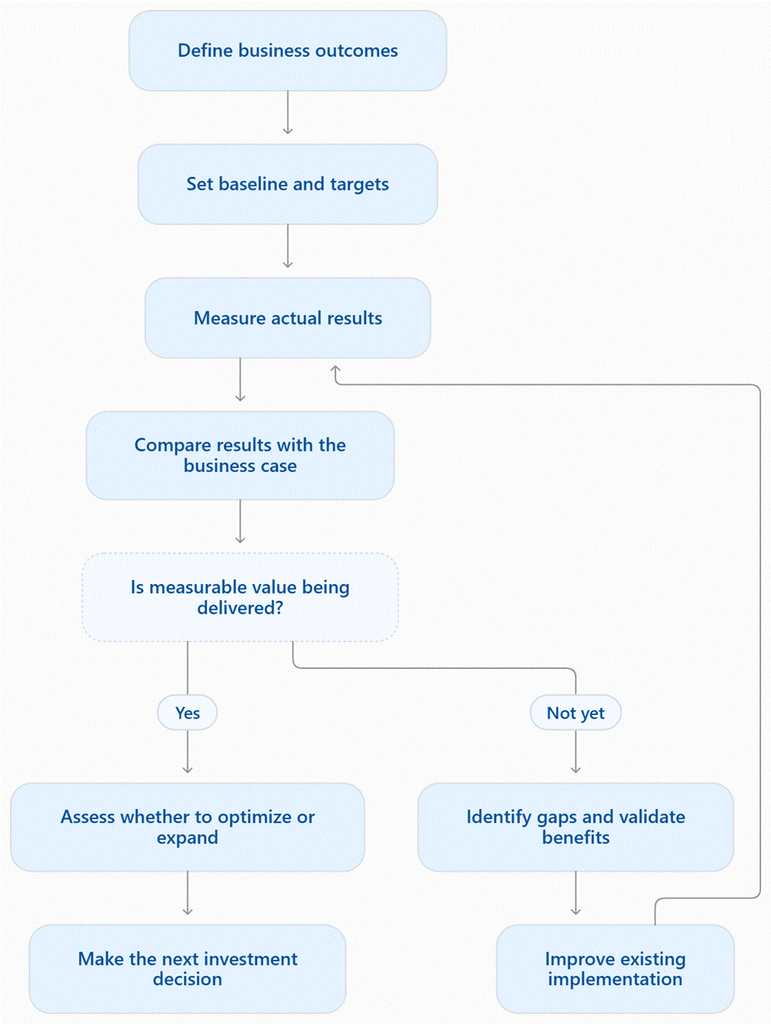
You can use the following steps to link implementation outcomes to business performance and make better investment decisions.
(Image ALT Text – How Can Businesses Measure the ROI of ServiceNow Implementation Beyond Cost Savings?)
- Begin with the Business Results You Want
Before you measure ROI, go back and look at why your organization invested in ServiceNow.
Was the objective to cut operating costs, improve service delivery, strengthen risk management, or support business growth without increasing overhead at the same pace?
How you measure success should depend on your priorities.
For example, the use of Service Catalog and Flow Designer can streamline the service request process and automate approvals.
But if the business goal is to increase employee productivity, you also need to know if employees spend less time waiting for services.
Connect your investment goals with your business outcomes.
| What Is Your Business Priority? | What Success Looks Like | Example Metric |
| Reduce operating costs | Lower support expenditure | Cost per service request |
| Improve productivity | Less time spent on repetitive work | Employee time recovered |
| Improve service delivery | Faster, more reliable support | Mean Time to Resolution (MTTR) |
| Reduce operational risk | Fewer disruptions from failed changes | Change failure rate |
| Support business growth | Handle more demand with available capacity | Requests handled per employee |
The decision to make: Which business outcomes matter most, and what evidence would show that ServiceNow is delivering them?
- Find Your Starting Point . . .
If you don’t know where you started, you can’t measure improvement correctly.
Before you implement, measure how your current processes are performing now.
Review costs of service delivery, incident resolution time, and backlog of requests. Check also for change failures and the time employees spend on manual tasks.
Then set realistic targets for the outcomes that matter most.
If your aim is to reduce disruption from critical incidents, then work out how often these incidents occur, how long services are affected, and what the disruption costs your business.
Then, once you have implemented or improved Incident Management and CMDB processes, compare the results to that baseline.
The question to be posed: Do you have credible baseline data and realistic targets, or are you judging success only after you have implemented?
- Measure Business Outcomes, Not Just Platform Activity
A successful implementation does not automatically mean a successful business outcome.
The number of automated workflows, deployed modules, or active users tells you something about platform usage. It does not prove that the business is getting better results.
For example, Flow Designer may automate dozens of workflows.
But the business value is in whether those workflows reduce processing time, eliminate manual handoffs, or improve service delivery.
Similarly, introducing Change Management does not automatically reduce operational risk. You need to see whether failed changes and related service disruptions have declined.
Time to make a decision: Are you measuring what ServiceNow does or what your business gets from it?
- Compare Actual Results to the Original Business Case
ServiceNow ROI should be measured against your original business case as the benchmark.
Compare the expected benefits with the results achieved to date. Some goals may have been reached, some partially reached, some may still be out of reach.
| Expected Outcome | Actual Result | What Leadership Should Investigate |
| Faster incident resolution | Resolution time has improved | Has business disruption also decreased? |
| Lower support costs | Costs remain unchanged | Have savings been offset by other expenses? |
| Higher employee productivity | Manual effort has decreased | Is the recovered time being used productively? |
| Better change control | Failed changes remain high | Are process gaps or low adoption limiting results? |
For example, faster incident resolution may increase service availability before it reduces support costs.
That does not automatically mean the investment has failed. It means you need to understand where the expected financial benefit has, and has not, materialized.
Don’t just blame ServiceNow for everything – look at other things too, like staff changes, new policies, or growth in the business.
The choice that has to be made: What were the results promised, what were the results achieved, what remains to be achieved, and why the gap?
- Calculate Financial ROI and Consider Broader Business Value
Some of the benefits of ServiceNow translate directly into financial savings.
Some improve productivity, service quality, or risk management first, without cutting costs immediately.
For financial ROI, use:
ROI (%) = [(Realized Financial Benefits − Total Costs) ÷ Total Costs] × 100
Include implementation costs and the ongoing costs such as licensing, integrations, training, maintenance, and optimization.
Beware of valuing productivity gains. If automation reduces the time employees spend processing requests, that does not automatically mean payroll costs have decreased.
If the business uses that recovered capacity to handle more work, report it as a productivity gain unless you can demonstrate a direct financial saving.
The same applies to risk reduction and employee experience. These benefits matter, but any monetary value assigned to them should be supported by a credible method.
The decision to make: What real financial value has been realized, and what other business benefits can you demonstrate?
- Use the Results to Decide What Happens Next
ROI measurement should help you decide where to focus your next investment. Not just verify if the implementation is done.
Where automation is providing tangible benefits, it might be worth exploring how it can be scaled to other appropriate processes.
If adoption is low, then it may be better to invest in improving existing workflows, rather than adding new capabilities.
If the process performance is improved but costs are still high, consider licensing, integration and operating costs before adding on more budget.
These decisions should be evidence-based, business-driven, and based on the cost and benefit you expect from the next move.
Facilitate regular business, IT and finance stakeholder meetings to review performance. This allows future investments to be based on real results rather than assumptions made at the beginning of the project.
The choice to make: Are you looking to optimize the current implementation, expand into new processes, address performance gaps, or redirect your investment?
What Should You Measure to Understand the Total ROI of ServiceNow?
| ROI Area | What Should Each CXO Measure? | What Benefit Does the Business Get? |
| Cost Savings | CFO: IT costs, licensing costs, and the total cost of running ServiceNow. | Better control over spending and clear visibility into cost savings. |
| Employee Productivity | CHRO: Time spent on manual tasks, request processing time, and employee satisfaction. | Employees spend less time on routine work and more time on important tasks. |
| Service Quality | CIO: Time to resolution, SLA performance, and repeat incidents. | Faster problem-solving and fewer disruptions to daily work. |
| Customer and Employee Experience | COO / CMO: Employee and customer satisfaction, self-service usage, and abandoned requests. | Easier access to services and a better experience for employees and customers. |
| Risk and Compliance | CIO / CISO: Failed changes, audit findings, and compliance issues. | Fewer process gaps and better control over business risks. |
| Business Growth | CEO / COO: Requests handled per employee and the cost of handling each request as demand grows. | The business can handle more work without increasing costs at the same rate. |
Track the real benefits here:
Research from the Project Management Institute (PMI) supports the value of tracking these benefits:
- 38% more projects met or exceeded their expected ROI in organizations with a formal process for reporting benefits, compared with organizations without that level of process maturity. (Source: PMI research.)
- 28% more projects met or exceeded their expected ROI in organizations that regularly reported project performance against identified metrics.
Why Measuring ROI on ServiceNow Is Tricky
- No baseline: Without baseline data, you can’t tell how much ServiceNow has improved performance.
- Benefits hard to measure: Time saved is not always money gained.
- Low user adoption: If employees stick to the old ways of working, expected benefits may not follow.
- Hidden ownership costs: Licensing, maintenance, training, and integrations can all eat into your returns.
- Business needs change: Workloads and priorities are changing, and results may be less comparable.
- Disconnected data: If IT, finance and business teams are measuring different things, it’s harder to get the full picture.
Set goals before you implement and then monitor results regularly. Work with the IT, finance, and business teams to have a better understanding of the ROI. Separate actual cost savings from wider business benefits to understand what ServiceNow is really delivering.
How Do You Find a ServiceNow Partner to Support Total ROI Calculation?
Use this scorecard to determine if a potential partner can help you measure business value beyond cost savings.
ServiceNow Partner ROI Scorecard
Rate each answer from 1 (poor) to 5 (excellent) based on the partner’s approach and evidence.
| What Should You Evaluate? | What to Look For |
| Business Goals | Clear, measurable outcomes tied to your business priorities |
| ROI Measurement | Defined baselines, targets, and financial and non-financial metrics |
| Post-Go-Live Tracking | Regular reviews against expected results |
| ROI Reporting | Clear reports showing business impact |
| Continuous Improvement | Practical recommendations to close gaps and improve returns |
How the score is used:
- 20-25: Good alignment. Support with evidence.
- 13–19: Fill in the process gaps first.
- 5–12: Go for a better ROI measurement plan.
These ranges are a practical guide, not an industry benchmark.
Before you decide, ask the partner to show how they would measure ROI for your specific business goals, not just how they would implement ServiceNow.
What Will You Do? Stop at Cost Savings or Look at the Bigger Picture?
The first step is saving costs, but is that enough? Not only numbers. But more than that, understand your service quality. Know productivity. Work on business impact. You will truly understand the real value of your ServiceNow implementation.

Chris Mcdonald has been the lead news writer at complete connection. His passion for helping people in all aspects of online marketing flows through in the expert industry coverage he provides. Chris is also an author of tech blog Area19delegate. He likes spending his time with family, studying martial arts and plucking fat bass guitar strings.