

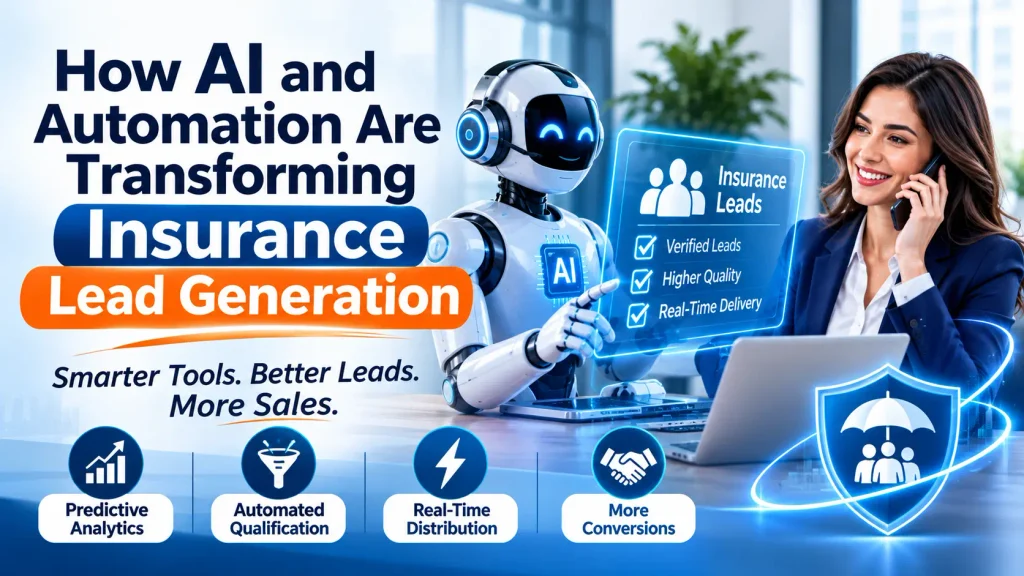
The biggest problem insurance agents have ever had is finding people who actually want coverage. Cold calling lists, bought databases, and referral networks can help agents find new business, but they don’t always put them in touch with people who are actively looking for insurance. By looking at the data and helping to send inquiries more quickly to the right agents, AI is changing how insurance companies find prospects, check them out, and decide which ones to work with first.
AI and automation are changing many parts of the insurance business, such as customer service, pricing, marketing, and underwriting. However, sophistication and adoption vary by insurance carriers, agencies, and independent lead generation platforms. By understanding the tools’ functions and the areas in which they are more or less effective, agents can make better choices about developing and maintaining their sales pipelines.
What AI Actually Does At The Top Of The Funnel
Most of the discussion surrounding AI-driven lead generation revolves around automated emails or chatbots. These applications are useful, but only part of the process. Artificial intelligence can also help right at the start of the lead creation process by looking at past customer behavior and guessing which prospects are most likely to be interested in an insurance offer.
Predictive analytics models look for patterns in search activity, interactions with ads, website visits, and other data sources that are allowed to guess if someone might want to buy something. A driver who has recently compared coverages, gone to a lot of insurance websites, and asked for quotes may be more interested than someone who has only clicked on a banner ad. In insurance, machine learning can find these trends on a big scale and then change the predictions as more information about the outcomes comes in.
In real life, this means insurance lead scoring, which sorts or scores each new prospect based on certain data points and trends that are connected to past contacts or sales with customers. Instead of taking every question as equally important, these numbers can help workers organize their callback queues.
But a lead score is an indicator of priority, not a solid measure of buying intent. The accuracy of the model depends on the quality of the data used to train it, the method used to train it, and how often the predictions are compared to the actual sales results. It also recommends that agencies watch for changes in consumer behavior that could undermine the reliability of existing scoring models.
How Automated Lead Qualification Cuts Through the Noise
The amount of leads may not be the biggest problem insurance agencies face. Also costly is the waste of precious time on duplicate, incomplete, irrelevant, or poorly documented inquiries. AI in insurance lead generation addresses some of these issues by including verification and qualification steps before the lead gets to an agent.
TrustedForm and Jornaya LeadiD are tools that can generate records of a consumer’s online engagement with a lead-generation form on the webform side. Depending on the tool and verification process, these records may contain the page presented, the time of submission, form interactions, and consent disclosures. This allows agencies to analyze the process by which a lead was generated and the information that was given to the consumer at the time their information was submitted.
But a certificate doesn’t validate a consumer’s identity; it doesn’t confirm the bona fide nature of the intention to buy, and it doesn’t ensure that any subsequent calls or messages are legally authorized. Agencies should not consider a certificate as a blanket approval to contact someone but should examine the actual disclosure, the method of contacting the person, and any consent requirements.
IVR (interactive voice response) can collect basic information, ask qualification questions, and route callers to the right agent or department for inbound calls. Depending on how the system is set up, it can help differentiate between relevant questions and misdials or calls that are not relevant. But IVR interaction alone is not enough to verify caller identity or to gain legal consent for all types of follow-up communication.
The following table shows the application of different verification and assessment methods to different types of leads:
| Lead Type | Verification or Assessment Method | What It Can Help Establish |
| Webform leads | TrustedForm, Jornaya LeadiD | Records of the form page, submission activity, and displayed consent disclosures |
| Inbound calls | IVR verification | Caller responses, basic qualification details, and routing preferences |
| Scored leads | Predictive analytics model | Behavioral patterns and estimated purchase likelihood based on available data |
These methodologies serve different purposes. Predictive scoring, consent documentation, and caller screening are not mutually exclusive methods of verification. When used with proper review processes, they can help agencies improve their lead management and make better choices about which leads to follow up on.
Live Lead Distribution and the Five-Minute Window
If a lead sits in a queue for hours before it is picked up by an agent, verification and scoring are of little value. The real-time distribution of leads moving forward is a critical operational priority.
A health insurance quote request from a consumer could mean that they are actively considering their options at that time. If the agency takes its time to respond, the consumer may lose interest, contact a different provider, or move on. If agents follow up quickly, they stay in touch with prospects while the original request is still timely.
Lead generation often refers to a five-minute response target, because older lead-response research found that getting in touch with web-generated prospects quickly could improve contact and qualification results over waiting longer. But these results do not provide a universal conversion guarantee for the insurance industry. They are meant to be an operational benchmark, not a promise that any lead called within five minutes will convert.
The practical objective is to minimize the time from the consumer’s query to the first appropriate response from the agent.
Ping-post technology is used on a large scale for lead distribution. When a consumer completes a form, the system sends partial lead information to qualifying buyers. The platform evaluates the responses from these buyers and then sends the full lead information to the selected buyer. The buyers respond with bids or acceptances. This allows lead sellers and buyers to automate portions of the distribution process without the need to contact each potential buyer individually.
Ping-post is an automated lead distribution method, not all AI. But it can be used in conjunction with other AI-enabled tools, like predictive scoring and qualification filtering. Together, these technologies can help determine the buyers that qualify for a lead and the rate at which the system should deliver it.
Inbound inquiries work in a similar way to call routing. A routing system can connect a consumer with an available agent based on product type, location, agent availability, or predefined distribution rules. Real-time routing can reduce the time between an incoming call and agent assignment, but the actual connection is still dependent on the availability of an appropriate agent, call queues, and working hours.
Impact of data-driven marketing on insurance strategy
Insurance marketing based on data changes how agencies get customers, not just how they manage individual leads. Agencies could focus on the performance of their marketing budgets and the sources of qualified inquiries and campaigns that generate sales, instead of just the number of leads they can buy each month.
The implementation of insurance marketing automation makes this analysis more continuous. Analytics and attribution platforms can track traffic sources, campaign engagement, lead delivery, contact rates, and sales outcomes. Agencies can feed reliable conversion data back into their campaigns and adjust budgets and targeting based on real performance, not just at the end of the month.
Another possible advantage is the personalized marketing of insurance. For example, a platform may find that consumers searching for final expense coverage through a specific campaign are generating more qualified leads than those reached via a general display advertising campaign. An agency can use this information to adjust its marketing strategy and focus on channels that give better results.
But targeting based on personal information, demographics, or behavioral data needs to have appropriate safeguards alongside it. Insurance companies and their technology partners need to know what consumer information their platforms collect, how it’s used, and if the targeting process complies with applicable privacy, insurance, and consumer protection laws. Monitoring predictive models for inaccurate or unfair results is also important, especially where demographic or other sensitive characteristics may impact the targeting or assessment of consumers.
We aim to improve the quality of incoming questions and the relevance of marketing while at the same time respecting consumer privacy, fairness, and regulatory responsibilities.
Places Where Automation Lags
Using AI to generate insurance leads does not replace the need for skilled agents. That changes the way agents spend their time. The system can score and route an inquiry, but it can’t independently build the trust it takes to turn a hesitant prospect into a policyholder. It can’t fully substitute for an agent’s judgment in answering questions about coverage eligibility, explaining policy exclusions, or comparing term life and whole life insurance.
There is also a real danger of over-reliance on lead scoring models trained on the past data. A model tuned to previous patterns might perform badly on new leads if market conditions shift, a new competitor enters a specific insurance market, or consumer behavior changes after a major event. Agencies should measure performance by comparing model predictions to actual contact and sales results, evaluating lead quality changes, and updating processes when performance drops.
The best operations practices treat AI in insurance lead generation as a decision-making assistant, not a stand-alone black box.
There are trade-offs for shared lead models. Sharing a lead with multiple agents at once can reduce cost per lead, but it also creates competition and points to the need for rapid response times. Exclusive leads are usually more expensive but restrict distribution to one purchaser, subject to mutually agreed terms. Neither model claims to improve conversion.
The right choice depends on the agency’s response capacity, competition, contact rate, close rate, and the total cost of acquiring a customer. Agencies should not look at the cost of the initial lead but at the cost per qualified contact and the actual sales that are generated.
Things to Consider When Selecting a Lead Generation Partner
When evaluating automated services for generating insurance leads, a few questions can help agents distinguish practical capabilities from marketing claims:
- How is each lead generated and verified? Does the buyer have access to the supporting documentation?
- Where does the traffic come from, and does the platform use those sources or rely on third-party publishers?
- How long does it take from the time the consumer submits until the agent receives it? How is the lead delivered?
- Are there exclusive and shared options? It is clear which distribution model is used for each campaign.
- How does the platform handle duplicate leads, disputes, or returns for inquiries not covered by the specific criteria?
- Is there access to the actual consent disclosure and related documentation on the platform?
- How does the provider monitor the quality of leads, the accuracy of scoring, and the trends in consumer behavior?
If a partner can’t answer these questions clearly, they may be reselling leads from other aggregators without meaningful quality controls or transparency. Documentation, performance reporting, lead sourcing, and speed of distribution are all key elements of the service. Lead count alone is not enough for an agency to know the value of a campaign.
Agents also need to understand the limits of the technology they are providing. A provider may send consent documentation or use automated routing without machine learning, without independently assessing the legality of a particular contact. Agencies should continue to review their own obligations to ensure their practices for acquiring and contacting leads comply with applicable requirements. If you’re an agent ready to move from a cold outreach-only pipeline to a consumer inquiry-driven one, a practical next step is to partner with a provider that offers transparent sourcing, documented lead generation, and efficient delivery. When agencies look at professional Life Insurance Lead Generation services that are built on verified lead processes and real-time routing, they get a better picture of what a modern, automation-backed pipeline looks like in practice.

Chris Mcdonald has been the lead news writer at complete connection. His passion for helping people in all aspects of online marketing flows through in the expert industry coverage he provides. Chris is also an author of tech blog Area19delegate. He likes spending his time with family, studying martial arts and plucking fat bass guitar strings.