
Most companies have SEO, they have paid ads, they keep track of conversions and sales, but often these things are handled independently. SEO is responsible for website visits, sales is responsible for success rate of ads and conversions, advertising is responsible for clicks.
The problem starts when these separate departments begin managing different information.
The website could be attracting tens of thousands of search engine visitors and not generating any business. The advert might be creating hundreds of calls for further enquiry, and only a very small proportion of those leads may be converting into sales. The sales team are therefore talking to prospects that they don’t know where they came from.
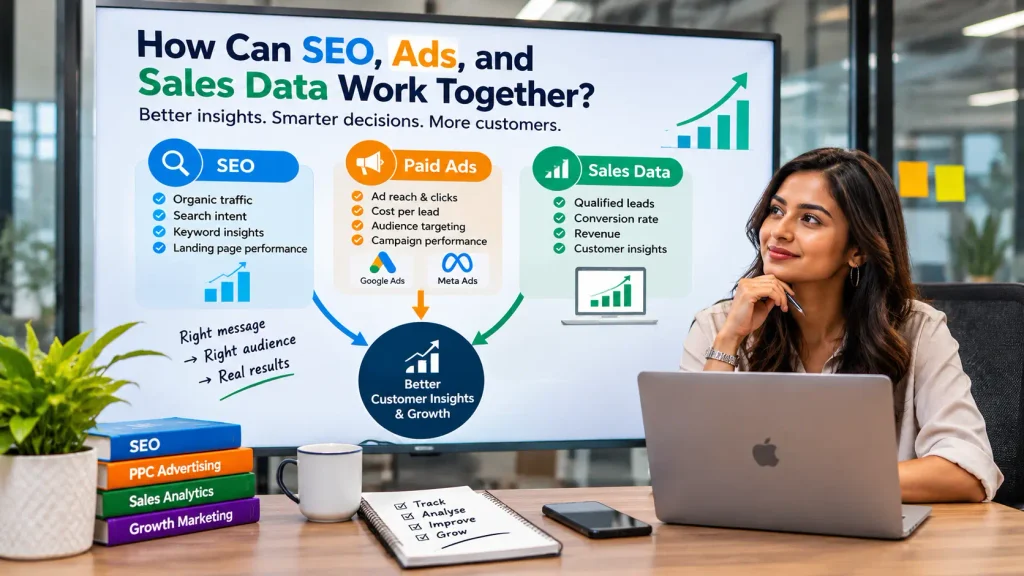
At this point, this is where the linkage of SEO, advertising and sales data is really important.
But when all three of those functions collaborate, businesses understand where their customers originate, what factors come into play, and what marketing efforts generate revenue.
Why SEO, Advertising, and Sales Data Should Not Work Separately
Each channel provides you with its own, unique perspective.
SEO attracts prospective customers who are actively searching for your specific niche, product or service. SEO also gives your business information on keywords, organic traffic, and the pages visited by the consumers.
Paid ads is a method of advertising your ads to your targeted audience on Google Ads and social media advertising. It will provide you with: Data on your campaign’s reach, clicks, cost per lead and conversions.
The sales report supplies information regarding what takes place after the prospect has called your organisation. It reveals the new sales accounts that have actually become clients, the income from them, as well as the sales prospects who have actually gone out of the pipe.
These three resources can be separated but this can be misleading. What a business could be doing is increasing the advert budget as they are getting enquiries without knowing their enquiries are not relevant. Alternatively a website could have ten keywords that bring visitors to the site with very few enquiries.
This information can be used by organizations to make a decision based on customer-first results rather than marketing metrics alone.
How SEO Can Help Identify the Right Customers
Search engine optimization isn’t just about getting ranking or page views. It’s about getting people to a business that is relevant to the business.
Suppose you run an accounting business. Your website could be found by people looking for general information about accounting. But people searching for “small business accounting services” are more likely to be looking for a business to help.
These two visitors, for instance, are likely to behave quite differently, even if they both arrived from an organic search.
Businesses may find the following insight from the Google Search Console and website analytics helpful:
- What are search queries that users type in leading to your site.
- What are the top landing pages that attract organic traffic?
- The pages showing visitors where to reach out to the company.
- Whether users are browsing the service pages or leaving after one article.
- What search topics draw the right crowd enquiries.
- It is even more valuable to then align this information to the sales records.
For instance, the service page may not attract as much traffic as the most popular blog post, but it might attract the best enquiries. The business that only measures traffic will target the most read blog post. When quality of enquiry and sales success are factored in, the service page won’t look so bad.
The number of visitors is not our goal. What we want is to attract the kind of visitors that have more potential to buy.
How Paid Ads Can Support SEO Insights
They are compared in the way that SEO is free but time consuming and paid campaigns are expensive and they do not always have to be at odds.
Paid campaigns provide quicker information on what, how, which pages to send traffic to and target audiences. These details can then be used by SEO in the long term for content and organic targeting.
Suppose you’re advertising your home improvement business with Google Ads, and the search terms for kitchen upgrades are providing more leads than search terms for renovation.
That information can guide its SEO strategy.
The business could make their own kitchen reno page, and some local, helpful content about the cost of renos, and then link that page internally to the related services page.
SEO data to guide your ad strategy. For example, you might discover in Google Search Console that some keywords are generating a steady flow of quality organic traffic.
But organic only gets you so far. Paid campaigns are highly intricate. You need to examine the search intent, the level of competition, cost per click of paid search advertising and the design of your website landing page.
Or another alternative: to have a go at seeing each route as a route which is consistent with ordinary business goals:
- What search queries are visitors coming through?
- What Paid Campaigns Generate Qualified Enquiries?
- What kind of landing pages motivate visitors to act?
- What channels are resulting in sales?
This allows us to be able to present a more holistic picture of how our customers are searching and assessing a company.
Why Sales Data Is the Missing Link
Traffic, impressions, clicks and enquiries are helpful marketing metrics but don’t necessarily measure a business’ growth.
Sales data provides the missing context.
Let’s say that your company gets 100 enquiries in a month. On the surface, this sounds like a very positive marketing outcome. However, on checking your sales file, you find that only 10 enquiries were relevant and that only two actually bought.
A more pressing question for the marketing team to explore is, “Why are so many enquiries not converting into customers?”
Possible reasons include:
It is drawing people beyond the intended audience.
The site was hard to understand.
The landing page raises hopes that are not attainable by the company.
The enquiry form collects incomplete information.
The sales team responds too slowly.
The price or service available does not meet customers expectations.
Without sales information the business could continue to increase the advertising budget to produce more inquiries. With sales information it can look at the actual problem.
Basic to a CRM system is recording where enquiries come from, what they are enquiring about, where they are in the sales process and the result.
It allows sales and marketing teams to work together to achieve the same goals.
Connecting SEO, Ads, and Sales Data in One Process
You do not require complex programs or a huge marketing team to combine these things. Even a clear tracking process can start.
1. Determine the Critical Conversion Steps
Decide on what is a sensible action for the business.
Based on your business model, it could involve:
A completed enquiry form.
A phone call from a potential customer.
A product purchase.
A service consultation booking.
A request for a quotation.
Follow these actions across all appropriate marketing channels.
2. Set Up Website and Campaign Tracking
Google Analytics 4 offers insights into how your visitors interact with your website. Organic traffic insights can be gained through Google Search Console and reports from other advertising platforms provide campaign level reporting.
Set up appropriate events and conversion tracking instead of just page views or clicks.
Campaign tracking tags – like UTM tags – can also be used to identify where visitors to your site are coming from, and through what channel.
For instance, the visitor using the Google Ads campaign should be capable of being identified if a visitor discovers your business using an organic search result.
3. Connect Enquiries With Sales Records
Whenever a visitor makes an enquiry, the business should identify the source of the enquiry.
A customer or lead management system, or even a clean spreadsheet of sales, might be able to log the following info:
Customer name and enquiry date.
Original marketing source.
Service or product requested.
Enquiry status.
Follow-up activity.
Final sales outcome.
This is useful for businesses that want to see not just which marketing channels result in leads but which ones convert leads to customers.
4. Review Performance Together
Validate the information. Marketing and sales teams must check their data periodically.
Rather than holding separate meetings about web traffic and ad clicks, they could be looked at together.
For instance, for the business organic search might send fewer enquiries but a greater proportion of the enquiries will convert into customers. They might then choose to invest more in the content that works.
The team will be able to analyze its targeting, ad message, landing page, and follow-up if a paid campaign produces a lot of leads with few sales.
The key is to change if evidence leads you to do so.
Common Mistakes Businesses Should Avoid
Even companies using multiple marketing solutions may have trouble with unifying their data.
Don’t assume every enquiry you receive is a successful conversion – while a contact form submission indicates an interest in a product or service, it doesn’t necessarily mean the inquiry is qualified or has purchasing intent.
The other issue is last-click attribution. A customer could find a business through an organic search, return to the site through paid advertising and then ultimately make contact with the business after being recommended. If the customer only looks at the last interaction, the earlier ones are missed.
Companies should be cautious of having too much information tracked without knowing why they need it. A report with impressions, clicks, sessions, and engagement ratios isn’t very beneficial without providing information to answer questions about your business.
Lastly, the marketing and sales teams should not have completely separate lists. If these are siloed, then you will have a hard time figuring out which campaigns result in profitable customers.
How a Digital Marketing Professional Can Bring These Activities Together
It isn’t enough to run separate marketing tools to handle your SEO, advertising, analytics, and sales information. There needs to be someone keeping track of how those activities work together.
By working with a Freelancer Digital Marketer in Coimbatore, a business can take advantage of being more focused in their digital marketing activities in Coimbatore, and can do so depending on what the freelancer provides and what the business needs.
A digital marketing specialist will have the ability to spot hot searches, understand which search opportunities to take advantage of, assist in developing an advertising campaign, optimize a landing page, and establish appropriate performance tracking. They will also work closely with the sales team to get feedback on lead quality and campaign results.
This shouldn’t mean one person has to put their hand up to everything sales related in the business. There still needs to be an open channel of communication between the marketing, sales and customer support teams.
The best approach is to compare marketing performance against actual results.
Final Thoughts
SEO, paid advertising, and sales data becomes apparent – businesses need to know how it all fits together. SEO provides us with insights into the behaviour of searchers, paid campaigns give us a way to reach the target audience, and the sales enable us to see if the activity is creating actual results.
It can begin with a complex report system and high-price marketing instruments such as various sales of grand-tickets. The solution is companies are capable of starting with identifying conversions, tracking enquiry sources, keeping thorough sales records and analysing simultaneously.
Marketing actions should be optimized to the customer journey. In this way, without having to pay for costs that don’t produce results, focus your budget on the most effective actions to increase the volume of good leads and grow your business.

Chris Mcdonald has been the lead news writer at complete connection. His passion for helping people in all aspects of online marketing flows through in the expert industry coverage he provides. Chris is also an author of tech blog Area19delegate. He likes spending his time with family, studying martial arts and plucking fat bass guitar strings.