
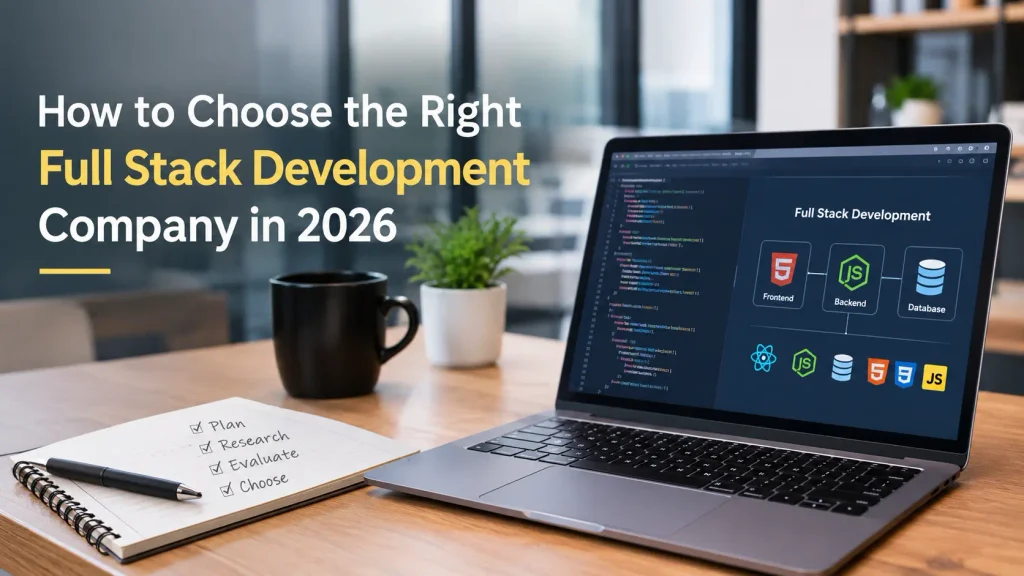
Choosing a full-stack development company may sound tedious, but the process becomes much easier when you look beyond a team’s knowledge of the latest technologies. It’s about finding successful full-stack development partners who understand your vision, anticipate challenges and build a high-quality product that takes your business to the next level.
But with so many companies promising smooth, hassle-free project delivery, how do you know which one is the right fit for your business?
This blog walks you through the key factors to consider, from evaluating technical expertise and security practices to assessing product scalability and 24*7 post-launch technical support.
In 2026, AI-powered technologies and modern tech stacks are reshaping the competitive software market, making it more important than ever to ask the right questions while choosing a full-stack development partner.
Explore the best ways to choose the right full stack development partner and discover how selecting the right full stack development services from day one can help turn your business requirements into a high-performing and scalable application.
Start With Your Project Requirements
Here’s what you need to know before choosing a full stack development company that can turn your business needs into a well-defined project plan with clear goals and measurable outcomes. Clearly outlining your project requirements before getting started will help your full stack development company understand your expectations and recommend the right technologies for your project.
This will also help you plan and manage your project budget, including the cost of hiring full-stack developers, based on the expertise of the development team and your preferred project delivery timelines.
Here are the top 4 things to consider before starting your full-stack development project:
- Know your project goals
Analyze and identify the business problem, bottlenecks and challenges you want to solve and build measurable outcomes for your software application.
- Understand the features & scope
Identify the essential and required stack features, user roles, privacy features, integrations and functionalities that would be needed for the initial product release.
- Calculate the budget & timeline
Discuss the project timeline and establish a realistic budget for your full-stack development project, along with a target launch date.
This will help your full-stack development partner allocate resources effectively and prioritize project deliverables. - Check out the future scalability
Explore how the built full-stack product will scale with trends and future market goals.
Learn if they pave the way for opportunities to grow business, maximize traffic and evolve requirements to ensure the full-stack applications can adapt over time.
Working on these details makes it easier to compare project proposals, assess technical recommendations and choose a full-stack development partner that aligns with your business objectives and future goals.
Evaluate Full-Stack Technical Expertise, Communication, and Collaboration
As a next step, you need to identify and hire the right technical talent who can demonstrate practical full-stack development skills, sound technical experience, effective problem-solving abilities and the right skill set to deliver functional, secure and high-performing applications that include the frontend, backend and end-to-end database layers.
- Frontend and Backend Expertise
Evaluate the candidate’s portfolio and assess their ability to build full-stack web applications with exceptional expertise in frontend and backend technologies.
Assess their technical skills in developing responsive frontend interfaces like:
- Develop and maintain applications using React.
- Implement RESTful APIs using Node.js and Express.
- Manage authentication and authorization securely.
- Maintain and enhance full-stack applications.
- Debug and resolve cross-layer issues across frontend, backend and database components.
- Databases, APIs & Integrations
Examine the capabilities that you expect in an experienced full-stack developer in designing database schemas, performing CRUD operations and integrating APIs with full-stack app components.
- Assess technical proficiency in MongoDB or SQL databases.
- Evaluate RESTful API development skills.
- Review request validation and error handling.
- Check error identification and debugging skills.
- Examine data persistence techniques.
- Verify authentication and security practices.
- Evaluate application workflow optimization.
- Review third-party service integration skills.
Conduct a thorough face-to-face technical interview to evaluate the candidate’s ability to maintain data consistency, implement secure and reliable APIs and ensure seamless communication between frontend and backend components.
- Technology Stack
Evaluate proficiency in the technologies required to build and maintain full-stack applications, including React, JavaScript, Node.js, Express, MongoDB, HTML, CSS and Git.
Assess familiarity with API testing, automated testing, debugging tools, version control, application deployment and basic CI/CD practices.
- Select appropriate full-stack technologies.
- Build high-quality applications.
- Integrate various components seamlessly.
- Develop complete, robust and well-functioning applications using the right technology stack.
- Relevant Technical Experience
Test the candidate’s hands-on experience in developing, debugging, testing and building full-stack applications to create complete, AI-driven smart solutions that keep pace with the latest technological trends.
Review the candidate’s ability to implement features, integrate AI into the system, manage tasks, deliver successful projects, implement secure authentication and develop resource-based CRUD functionality.
- Evaluate the candidate’s technical approach to problem-solving.
- Review the candidate’s ability to write maintainable Angular code.
- Check the candidate’s ability to handle edge cases.
- Examine the integration of frontend and backend components.
- Verify the ability to meet functional requirements within the allotted project deadlines
Check Out the Portfolio and Success Stories
See how many projects the full-stack development agency has completed, such as 300+ software projects and explore its technological expertise, ranging from data migration to AI solutions. Look for experience in building exceptional mobile apps, web apps, augmented reality experiences and more. Explore customer success stories and testimonials to understand how the company helps businesses grow and achieve their goals.
Before hiring full-stack developers, review the company’s portfolio to assess its expertise. Look for a team that includes AI-skilled engineers, cloud and DevOps experts, full-stack development specialists and UI/UX designers who can work together to architect and build AI-powered products from end to end that suit your business needs.
Here are the top things you should consider before choosing full-stack developers:
- Similar projects : See if they have delivered any similar projects that align with your project requirements, feature demands and market trends and check whether they have delivered them in the right way.
- Industry experience: Check their total years of experience and industry expertise in delivering successful projects. This indicates their level of experience, track record of success and how much you can trust their position in the market.
- Project complexity : See how well the company has handled complex projects, what it has delivered, where it has integrated AI into existing systems, how it has implemented cloud-native solutions and how effectively it has leveraged the latest technologies to build robust and scalable full-stack systems.
- Results & client outcomes: Explore the company’s ability to meet project launch deadlines, provide post-launch maintenance and deliver ongoing support. Evaluate how satisfied clients are with the results and the quality of post-deployment support. A great software development company ensures that its clients receive reliable support not only during the project but also long after its completion.
Communication and collaboration
Assess the communication style and collaborative approach of the full-stack software development company and the team you hire.
Evaluate how well they collaborate, whether there are any language barriers or cultural differences that could hinder communication and how effectively they work together, whether they are an offshore team or an extension of your in-house team.
- Cross-Functional Collaboration: Evaluate their cross-functional capabilities in explaining technical concepts clearly to clients who may lack technical knowledge, while collaborating effectively with different teams, organizational hierarchies and departments.
- Project clarification: See if the hiring team can communicate requirements clearly and build a consistent and future-proof roadmap to make sure you collaborate with your team without relying on the assumptions of the individual teams.
- AI-driven Discussion: Assess whether they can adapt to and work flexibly with AI-generated code, justify their technical decisions and document their efforts to fix errors and minimize downtime
- Team Reviews and Code Collaboration: Assess their collaboration style using Git, their document proposal style and review processes and also their responsiveness to team feedback and ability to conduct reviews continuously and effectively.
Review the Team’s AI, Cloud & Full-Stack Development Skills
Before hiring full-stack development experts, make sure they meet specific industry standards and possess the essential skills required to succeed as a full-stack developer. They should have a solid understanding of both front-end and back-end technologies to handle diverse projects effectively.
If you are in the process of deciding which skills and technologies your developers must be well-versed in, consider the top MEAN stack, which stands for MongoDB, Express.js, Angular, and Node.js. These four technologies form a popular technology stack that enables developers to build full-stack web applications. Another popular technology stack is the LAMP stack, which consists of Linux, Apache, MySQL and PHP/Perl/Python.
A full-stack developer should be proficient in two main areas of development: front-end and back-end technologies. Before you start looking for the right talent for your team, consider the following criteria to make an informed hiring decision.
- Developer experience: Check the expertise and experience levels of the developers you hire for your full-stack project. Find out the project costs and development timelines that may vary depending on the skill levels and experience, so choose your development team wisely.
- Team structure: Build your full-stack development team progressively by finding the right talent, having meaningful discussions and managing the team through regular interviews, meetings and discussions from the very beginning.
- Dedicated development options: Analyze the various hiring engagement models and their approaches to development, design and project management. Ensure they align with your company’s goals and project requirements to help you choose the right team and deliver your project on time.
- Project management: Examine their project management skills by evaluating their task management, team management and hiring processes for full-stack developers. Also, assess how efficiently they create project roadmaps and manage workflows to ensure timely project delivery.
Compare Pricing and Engagement Models
Conduct research on leading companies that offer dedicated full-stack development teams and compare their pricing, engagement models and track records of successful project delivery in a period of time.
- Fixed-price model – Check whether they offer a fixed full-Stack development company. pricing model with no fluctuating rates, hidden fees or unexpected additional costs. Clarify all pricing terms during the initial contract discussions without keeping it until the deployment.
- Time and material – Evaluate their proposed project timeline and delivery deadlines, ensuring that the technical stack, modernization techniques, cloud-native solutions and AI-centric approach are well aligned with the project requirements.
- Dedicated development team – Assess whether a dedicated full-stack development team can manage the software development process seamlessly and scale with growing project demands without relying on external resources.
- Why the lowest price isn’t always the best choice – When hiring developers or choosing a full-stack development company, never decide based on budget or pricing only. Choosing a cheaper company may mean compromising on quality. Instead, carefully evaluate all the factors discussed above and select the full-stack development agency that best aligns with your project requirements.
Check Security, Quality, Support & Reviews
Before choosing a full-stack development company, ensure that its security measures, quality assurance processes, customer support and code review practices meet industry standards and comply with relevant IT infrastructure and security regulations.
- Security practices – Understand their security measures, integrated multi-tenant security alerts, authentication mechanisms, admin controls, restricted access, data protection protocols, and safeguards against cyberattacks, piracy and other related threats. Check whether they can assure you of robust security measures and reliable data protection.
- Testing and quality assurance – Make sure their quality testing and security measures comply with industry standards and protocols, and that feature releases do not cause constant interruptions. This ensures that the app can scale effectively and that features are released at appropriate intervals without delays or excessive bugs.
- Post-launch maintenance – Even after deployment, performance monitoring and continuous support are essential, as the post-launch phase reveals how well the product performs, the results it delivers, and whether it meets the required performance standards.
- Client reviews – This is crucial, as you need to ensure that they have positive client reviews, high customer satisfaction rates and numerous success stories. Before assigning them a project, make sure you can trust their experience, proven expertise and technical capabilities to deliver an enterprise-grade full-stack development process.
Full-Stack Development Company Checklist
Now that we have covered various aspects of building the right full-stack product and choosing the best full-stack development company, here is a checklist to help you finalize your decision and determine the next steps.
Here is a brief overview of how to choose the right full-stack web development company and the key factors to consider before making your final decision.
- Expertise: Assess and evaluate the team’s front-end and back-end expertise in technologies such as React, HTML, Express.js, JavaScript, Node.js, MongoDB and Git. Check out the technical skills and the total experience that align with your project requirements to deliver scalable and high-quality projects.
- Experience: Check the total number of years of experience in delivering successful projects to clients. A full-stack development company with 10+ years of experience, a sound understanding of current market trends and a proven track record of delivering seamless and innovative solutions.
- Team: Choosing a well-equipped full-stack development team is a crucial process that requires the right budget, careful planning, focused attention and a thorough review process, as the success of the project depends on the team’s skills and expertise.
- Process: Choose the right full-stack development engagement model, project management approach and task management process to ensure every effort stays on track and contributes to the success of the project.
- Communication: Look for a development team that prioritizes seamless communication, streamlined workflows, regular sprint discussions and consistent project meetings to keep your project on track and ensure successful, on-time delivery.
- Pricing: The total cost of Full-stack development ranges between $20–$50+ per hour for hourly hiring. For monthly hiring, it might cost around $2,000–$8,000+. $5,000–$15,000 for basic web apps $15,000–$50,000 for medium-complexity apps and $50,000–$150,000+ for complex or AI-powered applications.
- Security: Look for strong security and compliance measures, including multi-layered security protocols, company policies, governance frameworks, authorization controls and administrator roles. These security measures help streamline security management, protect sensitive data and make sure your data confidentiality and access control are intact.
- Support: Check whether the company provides long-term support not only during project launch but also after the deployment. Look for continuous performance monitoring, regular app maintenance and 24/7 customer support or AI-powered assistance to ensure your application runs smoothly.
This blog covers how to choose a full-stack development company and the essential factors to consider before finding the one that best suits your needs.
Starting from the top questions to ask a full-stack development company to the key factors to evaluate, this blog provides valuable insights to help you make an informed decision and ensure that your software application development journey is worthwhile.

Dinesh Kumar M is a Content Writer and SEO professional at Contus Tech, a product development and full stack development company. He enjoys writing about software development, full stack technologies, and the latest trends in the tech industry. His focus is on making technical topics easier to understand and turning complex ideas into useful, reader-friendly content. Along with content writing, he works on SEO and digital marketing to help content reach the right audience. Outside of work, he likes exploring new technology and keeping up with what’s happening in the digital world.
LinkedIn ID: https://www.linkedin.com/in/dinesh-seoanalyst/