
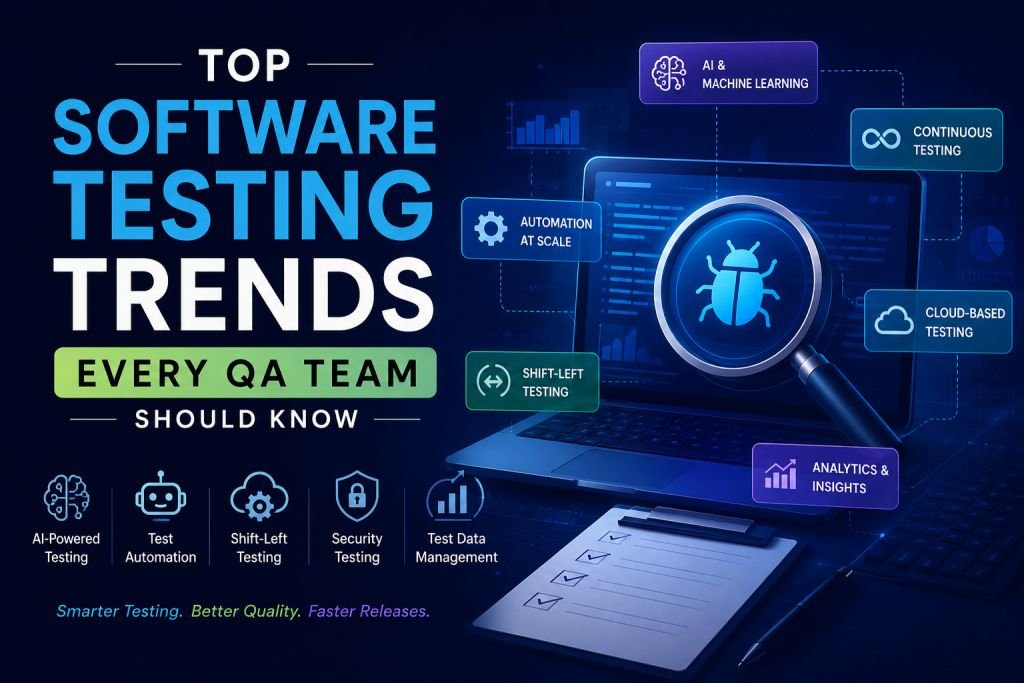
Software development is moving at a velocity that traditional, siloed testing methods can no longer sustain. Rapid-fire release cycles, microservices-driven architectures, and unforgiving user expectations have fundamentally transformed quality assurance from an isolated phase into an integrated engineering discipline.
As a result, software testing trends 2026 are focused squarely on advanced automation, continuous resilience, and proactive engineering frameworks. Modern QA teams are shifting away from manual intervention and brittle script maintenance, moving instead toward autonomous systems that assist corporations in providing highly reliable software without compromising the speed of innovation.
Emerging Software Testing Trends 2026 for Modern QA Teams
Let’s explore the defining trends in software testing that are restructuring how QA teams operate, manage risk, and optimize software to meet rigorous enterprise requirements.
1. AI and Machine Learning – The Game-Changer in Testing
Artificial intelligence has rapidly transitioned from an experimental concept to an operational necessity. According to global industry benchmarks, enterprises embedding AI into their QA approaches are reporting quicker test execution, enhanced defect detection before code reaches production, and more effective testing processes. This developing adoption is reflected in the broader market, with the global software testing market projected to grow from USD 55.8 billion in 2024 to USD 112.5 billion by 2034, at a CAGR of 7.2%, highlighting the increasing demand for AI-powered quality assurance and modern software testing practices.
How AI Testing Transforms the QA Process
Early attempts at AI-driven testing generated rigid, unoptimized test cases that failed to reflect authentic user journeys. Today’s machine learning models analyze application behavior, historical test execution repositories, and real production user patterns to synthesize contextual test scenarios.
By leveraging historical testing data, these systems evaluate thousands of permutations concurrently, mapping out deep edge cases that manual test design often overlooks. AI-powered test generation delivers clear efficiencies across multiple layers-
- Contextual Test Synthesis- Automatically creates comprehensive functional test cases directly from raw requirements, JIRA tickets, and user stories.
- Intelligent Data Generation- Synthetically produces data pools that reflect real-world complexities while ensuring structural compliance.
- Production-Driven Modeling- Maps test scenarios directly against telemetry data from actual production usage patterns.
- Automated Gap Analysis- Regularly scans application changes to pinpoint areas lacking sufficient test coverage.
- Risk-Based Prioritization- Analyzes code commits to recommend and execute only the test suites mapped to high-risk modules.
Self-Healing Test Scripts
Maintaining automated test suites has historically demanded significant engineering overhead. Minor alterations to front-end UI components – such as a shifted element ID, a modified class name, or an updated CSS selector – frequently trigger cascading test failures across test suites.
AI-powered software testing platforms resolve this maintenance bottleneck via self-healing capabilities. When an automated script encounters an altered UI element during execution, machine learning models evaluate the application’s updated DOM structure, dynamically locate the correct alternative selectors, and update the element references in real time.
Predictive Analytics for Defects
With the fusion of AI and deep static code analysis, the quality engineering team will be able to anticipate where defects may occur before any testing begins. These predictive engines evaluate historical code commit frequencies, past defect densities across specific modules, developer churn, and recent production telemetry.
Instead of treating all code uniformly, QA leads can focus engineering resources directly on high-probability risk areas, saving time otherwise spent running redundant regression tests across stable, unchanged components.
Predictive analytics pipelines supply clear operational insights-
- Risk Scoring- Assigns real-time risk scores to incoming pull requests based on historical code stability.
- Module-Level Probability- Identifies specific components showing a high propensity for regressions.
- Optimized Execution Paths- Tailor test suites to execute the precise subset of tests required to validate specific code changes.
- Resource Optimization- Recommends optimal resource allocation based on incoming code complexity.
2. Shift-Left and Shift-Right Testing – Continuous Quality
The quality assurance lifecycle is no longer bounded by conventional development phases. While the shift-left movement focuses on integrating quality checks earlier in the cycle, shift-right testing extends validation directly into production environments. When balanced properly, these parallel strategies build a comprehensive validation loop.
Shift-left testing ensures that quality verification occurs alongside initial design and architectural phases. Identifying an architectural anomaly or logic flaw during requirements analysis avoids code rework later when defects are significantly more expensive to resolve.
Core shift-left practices include-
- Early Test Synthesis- Drafting explicit test cases during requirements gathering and user story grooming.
- Isolated API Verification- Commencing thorough API testing before front-end user interfaces are developed.
- Automated Security Guardrails- Embedding static vulnerability checks directly into daily code reviews.
- Accessibility-First Design- Evaluating wireframes and component libraries against accessibility criteria before development.
Real-World Case- A prominent logistics enterprise migrating from a monolithic architecture to an AWS-hosted microservices model adopted Pact to enforce consumer-driven contract testing as part of its shift-left strategy. By validating service contracts before microservices were deployed, the engineering team identified over 40 API contract mismatches during the early design phase. This proactive validation saved an estimated $15,000 per defect compared to identifying integration failures later in staging environments.
Concurrently, the team implemented a shift-right strategy using LaunchDarkly for advanced feature flagging. This allowed them to deploy completed code directly to production in a dormant state, running controlled canary deployments to evaluate performance on 1% of live users before initiating a full-scale public release.
3. Continuous Testing in CI/CD – Pipeline-Integrated Gates
Continuous testing has evolved from an optional optimization target into core infrastructure for modern development. Testing is no longer a distinct gate executed between code completion and deployment – it is an ongoing process that triggers automatically across CI/CD execution pathways to provide immediate feedback loops.
Automated Pipeline Integration
To sustain high release frequencies, every code push must initiate a series of parallelized, automated quality gates designed to inspect code fitness across multiple tiers.
Executing these testing stages sequentially inside a modern delivery framework can introduce significant delays. High-performing engineering organizations leverage cloud-based container parallelization to run test matrices simultaneously, ensuring comprehensive test suites return results within minutes.
4. Test Automation Expansion – Beyond Web UI Testing
Automated testing has traditionally focused heavily on front-end browser interactions, but today’s application architectures require deep validation below the interface level. With the rise of microservices, cloud native architectures and complex data broker ecosystems, API and headless testing have emerged as key pillars of modern test strategies.
Relying purely on UI-driven automation introduces fragility, as front-end layouts shift frequently. In contrast, testing application logic at the API layer allows teams to validate core business processes independently of the presentational layer.
API automation provides distinct structural advantages-
- Execution Velocity- API requests are processed in milliseconds, significantly outpacing heavy, browser-driven UI engines.
- Direct Logic Isolation- Verifies backend business logic, validation constraints, and error handling are free from UI interference.
- Early Validation Capabilities- Empower QA teams to validate core service behaviors long before user interfaces are designed.
- Framework Stability- Avoids the common brittle failures associated with changing front-end layouts, IDs, and styling adjustments.
- Data-Driven Scalability- Facilitates the rapid execution of vast datasets across various payloads and boundary conditions.
- Microservices Strategy- Ensures disparate components retain reliable communication contracts across distributed environments.
5. Security Testing Integration – DevSecOps Realized
Security validation can no longer be treated as an isolated exercise performed right before a major release. Given evolving regulatory requirements and the complex nature of modern application security threats, security testing must be embedded continuously across the entire SDLC (software development lifecycle.
Shift-Left Security
One of the most significant software testing trends 2026 is the use of gates for Automated Security Testing (AST), enabling the examination of code in its early stages of development and allowing teams to detect vulnerabilities before they become costly security concerns. Static code analysis tools check raw repositories for insecure patterns and types of vulnerabilities.
Real-World Implementation- Leading enterprise software teams integrate tools like Snyk or GitHub Advanced Security directly into their build orchestration pipelines. For a healthcare application handling protected health information (PHI), embedding automated OWASP Top 10 checks into the daily build pipeline ensured that risks such as SQL Injection or Broken Object Level Exploitation (BOLA) were flagged during the pull request phase. Catching vulnerabilities early ensures continuous compliance with regulatory standards like HIPAA and SOC 2 without creating manual testing backlogs.
Compliance Automation
As compliance demands evolve globally, manually validating internal system controls against technical regulations is increasingly impractical. Automated compliance frameworks verify configuration rules continuously, generating clear audit trails as a byproduct of regular execution.
Automated compliance suites inspect several core vectors-
- Data Transit Security- Verifies that strong TLS configurations and encryption protocols are consistently applied across all endpoints.
- Access Control Integrity- Tests authentication mechanisms, token expiration rules, and granular role-based access controls.
- Audit Trail Completeness- Confirms that critical system actions systematically generate immutable, structured log records.
- Data Lifecycle Enforcement- Validates automated data retention policies, isolation rules, and secure deletion routines.
6. Advanced Test Data Management with AI
Providing clean, representative, and safe test data across complex testing environments remains an operational challenge. Real production data often contains personally identifiable information (PII) that cannot be legally transferred to staging environments due to strict privacy regulations like GDPR and CCPA.
Synthetic Data Generation
Advanced test data management systems utilize generative AI models to analyze the mathematical distribution and structural constraints of production data to create synthetic datasets. These AI-synthesized datasets look, act, and scale like real user data, retaining full relational integrity without exposing actual consumer information.
This model provides clear engineering advantages-
- Regulatory Compliance- Obviates complex data masking overhead by generating production-compliant, non-real data from scratch.
- Vast Structural Scale- Generates high-volume data pools on demand to support extensive load and stress testing initiatives.
- Domain-Specific Logic- Adapts output data to match real industrial paradigms across finance, healthcare, and retail sectors.
- Boundary Condition Expansion- Automatically introduces rare scenarios, structural anomalies, and edge cases to test validation limits.
- Relational Integrity Preservation- Maintains complex, multi-table database relationships across large, distributed data models.
7. Cloud-Based Testing Platforms – On-Demand Scalability
Cloud-based testing infrastructure has matured into a core foundational architecture for modern development groups. Cloud execution environments eliminate the need to maintain local hardware configurations, providing immediate access to elastic computing resources.
Elastic Testing Infrastructure
Cloud-based infrastructures allow teams to scale compute capacity dynamically to match varying release cadences. QA teams can provision thousands of concurrent execution nodes to run vast automated regression matrix tests or execute deep load simulations, then decommission those resources immediately upon completion to control infrastructure costs.
Organizations benefit across several key operational areas-
- Dynamic Capacity Scaling- Matches real-time compute resources to fluctuating testing demands automatically.
- Global Access Matrix- Provides geo-distributed development environments with uniform access to shared test execution spaces.
- Zero Infrastructure Overhead- Removes local device maintenance, environment drift management, and physical hardware upgrades.
- Continuous System Updates- Ensures underlying browser types and operating system platforms stay systematically updated.
Cross-Browser and Device Testing
Modern applications must run reliably across a fragmented ecosystem of devices, viewports, operating systems, and browser engines. Cloud-hosted testing networks allow teams to run automated tests across extensive hardware configurations on demand.
Instead of managing physical local device labs that are difficult to scale and maintain, testing teams use cloud-based platforms like BrowserStack or Sauce Labs to connect directly to thousands of real desktop browsers and physical mobile devices. This ensures comprehensive validation across core user environments-
- Desktop Environments- Automated execution across varying versions of Chrome, Firefox, Safari, and Edge.
- Physical Mobile Hardware- Real iOS and Android devices, avoiding the hidden variances often missed by basic software emulators.
- OS Combinations- Validating application stability across diverse distributions of Windows, macOS, and Linux.
- Responsive Visual Matrices- Testing application rendering across varied layout breakpoints, screen resolutions, and orientations.
8. Accessibility Testing- Inclusive Quality Engineering
Accessibility validation has shifted from a late-stage compliance check to a core product quality metric. Ensuring software is accessible is driven by an industry commitment to inclusive design, clear ethical considerations, and evolving global accessibility regulations.
Automated accessibility frameworks monitor several core parameters-
- Contrast Accuracy- Evaluates text-to-background color contrast ratios across various rendering states.
- DOM Attribute Integrity- Verifies the presence and structural validity of critical ARIA tags and image alt attributes.
- Keyboard Navigation Paths- Validates focus on indicators and page interaction paths for users navigating without a mouse.
- Semantic Code Structure- Confirms that application layout trees leverage valid, hierarchical HTML markup.
Integrating accessibility checks into automated CI/CD pipelines allows engineering teams to identify accessibility defects early in the development cycle. Modern teams use open-source analysis cores like Axe-core directly inside end-to-end automation frameworks to catch common layout errors before code changes are merged into production branches.
9. Performance Testing Evolution – Shift-Left Performance
Performance evaluation has changed from a legacy load test executed right before production deployment into a continuous validation metric tracked across daily builds. Modern teams use tools like k6 or Gatling to establish explicit “performance budgets” directly inside continuous integration pipelines.
This continuous approach uses targeted performance simulations to monitor application efficiency throughout the development process-
- Load Testing- Evaluates application behavior and response times under typical operational workloads.
- Stress Testing- Pushes the application to its operational limits to assess failure modes and system recovery paths.
- Spike Testing- Simulates sudden, dramatic traffic increases to verify that autoscaling configurations respond effectively.
- Endurance Validation- Runs prolonged traffic simulations to surface hidden memory leaks and resource degradation.
- Scalability Profiling- Measures the cost-efficiency and scaling performance of cloud infrastructure under load.
10. Exploratory Testing – The Critical Human Element
Even as AI-driven automation scales, structured exploratory testing remains an indispensable component of an enterprise quality strategy. Automated tools execute pre-defined logical assertions, but they lack the human intuition, contextual understanding, and creative problem-solving required to uncover nuanced usability defects.
Modern exploratory testing is a disciplined, targeted methodology that uses structured sessions to explore unscripted application states-
- Charter Specification- Defines clear testing boundaries and goals for the exploratory session to ensure focused coverage.
- Time-Boxed Sessions- Restrict testing intervals to focused, 60-to-90-minute blocks to maintain high analytical intensity.
- Observation Logging- Captures rich system telemetry, user paths, and unexpected environment interactions during execution.
- Defect Correlation- Flags complex behavioral anomalies and usability concerns that automated scripts are not designed to catch.
- Retrospective Assessment- Reviews exploratory findings to expand future automated regression test coverage.
Final Thoughts
The evolving software testing trends 2026 presents both significant opportunities and clear technical challenges for modern QA teams. Successfully adopting trends like AI-driven test maintenance, integrated security gates, and continuous performance budgets requires more than simply deploying new testing tools. It demands a cultural shift toward shared quality ownership across the entire delivery pipeline. By adopting these modern validation practices, engineering organizations can establish robust quality frameworks that support continuous innovation at scale.

Liza Kosh is a strategic content writer at Seasia Infotech, a trusted AI and ML development company, with expertise in producing high-quality content on software development, AI, machine learning, web development, and innovative technologies that help businesses accelerate digital transformation.