
AI agents create a strange budgeting problem. The visible cost of intelligence can fall while the total cost of an automated workflow rises.
A company sees lower model prices, faster responses, and increasingly capable agents. A team can automate more steps for less money per interaction. That makes scaling look financially obvious. Yet the organization may also be adding more API calls, more connected systems, more background tasks, more human review, more exception handling, and more recovery work. The cost of each individual action can decline while the cost of operating the system grows.
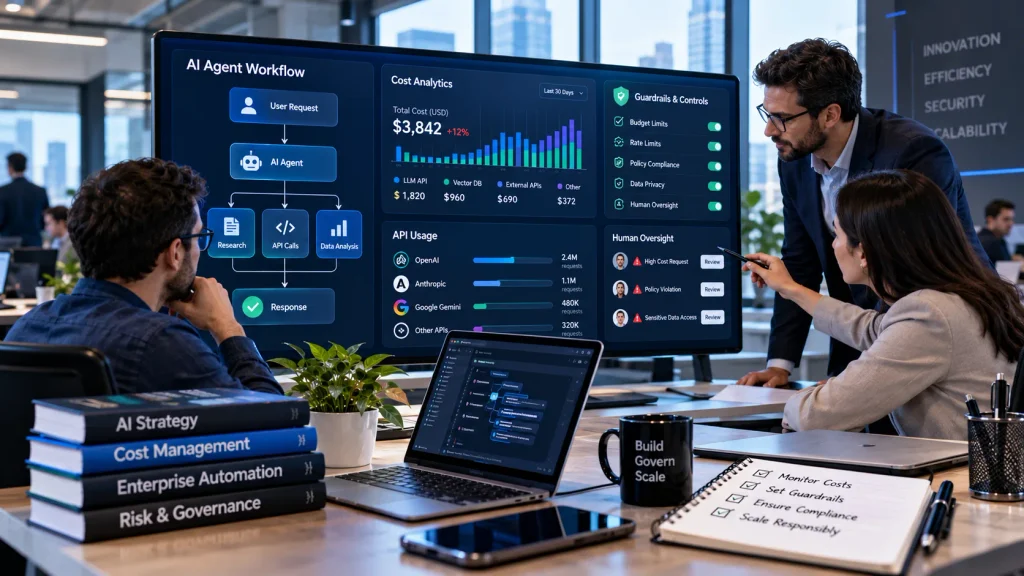
That tension became harder to ignore on August 26, when Google Cloud announced new billing and cost-management controls for AI agents. The company introduced options including pay-as-you-go agent workloads, pooled quotas, savings plans, project-level spending caps, anomaly detection, and tools for estimating agent runtime costs. The announcement treats agent spending as something organizations need to govern deliberately rather than something that can be inferred from a model price sheet.
That is the right direction. Enterprises should go one step further by creating cost guardrails before they scale an agentic workflow.
A cost guardrail is more than a budget ceiling. It is a rule connecting the money and human effort consumed by an AI workflow to the business result that workflow is supposed to produce. It tells leaders when an agent has earned the right to expand and when apparent automation is hiding an operating burden.
Why Token Cost Is the Wrong Unit of Management
AI economics are often discussed through token prices, license fees, or compute costs. Those numbers matter, but they answer a narrow question: what does the technology consume?
Executives need a broader answer: what does the business consume to produce a useful outcome?
Consider an agent that qualifies inbound sales leads. The direct technology cost might include model usage, a CRM connector, an enrichment service, and an automation platform. But the real operating cost can also include a salesperson checking ambiguous leads, a manager correcting qualification rules, an administrator repairing failed integrations, and the original builder explaining why certain exceptions must be handled manually.
If the agent processes 10,000 leads cheaply but creates a large volume of low-quality opportunities, the low technical cost is irrelevant. If it saves junior staff time but consumes senior staff time through exceptions, the economics change. If only one employee knows how the workflow is configured, the organization has acquired a hidden dependency that will eventually appear as maintenance or recovery cost.
The correct unit of management is therefore the business outcome after the full operating burden is counted.
That principle fits the broader direction of responsible AI. Complete Connection recently highlighted the growing importance of privacy, risk management, and transparency in B2B AI products. Cost discipline belongs in the same operating conversation. A system can be technically capable, secure, and well-governed while still being economically fragile because nobody has measured what it takes to keep it working.
A 30-day cost-guardrail test can expose that fragility before an organization expands agent authority.
Start With One Business Outcome
The first guardrail is simple: every agentic workflow needs one primary business outcome.
That outcome should exist outside the AI system. Good examples include reducing time to resolve a customer problem, increasing qualified sales opportunities, lowering invoice-processing cost, improving order accuracy, accelerating proposal turnaround, reducing employee time spent on a recurring analysis, or decreasing the number of errors in a controlled process.
Avoid defining success as “more agent usage,” “more automated tasks,” or “more AI interactions.” Those are activity measures. They can grow while the business result stays flat or deteriorates.
Establish a Baseline Before Automation
Establish a baseline before the workflow changes. If the objective is faster customer resolution, record the current resolution time and repeat-contact rate. If the objective is lower processing cost, calculate the current labor and system cost per completed item. If the objective is sales growth, track the existing conversion path from lead to qualified opportunity or revenue.
Five AI Agent Cost Guardrails Enterprises Should Track
This creates a denominator for the cost calculation. Without it, teams can demonstrate technological efficiency without proving business value.
Guardrail 1: Direct Technology Cost
The first cost category is the easiest to see.
Record model usage, agent-platform charges, licenses, API fees, search or enrichment costs, storage, orchestration services, and any other direct technology charges required for the workflow. If costs vary by volume, calculate them per meaningful unit of work as well as in total.
For example, an agent that prepares supplier-risk reports should calculate technology cost per completed report, not simply monthly AI spend. An agent that handles customer inquiries should calculate cost per resolved issue rather than cost per conversation.
Google Cloud’s new August 26 controls are useful because they make this type of spending more governable. The company now describes project-level caps, anomaly alerts, estimated agent runtime costs, and consolidated reporting designed to help organizations see and control agent spending. These tools can protect budgets, but the business still needs to decide whether the spending produces enough value.
That is where the next categories matter.
Guardrail 2: Human Verification Cost
AI systems frequently shift work rather than eliminate it.
A person who previously created an analysis may now review an AI-generated analysis. A service representative who once handled a customer request from beginning to end may now monitor exceptions. A manager may spend less time approving routine cases but more time investigating unusual ones.
Measure this work in minutes and convert it into cost using a reasonable labor rate. Track only meaningful verification and correction work tied to the workflow, not every casual glance at an AI output.
This is especially important when senior employees perform the checking. Ten hours removed from routine junior work can look impressive until the organization discovers that the agent requires four hours of specialist judgment to catch subtle problems.
The workflow may still be worthwhile. The goal is to make the trade visible.
Guardrail 3: Exception Cost
Routine cases make automation look good. Exceptions reveal whether it can operate economically.
Create an exception log for the 30-day test. Record situations in which the agent encounters missing information, conflicting instructions, uncertain classification, an unavailable system, an unusual customer request, a policy conflict, or a decision that requires judgment.
For each exception, record three things: the reason, the human role needed to resolve it, and the time required to return the workflow to normal operation.
Then group repeated exceptions.
If the same problem appears again and again, it may indicate missing data, unclear rules, weak integration, or an agent that has been given too broad a scope. These are design problems that should be fixed before scale amplifies them.
Exception cost is one of the easiest ways for an apparently efficient pilot to become expensive in production. A workflow that handles 90 percent of cases automatically can still be costly if the remaining 10 percent consumes disproportionate expert attention.
Guardrail 4: Recovery Cost
Every consequential agent needs a known failure path.
During the 30-day test, deliberately introduce one bounded failure. Temporarily remove access to a noncritical data source. Interrupt an integration. Provide an incomplete input. Create a controlled situation in which the agent should stop or escalate.
Measure time to detection, time to a safe state, time to diagnosis, and time to restore the underlying business process.
The distinction between technical recovery and business recovery matters. A connector may be restored in five minutes while customers remain affected for an hour. An API may resume responding while incorrect records still need to be fixed. The real recovery cost ends when the business is back in an acceptable state.
This test also exposes whether the organization knows who owns the problem. If employees spend 30 minutes simply determining who should intervene, that coordination cost belongs in the workflow economics.
Guardrail 5: Builder-Dependence Cost
Many AI pilots are successful because one motivated employee quietly holds the system together.
That person knows the best prompt, the reliable data source, the workaround for a weak integration, the meaning of an internal exception code, and the colleague to contact when something fails. Their knowledge functions like an invisible software component.
Track the time this original builder spends supporting the workflow during the test. Include questions, troubleshooting, rule explanations, prompt adjustments, permission changes, and exception rescue.
Then perform a second-operator handoff.
Give another qualified employee the normal documentation, approved access, source materials, and operating rules. Do not allow a private briefing from the original builder. Ask the second operator to run routine cases, handle a realistic exception, and recover from a controlled failure.
Record clarification requests, errors, recovery time, and any undocumented knowledge that the second operator had to reconstruct.
A workflow that cannot survive this handoff has not yet become an organizational capability. It still depends on a person. That dependency should be treated as a cost before the agent receives more authority.
Set a Cost Ceiling Before the Test Begins
Once the five categories are visible, leaders can define a cost ceiling.
The ceiling should be tied to the business result rather than to technology spending alone. For example, a sales workflow might be allowed to consume no more than a defined total cost per qualified opportunity. A service workflow might have a maximum cost per resolved issue. An operations workflow might have a maximum human-intervention rate and recovery burden per hundred completed cases.
The exact threshold will differ by organization and use case. What matters is that the decision rule exists before leaders become attached to the pilot.
Without a precommitted rule, teams can rationalize almost any result. If costs rise, they argue the system is still learning. If exceptions multiply, they call them temporary. If senior employees keep rescuing the workflow, they describe the effort as necessary oversight.
Some of those explanations may be true. A cost guardrail requires evidence before the organization treats them as true.
Watch the Marginal Cost of Autonomy
Agentic systems create another economic issue that ordinary software licenses often hide: the cost can change as authority increases.
An assistant that summarizes a document may make one or a few model calls. An agent that researches the issue, queries several systems, compares alternatives, asks another agent for specialist input, updates a record, drafts a communication, and checks its own work can generate a much larger chain of activity.
The business therefore needs to watch marginal cost as autonomy expands.
During the 30 days, group agent actions by authority level. A simple model might use four levels:
Level 1: Prepare Information for a Human
Level 2: Recommend a Decision
Level 3: Execute After Human Approval
Level 4: Execute Within Predefined Rules and Report Afterward
Compare direct technology cost, human review time, exception frequency, and recovery burden at each level.
Higher autonomy should earn its way upward. If Level 3 creates substantially more operating burden without improving the business result, the organization should not assume Level 4 will fix the problem.
The goal is not to minimize agent usage. It is to find the level of autonomy that produces the best net business value.
Connect Cost Controls to Authority Controls
Financial and operational governance should reinforce each other.
A spending cap is useful because it limits financial exposure. An authority cap limits operational exposure. Enterprises should use both.
For each agent, document what it can read, what it can change, when human approval is required, who owns exceptions, and how it is stopped. Then connect those permissions to the cost guardrails.
If the workflow exceeds its human-intervention threshold, pause authority expansion. If recovery repeatedly requires the original builder, fix documentation and ownership before adding users. If spending rises faster than the business result, narrow the use case or reduce unnecessary agent steps.
This creates a feedback loop between economics and governance.
It also supports responsible AI adoption. A system with explicit authority, clear ownership, measurable value, and known recovery conditions is easier for employees to understand and trust. Leaders can explain what the agent is supposed to do, how much operating burden is acceptable, and what will cause the organization to reconsider its use.
Do Not Confuse Cheaper Intelligence With Cheaper Work
The most important economic lesson of agentic AI is simple: cheaper intelligence does not automatically create cheaper workflows.
Model prices can fall while usage expands. Faster agents can generate more work for downstream systems. More automation can create more exceptions. Better capabilities can tempt teams to give agents broader authority before the operating process is ready.
That is why organizations need to manage the full workflow rather than the model in isolation.
At the end of 30 days, calculate the total operating cost:
Direct technology cost
plus human verification and correction cost
plus exception-handling cost
plus recovery cost
plus builder-dependence cost.
Then compare that total with the business outcome established at the beginning.
The calculation does not need false precision. Even approximate labor estimates will usually reveal more than a dashboard that reports only model usage and license fees.
Make One of Four Decisions
Before the test starts, define four possible outcomes: scale, redesign, narrow, or stop.
Scale
Scale when the business result improves, total operating cost stays within the guardrail, exception and recovery burdens are acceptable, and a second qualified operator can run the workflow.
Redesign
Redesign when the use case creates value but repeated exceptions, hidden labor, or recovery problems keep the total cost above the threshold.
Narrow
Narrow when the agent works economically for a specific subset of cases but becomes expensive or fragile when its authority expands.
Stop
Stop when the business result does not justify the full operating burden.
This framework prevents a common organizational mistake: treating the existence of a technically successful pilot as proof that the pilot should become infrastructure.
Google Cloud’s new cost controls make clear that the agentic era will require more sophisticated financial management. Organizations can set spending caps, detect anomalies, estimate runtime costs, and choose billing models that fit different usage patterns. Those capabilities are valuable. They work best when leaders pair them with an internal operating model that includes human and recovery costs.
AI agents can create major economic value because they can perform increasingly complex work across systems. The same capability makes cost harder to see. A workflow may consume money through tokens, APIs, licenses, employee judgment, exceptions, maintenance, and recovery at the same time.
Enterprises should make those costs visible before they scale.
A 30-day cost-guardrail test provides a practical starting point. Define the business result. Count direct technology cost. Count human verification. Track exceptions. Test recovery. Measure builder dependence. Hand the workflow to a second operator. Then compare the full operating burden with the outcome the agent was supposed to improve.
If the numbers work, scale with confidence. If they do not, change the workflow before greater autonomy makes the problem more expensive.
The cheapest agent is not the one with the lowest token price. It is the one that produces a worthwhile business result without creating a larger hidden operating system around it.
Gleb Tsipursky, PhD, a behavioral scientist, CEO of Disaster Avoidance Experts, and author of The Psychology of AI Adoption at Work: From Resistance to Results (Georgetown University Press, 2026). https://disasteravoidanceexperts.com/aibook

Chris Mcdonald has been the lead news writer at complete connection. His passion for helping people in all aspects of online marketing flows through in the expert industry coverage he provides. Chris is also an author of tech blog Area19delegate. He likes spending his time with family, studying martial arts and plucking fat bass guitar strings.