

Agriculture has always been the backbone of human civilization. For centuries, farmers have relied on experience, weather patterns, and traditional practices to grow crops and raise livestock. While these methods still hold value, farming today faces challenges that previous generations never had to deal with. Unpredictable weather, rising production costs, labor shortages, water scarcity, and increasing food demand have made agriculture more complex than ever.
Fortunately, technology is helping farmers tackle these challenges in new ways. One of the biggest innovations changing modern agriculture is the Internet of Things (IoT). IoT connects physical devices such as sensors, cameras, weather stations, drones, tractors, and irrigation systems to the internet. These connected devices collect real-time information, helping farmers make informed decisions instead of relying solely on guesswork.
Rather than replacing farmers, IoT acts as a digital assistant that provides valuable insights throughout the growing season. Whether it’s monitoring soil moisture, detecting crop diseases early, or automating irrigation schedules, IoT enables farmers to manage their fields with greater precision and confidence.
As global food demand continues to rise, smart farming technologies are becoming increasingly important. Farms that use IoT solutions often experience better crop yields, lower operating costs, improved resource management, and more sustainable farming practices.
In this article, we’ll explore how IoT is helping farmers build smarter, more efficient farms and why connected agriculture is shaping the future of food production.
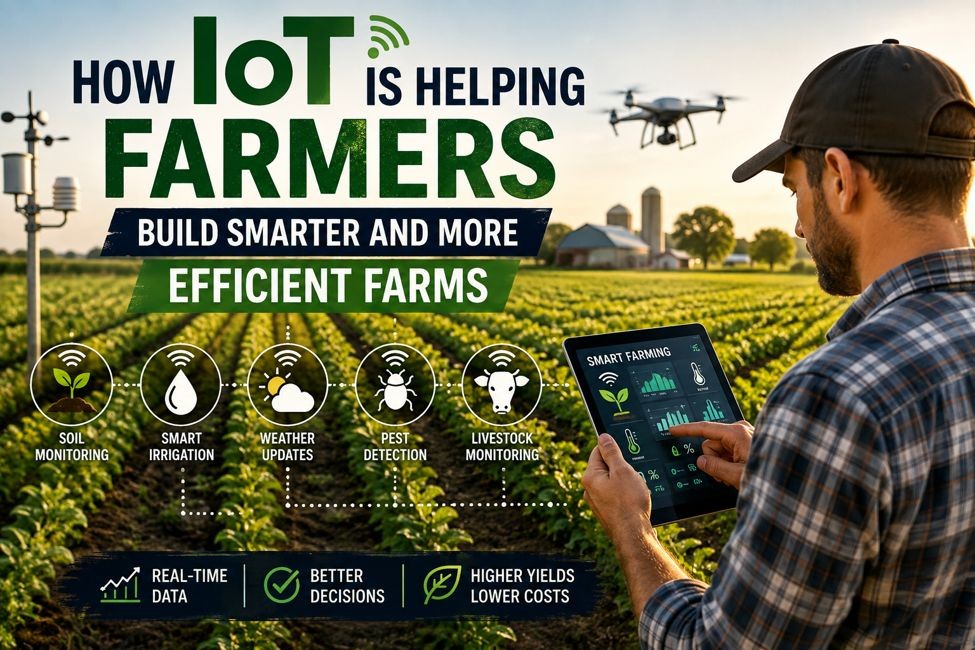
Understanding IoT in Agriculture
The Internet of Things refers to a network of physical devices that communicate with each other through the internet. These devices gather information using sensors, process data, and share it with farmers through smartphones, tablets, or computers.
In agriculture, IoT devices can monitor nearly every aspect of farming operations, including:
- Soil moisture
- Soil temperature
- Air humidity
- Weather conditions
- Crop health
- Water usage
- Livestock movement
- Equipment performance
- Greenhouse climate
Instead of manually checking every field every day, farmers receive accurate, real-time updates that help them respond quickly to changing conditions.
For example, if soil moisture drops below a certain level, an IoT system can automatically notify the farmer or even activate an irrigation system without requiring manual intervention.
This level of automation saves both time and resources while reducing unnecessary work.
Why Smart Farming Matters More Than Ever
Today’s farmers face a unique combination of challenges.
Climate change has made rainfall less predictable. Heat waves and droughts are becoming more frequent in many regions. At the same time, global populations continue to grow, increasing the demand for food.
Farmers also need to:
- Reduce water consumption
- Minimize fertilizer waste
- Lower production costs
- Improve crop quality
- Protect natural resources
- Meet sustainability goals
Traditional farming methods often depend on routine schedules rather than actual field conditions. For instance, watering crops every three days may seem practical, but plants may need water sooner during hot weather or later after rainfall.
IoT changes this approach by allowing farmers to make decisions based on real-time data instead of fixed schedules.
This data-driven approach leads to better productivity while using fewer resources.
Key IoT Technologies Used on Modern Farms
Smart farming combines several connected technologies that work together.
Soil Monitoring Sensors
Healthy soil is the foundation of successful farming.
IoT soil sensors continuously measure:
- Moisture levels
- Soil temperature
- pH balance
- Nutrient availability
- Electrical conductivity
Instead of applying fertilizer uniformly across an entire field, farmers can identify specific areas that require additional nutrients.
This targeted approach reduces fertilizer waste while improving crop growth.
It also helps prevent nutrient runoff that can negatively affect nearby rivers and lakes.
Smart Irrigation Systems
Water is one of agriculture’s most valuable resources.
Many farms still rely on fixed irrigation schedules that may overwater or underwater crops.
IoT-powered irrigation systems work differently.
Connected moisture sensors monitor soil conditions in real time.
When moisture falls below a predefined threshold, irrigation systems automatically activate. Once adequate moisture levels are restored, watering stops.
This automation offers several advantages:
- Conserves water
- Reduces electricity usage
- Prevents overwatering
- Improves crop health
- Saves labor
In regions experiencing water shortages, smart irrigation has become one of the most valuable applications of IoT technology.
Weather Monitoring Stations
Weather has always influenced farming decisions.
Modern IoT weather stations collect localized information including:
- Rainfall
- Temperature
- Wind speed
- Humidity
- Solar radiation
- Atmospheric pressure
Instead of depending solely on regional weather forecasts, farmers receive field-specific data.
This information helps determine the best time for:
- Planting
- Fertilizer application
- Irrigation
- Pesticide spraying
- Harvesting
Accurate timing improves both crop quality and operational efficiency.
Crop Health Monitoring
Detecting crop stress early can prevent significant yield losses.
IoT combines field sensors with drones and satellite imagery to monitor crop conditions throughout the growing season.
These systems identify:
- Water stress
- Nutrient deficiencies
- Disease symptoms
- Pest infestations
- Uneven crop growth
Instead of discovering problems after visible damage occurs, farmers receive alerts while issues are still manageable.
Early intervention often results in healthier crops and reduced chemical usage.
Smart Farm Equipment
Modern agricultural machinery has become increasingly intelligent.
Many tractors, harvesters, and planting machines now include IoT connectivity.
Connected equipment can monitor:
- Fuel consumption
- Engine performance
- Machine location
- Maintenance schedules
- Field coverage
- Operating efficiency
If a machine develops a mechanical issue, the system can alert operators before a major breakdown occurs.
Predictive maintenance reduces repair costs while minimizing costly downtime during busy farming seasons.
Challenges of Implementing IoT in Agriculture
Although IoT offers significant advantages, adopting these technologies is not without challenges. Many farmers, especially those managing small and medium-sized farms, may face obstacles when introducing smart farming solutions.
Initial Investment
IoT devices, sensors, weather stations, drones, and automated irrigation systems require an upfront investment. While these technologies often lead to long-term savings, the initial cost can be a concern for some farmers.
Internet Connectivity
Many agricultural regions still experience limited or unreliable internet access. Since most IoT devices depend on stable connectivity, poor network coverage can affect their performance.
Technical Knowledge
Using smart farming tools requires basic technical skills. Farmers may need training to understand how to install devices, interpret data, and maintain connected systems.
Data Security
As farms become more connected, protecting digital information becomes increasingly important. Farmers should use secure platforms and regularly update their devices to safeguard farm data.
Despite these challenges, technology providers are developing more affordable, user-friendly, and reliable solutions, making IoT increasingly accessible to farms of all sizes.
The Future of IoT in Agriculture
The future of farming is becoming more connected, automated, and data-driven. IoT is expected to play an even bigger role as new technologies continue to evolve.
In the coming years, farmers may benefit from:
- Autonomous tractors that perform field operations with minimal human input.
- AI-powered systems that predict crop diseases before symptoms appear.
- Robots that assist with planting, weeding, and harvesting.
- Blockchain integration to improve food traceability from farm to consumer.
- Advanced climate monitoring systems that provide highly localized weather forecasts.
As these innovations become more affordable, even small farms will have greater access to smart farming tools. This shift will help improve food security while encouraging more sustainable agricultural practices.
Best Practices for Farmers Adopting IoT
Farmers interested in smart farming don’t need to transform their entire operation overnight. A gradual approach often works best.
Here are a few practical tips:
- Start small: Begin with one solution, such as soil moisture sensors or a weather station, and expand as you become comfortable with the technology.
- Choose reliable equipment: Invest in devices from trusted manufacturers that offer technical support and regular software updates.
- Use the data: Collecting information is only valuable if it informs your decisions. Review reports regularly and adjust your farming practices based on the insights.
- Train your team: Ensure everyone involved understands how to use and maintain the technology effectively.
- Evaluate results: Monitor improvements in crop yield, water usage, and operating costs to measure the return on your investment.
Frequently Asked Questions
1. What is IoT in agriculture?
IoT in agriculture refers to the use of internet-connected devices such as sensors, weather stations, drones, and smart equipment to monitor farm conditions and improve decision-making through real-time data.
2. How does IoT help farmers save water?
IoT-enabled soil moisture sensors measure the amount of water available in the soil. Smart irrigation systems use this information to water crops only when necessary, reducing water waste.
3. Can small farms benefit from IoT?
Yes. Many IoT solutions are now available at different price points, allowing small and medium-sized farms to adopt technologies that improve productivity and resource management.
4. Does IoT reduce farming costs?
Although there may be an initial investment, IoT can lower long-term costs by reducing water usage, fertilizer waste, equipment downtime, and unnecessary labor.
5. Is IoT useful for livestock farming?
Absolutely. Wearable sensors and GPS tracking devices help monitor animal health, activity, and location, allowing farmers to identify health issues early and manage livestock more efficiently.
6. What is the future of IoT in agriculture?
The future includes greater integration with artificial intelligence, autonomous machinery, robotics, and predictive analytics, helping farmers make faster and more accurate decisions.
Conclusion
Modern agriculture is evolving rapidly, and the Internet of Things is at the heart of this transformation. By connecting farms with real-time data, IoT enables farmers to make smarter decisions, reduce waste, improve productivity, and use natural resources more responsibly.
From monitoring soil moisture and automating irrigation to tracking livestock health and optimizing machinery performance, IoT supports nearly every aspect of farm management. These technologies not only help farmers address today’s challenges but also prepare them for a future where sustainability and efficiency are more important than ever.
While adopting IoT requires investment and learning, the long-term benefits often outweigh the initial challenges. As technology becomes more affordable and accessible, farms of all sizes will be able to take advantage of connected solutions that increase profitability and resilience.
Smart farming is no longer just an emerging trend—it is becoming an essential part of modern agriculture. Farmers who embrace IoT today will be better equipped to meet the growing demand for food while protecting valuable resources for future generations.

Chris Mcdonald has been the lead news writer at complete connection. His passion for helping people in all aspects of online marketing flows through in the expert industry coverage he provides. Chris is also an author of tech blog Area19delegate. He likes spending his time with family, studying martial arts and plucking fat bass guitar strings.