
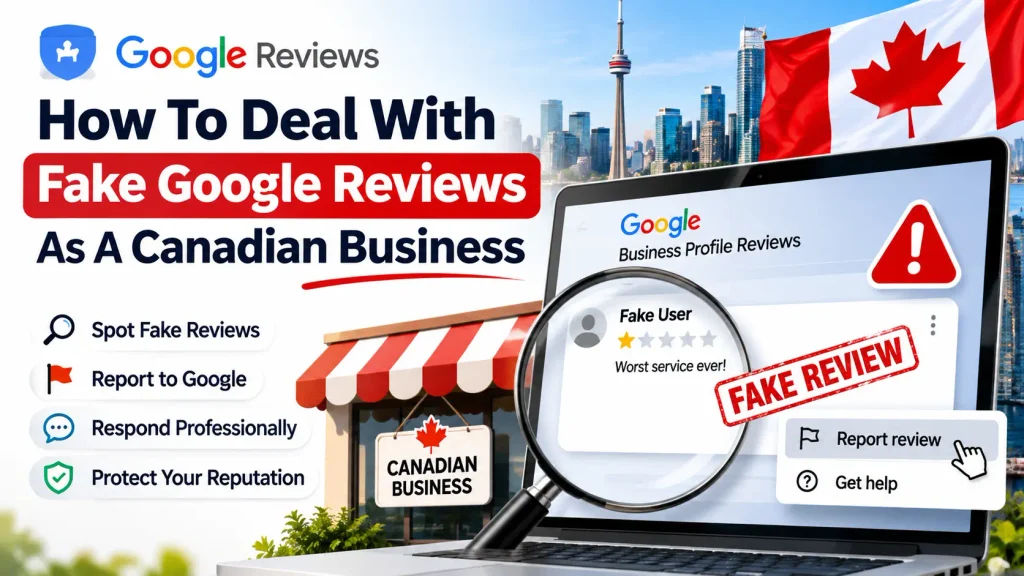
As a small business in Canada, getting a review on Google can help you gain a phone call or lose out on business to a competitor. People often look at reviews when choosing a moving company, restaurant, contractor or local mechanic. A couple of positive comments can make people feel more confident in using your business. However, a particularly negative review can turn people off.
Whilst most owners understand that people are going to leave negative comments, sometimes customers simply won’t be happy with the service. This can help businesses gain insight into where they can improve. However, fake reviews can be tricky. They can cause confusion for potential customers and leave you trying to argue a negative.
Imagine one morning on Monday you go to look at your profile and notice you’ve got several 1 star reviews. These reviews are from people you don’t recognise. Some of them say things that just aren’t true. One may even accuse one of your employees of misbehaving. It can be tempting to retaliate, but instead you should start by gathering evidence and understanding exactly what can and can’t be removed from Google.
Why Fake Reviews Can Be A Problem For Local Businesses
Depending on your business type, in Toronto you may have dozens of similar businesses within a short distance. This can be the case for cleaning services in Calgary, dental clinics in Ottawa or family run restaurants in Halifax. People often search quickly for businesses, and having a star rating can help put your business on shortlists.
Depending on your business type, you may rely on weekend business. Tradespeople may get only a few worthwhile enquiries each week, and restaurants may get customers deciding that evening. This means having an inaccurate review can cause doubt.
Whilst having one bad review won’t ruin your business, customers will look at recent reviews, photos, how the owner responds and what the general trend is. However, if you notice an unusual amount of 1 star reviews suddenly appearing, it’s worth taking note.
Is It A Fake Review?
Whilst not all negative reviews are fake, some customers will review under a different name on Google, book through a relative or comment on an experience they had months ago. Even if the review is angry or unfair, it could still be a genuine experience. Just because you disagree with the comment doesn’t mean it breaches Google’s policies.
Start by looking at what you can reasonably verify. Look at appointment books, invoices, bookings, customer service messages and the date of the incident. For restaurants look at bookings or orders. Contractors may want to look at addresses and estimates. Professional services may have privacy issues.
Try to find factual evidence. Whilst someone who only has one review isn’t necessarily fake, if they mention a product you don’t sell, a location you don’t operate from or an employee who doesn’t work there it can be useful.
Save the URL of the review, screenshots, the date and any internal notes. If there are several reviews with the same unusual language or within a short period of an issue, make a note. Don’t gather any unnecessary personal information. Keep this information in one place so you can refer back to it if Google requests more details. It can also help you avoid submitting conflicting reports when different members of your team are handling the same issue. Make sure any records you keep are stored securely and shared only with the people who need them.
Know What Google Policies Apply
Google allows people to leave honest reviews, including negative ones. However they have policies in place to stop fake engagement, conflict of interest, harassment and other restricted content. When requesting a removal, include what policy may apply and keep it factual.
If the review was written by a current or former employee to harm the business, it may be seen as a conflict of interest. If there is a pattern of reviews involving fake engagement (the reviewers didn’t have a genuine experience with your business), then this may apply. Any threats or targeted harassment should also be looked at.
However if the customer is commenting on late repairs, disappointing food or rude staff this generally wouldn’t qualify for removal. Google isn’t an independent court for all customer service issues.
Business owners can look at the Google Business Profile guidelines or user generated content policies on Maps. These can change so it’s best to check the policies are up to date.
Reporting A Suspicious Review
The easiest thing to do is log into the account that manages your Google Business Profile. Find the review and click report. Choose the most applicable reason for why you believe the review breaks the policy. If Google have a system in place for managing reviews or appealing then use this to ensure you’re making the right decision and include extra information if possible.
Be specific. Don’t just say they’re lying and trying to ruin you. Mention why you know it’s fake. This could be because they’re mentioning a service you don’t offer, several very similar reviews within hours or they’ve mentioned they have a relationship with a competitor. Try to keep it factual.
Don’t make up any documents, pretend to be customers or make any legal claims. This can backfire and make your case seem less reasonable. Keep a copy of what you sent and what the outcome was. Especially if there are several reviews.
There’s no guarantee your evidence will be enough to get the review removed. Ultimately Google will decide if the content breaks their policies. If the review isn’t removed it doesn’t necessarily mean it’s genuine, it could just mean there wasn’t enough evidence to show it broke any policies.
Calming Public Response
Whilst waiting for your report to be processed having a calm response can help potential customers. Remember this isn’t just for the reviewer but everyone who finds your business next week/next year.
If you can’t identify who the person is you can say something like: “We take customer feedback seriously, but we have not been able to match this experience to our records. We would welcome the opportunity to review the situation. Please contact our team directly with the date of your visit.”
Try to keep it professional. Don’t mention any details of your account, medical information, private addresses or customer messages. Usually saying they’re lying will do more harm than good. Also don’t write a long response to each line, this can attract more attention.
If the review was from a genuine customer, it may be best to resolve the issue. Depending on the situation a refund, correction or apology may be needed. Never offer incentives for positive reviews.
Multiple Reviews Suddenly Appear
Sometimes a sudden increase in bad reviews can be referred to as ‘review bombing’. This can be due to a co-ordinated effort but it doesn’t necessarily mean it is. It can be due to a news story, social media going viral or an actual issue with your service.
Make a timeline of when the reviews were made and what you know. Look for any repeating phrases, mentions of the same event and relevant messages. If you’ve had any threats to harm your rating keep these. This can help explain why you need to look into this further.
Have one member of staff deal with reporting the reviews. This will ensure you’re giving a consistent message. Try to continue to provide a normal service to your customers. Spending your whole week arguing online can cause you to accidentally increase the story and neglect your customers.
If there are any threats, extortion, impersonation or potential illegal activity then consider seeking the correct legal advice/reporting. Google’s content review process shouldn’t be used as a replacement for emergency services/legal.
Third Party Help
Some owners will have time to look into, report and follow up on one questionable review. However others will be busy managing staff schedules, customer calls and running their business. In these situations specialist help can be useful to help organise your evidence.
If you’re looking into third party help in Canada you may find services such as ReviewRemoval.ca and ReviewsBoost.ca. These are designed to help businesses with Google reviews that may be breaking the platform’s policies. Choosing the right provider will depend on knowing how they work, how much they charge and what they can realistically promise.
A reputable provider should make it clear that the final decision to remove the review is down to Google. They should also make it clear that whilst the review may be breaking policies, it may just be a genuine negative review from a customer. Be cautious of anyone promising to remove all negative reviews, having secret access to Google or using misleading tactics.
Ask them how they’ll handle customer records. Whilst many situations can be started with just the links to the reviews and extra details, you should make sure you’re in control of your accounts. Don’t give them your passwords.
Protect Your Reputation
Removing reviews is just one aspect of protecting your online reputation. The best way to protect your reputation long term is to ensure you’re providing a consistent service, clear communication and accurate representation of your business.
Ask customers to leave genuine feedback. This can be done by sending a follow up email, linking to their receipt or having a small notice at your counter. Don’t select only happy customers or offer incentives.
Respond to genuine complaints. A short response and helpful next steps will often tell future customers more than arguing. If the issue has been resolved the customer can choose to update their review.
Ensure your business hours, contact details, services and website are up to date. If people can easily confirm that your business is active and contactable then one suspicious comment may not hold much weight. Having updated photos, accurate descriptions and thoughtful responses from the owner will help people see the bigger picture.
If you have multiple locations have an easy process in place for local managers to highlight suspicious reviews. Having a shared spreadsheet with the review URL, date, if you’ve responded and any supporting records will be enough. You don’t want to be overly concerned with every comment but want to ensure any potential issues are dealt with consistently.
A Practical Example For Canadian Business Owners
Imagine you’re a family run moving company in Mississauga and you’ve had 3 1 star reviews in 2 days. One mentions storing furniture which you don’t offer. Another mentions an employee that left years ago. The last one is detailed and matches a recent issue with a customer.
You shouldn’t treat all 3 the same. The first two may be worth looking into further and carefully documenting. The last one may be a genuine complaint from a customer and should be responded to with respect. Using the same reasoning that they’re fake reviews will miss the key difference.
Using this approach will help you maintain your credibility. By accepting genuine mistakes and arguing against clearly misleading content you’ll be putting yourself in a better position to gain trust.
Whether you’re in Vancouver, Edmonton, Winnipeg, Montreal, Quebec City or a smaller community in Canada the principles are the same. Gather your evidence, understand the policies, report through the correct channels and maintain a professional response. The specifics will be more important.
Final Thoughts
It can be frustrating having fake reviews on Google as it affects something you’ve worked hard to build over the years. However, it’s important to approach the situation sensibly. The best thing to do is try to understand what has happened, gather evidence you can verify and understand if it’s a genuine complaint or may be breaching Google’s policies.
Many situations can be dealt with by using Google’s reporting tools. However if your situation becomes complex or time consuming then third party help may be worth considering. Overall you want to ensure you’re fairly representing your business.
A trustworthy online reputation comes from doing a good job, asking for genuine feedback and responding consistently to issues.

Chris Mcdonald has been the lead news writer at complete connection. His passion for helping people in all aspects of online marketing flows through in the expert industry coverage he provides. Chris is also an author of tech blog Area19delegate. He likes spending his time with family, studying martial arts and plucking fat bass guitar strings.