
Let me be upfront with you.
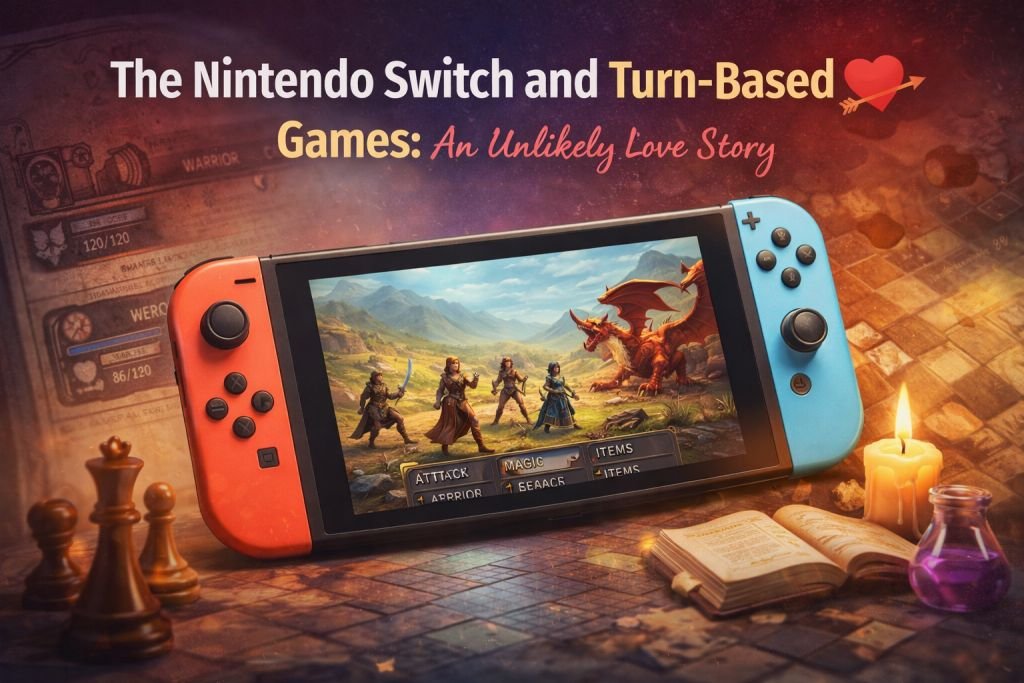
When most people think of the Nintendo Switch, they picture Mario leaping across colourful platforms, or Link sprinting through Hyrule. Turn-based strategy isn’t exactly the first thing that comes to mind. I get it. I was the same way.
But here’s what I found out after spending an embarrassing number of hours with the Switch: it’s actually a quietly brilliant home for turn-based games. The ability to flip into handheld mode and take your tactics session on the train, into a waiting room, or onto the couch? That changes everything. Suddenly ‘one more turn’ becomes a lot more dangerous.
The Switch library covers a wide range — from household names like South Park to indie darlings and offbeat party games inspired by the Las Vegas Strip. There’s a lot of noise out there, so I’m cutting through it with three games that genuinely deserve your time.
Here’s what each one is really like to play.
#1 Vegas Party — Best for: Couch Multiplayer Fun (2018)
Wait — Casino Games on the Nintendo Switch?
I know what you’re thinking. ‘Casino games on Nintendo? Really?’ That was my reaction too. Nintendo built its empire on family-friendly mascots and clean-cut adventure games. A Vegas-themed dice-rolling, card-flipping party game feels like a strange fit.
And yet, here we are. Vegas Party exists. It made it to the Switch. And it’s actually an interesting little curio — if you go in with the right expectations.
What Vegas Party Actually Is
Think of Vegas Party less like an online casino simulator and more like Mario Party with a Sin City makeover. The central mode — called ‘The Strip’ — is a turn-based board game where up to four players roll dice, move across spaces representing Las Vegas casinos, and compete in mini-games to rack up tokens. The player with the most tokens at the end wins.
The mini-games themselves are drawn straight from the casino floor: Blackjack, Texas Hold’em, Roulette, Baccarat, and Bingo are all here. None of them use full real-world rules — they’ve been simplified for casual play — but there’s something undeniably fun about sitting across from friends, gambling virtual tokens, and trash-talking over digital Blackjack.
“Played as a race, the goal is to reach the end of the Strip before anyone else. Avoid twisters and earthquakes, trust no one, and forget the meaning of mercy.” — Official game description
The Experience in Real Life
I’ll be honest with you — Vegas Party is not a masterpiece. When I first sat down to play it solo, I could see the cracks immediately. The controls feel like they were designed for a Wii Remote and never quite adapted to the Switch’s Joy-Cons. The motion controls for mini-games like Darts are genuinely awkward in handheld mode. And the lack of a save function means if you walk away mid-game, your progress is gone.
But here’s the thing: the moment I set it up with three other people in the same room? Something clicked. The game transformed. Suddenly the stereotypical characters — the rapper, the James Bond wannabe, the old lady on a lucky streak — felt charming rather than dated. Shouting at each other over Roulette outcomes, catastrophising over a bad dice roll, someone inevitably landing on the earthquake space at the worst possible moment — it becomes genuinely entertaining.
💡 The Real-Life Lesson: Vegas Party is not a game you buy for solo play. It’s specifically designed as a couch multiplayer experience. Treat it like that and you’ll have a surprisingly fun evening.
Who Should Play Vegas Party?
If you love casino games — the strategy of poker, the tension of Blackjack, the reckless thrill of Roulette — and you want that experience without any real money changing hands, Vegas Party scratches that itch in a low-stakes, laughs-first format. It works best with three or four local players who aren’t expecting depth, just fun.
If you’re a solo player looking for a rich, strategic turn-based experience, though, you’re going to be disappointed. This is not that game.
Quick Ratings
Fun with Friends: ★★★★☆ genuinely entertaining local multiplayer
Solo Experience: ★★☆☆☆ shallow and grows repetitive quickly
Controls: ★★☆☆☆ motion controls feel like an afterthought
Casual Replayability: ★★★☆☆ works for occasional game nights
Genre: Party / Casino Board Game | Players: 1–4 (local) | Developer: Storm City Games
#2 South Park: The Stick of Truth — Best for: Comedy RPG Fans (2014 / Switch 2018)
The Game That Proves Licensed Games Can Be Great
Let me tell you something that surprised me when I first played The Stick of Truth: I expected it to be a cash-grab. A studio slapping the South Park name on a mediocre RPG to make a quick profit. That’s what licensed games are, right?
Wrong. Completely, utterly wrong.
South Park: The Stick of Truth — developed by Obsidian Entertainment (the people behind Fallout: New Vegas and Pillars of Eternity) and written by South Park creators Trey Parker and Matt Stone — is genuinely one of the best RPGs I’ve played on the Switch. And I don’t say that lightly.
The Story: Beautifully Ridiculous
You play as ‘The New Kid’ — a completely customizable, voiceless protagonist who has just moved to South Park. Within the first fifteen minutes, you’re recruited by Eric Cartman into an epic backyard role-playing game involving elves, wizards, and a powerful artefact called ‘The Stick of Truth.’
Then things get weird. Supernatural events crash the LARP session. Government conspiracies emerge. Nazi zombies appear. Canada becomes involved. And somehow, through all the chaos, an unexpectedly heartfelt adventure takes shape underneath all the toilet humour.
“Not since Earthbound and Super Mario RPG has there been a turn-based RPG with such a distinct style and so many memorable moments.” — Metacritic critic review
The writing is sharp, the voice acting is the full cast from the show, and the game looks so much like actual South Park episodes that you sometimes forget you’re playing a game. It’s one of the most authentic adaptations of any TV show into a video game, full stop.
The Turn-Based Combat: Simple, But Never Boring
Here’s where it gets interesting from a turn-based perspective. The Stick of Truth takes a Paper Mario-style approach to combat: simple enough to pick up in minutes, but layered enough to stay engaging.
You and one companion face enemies in turn-based battles. Your class determines your ability set — you choose at the start between Fighter, Thief, Mage, or Jew (yes, really — this is South Park). Each class plays differently, and the combat has an active element that keeps you from zoning out: when your weapon flashes, tap the right button at the right moment to boost your attack damage. Do it while defending to reduce incoming hits. It’s a small mechanic, but it means you’re always involved, even on the opponent’s turn.
Magic in this game is called ‘fart abilities.’ That tells you everything you need to know about the tone.
The Switch Advantage: Playing It in Handheld Mode
I first played The Stick of Truth on PC back in 2014. Replaying it on the Switch — in handheld mode, on the couch, at midnight when I should have been sleeping — felt like a completely different experience. The portability makes the game’s 12-to-15-hour runtime feel easy to chip away at in small sessions. It’s perfect for 30-minute handheld play before bed, or a longer TV-mode Saturday afternoon session.
🎮 Pro Tip: Play with headphones on the Switch. The full South Park voice cast and soundtrack were designed to be heard, and the audio quality really elevates the whole experience. Just maybe not around children.
Is It Perfect? Honest Verdict
No. Nothing is. The game is relatively short — completionists can see everything in 15-20 hours, and some will wish it were longer. A handful of quick-time events during boss fights are notoriously difficult with the Joy-Con controls. And the game is absolutely not for everyone — if South Park’s style of humour makes you uncomfortable, this is not your game.
But if you’re a fan of the show, or if you love accessible turn-based RPGs with strong writing and a distinct sense of personality, The Stick of Truth is essential. It might be the best licensed game ever made.
Quick Ratings
Story & Humour: ★★★★★ one of the funniest games ever written
Turn-Based Combat: ★★★★☆ accessible, active, and surprisingly deep
Switch Performance: ★★★★☆ smooth, improved from original launch
Replay Value: ★★★☆☆ great first run, less reason for second
Genre: Turn-Based RPG | Players: 1 | Developer: Obsidian Entertainment | Publisher: Ubisoft | ESRB: M
#3 Pathway — Best for: Indiana Jones Fans & Tactics Purists (Switch: May 2021)
The Indiana Jones Game That Isn’t Called Indiana Jones
Picture this: it’s 1936. You’ve got a battered jeep, a ragtag crew of adventurers — think mercenaries, archaeologists, and rogues — and a map covered in mystery locations scattered across the deserts of Morocco and the Middle East. Nazi forces are spreading across the region, hunting for occult artifacts powerful enough to change the course of history.
Your job is to find those artifacts first.
Pathway, developed by German indie studio Robotality, is exactly the game that premise deserves: a turn-based tactical RPG dripping with 1930s pulp adventure atmosphere, gorgeous pixel art, and a roguelite structure that means no two playthroughs are identical. If you’ve ever watched an Indiana Jones film and thought ‘I want to make these decisions,’ this game was made for you.
The Core Gameplay Loop
Here’s how a typical session unfolds. You assemble a team of two adventurers from a roster of characters, each with their own stats — agility, dexterity, intelligence, weapon proficiency — and unique skill trees. Then you navigate a procedurally generated map in your jeep, managing a limited fuel supply as you choose between different nodes: temples to explore, markets to visit, strangers to help or ignore, and enemy camps to avoid or raid.
At each node, you make decisions. Search the temple, or move on? Help the village being threatened by Nazis, or conserve your ammunition for later? Betray the informant, or protect them? These choices lead to text-based scenarios with randomised outcomes, and they shape how your campaign unfolds.
“The title describes the procedurally-generated journey you take in your little jeep — different every time, full of random events, chance-based decisions, and playing out like the lovechild of a board game and a choose-your-own-adventure novel.” — Finger Guns Review
The Turn-Based Combat: Tactical and Satisfying (When It Lands)
When you encounter enemies — and you will, frequently — the game shifts into grid-based, turn-based tactical combat. Each character gets two actions per turn: move, attack, use an ability, or take cover. Cover matters. Moving into flanking positions matters. Managing your team’s action economy and knowing when to be aggressive versus conservative is the core strategic puzzle.
The combat starts tense and rewarding. Facing a group of armed Nazis with two half-wounded adventurers, limited ammo, and unfavourable terrain is genuinely stressful in the best possible way. The pixel art animations are punchy, the sound design is satisfying, and there’s a real sense of achievement when a difficult encounter breaks your way.
⚔️ Tactical Highlight: Each character gets two actions per turn. You can use both to move, both to attack, or mix them — but the real skill is in positioning and cover. Using terrain smartly wins fights that brute force would lose.
The honest caveat: combat can become repetitive by the mid-game. The enemy variety is limited, and if you play multiple campaigns back-to-back, the tactical situations start to feel familiar. The game rewards playing in focused sessions rather than extended marathons.
The Roguelite Structure: Learning From Every Loss
This is where Pathway differentiates itself from a traditional tactics game. It’s built around roguelite principles — each campaign is procedurally generated, so the map, events, and encounters are different every run. Lose a character or even a campaign? You don’t lose everything. The experience your adventurers gained carries forward in the form of unlocks and progression.
There are five scenarios of escalating difficulty, from a straightforward desert chase to a complex plot involving the Queen of Sheba’s sacred tomb. New adventurers unlock as you meet certain conditions in-game, slowly expanding your roster of characters and tactical options.
Even when combat goes against you — and it will — losing doesn’t feel punishing. It feels instructive. You learn to manage fuel better. You learn which characters synergise. You learn to stop rushing into temples unprepared. Each failed run makes you meaningfully smarter for the next one.
The Visual and Audio Atmosphere: Genuinely Stunning
Whatever you think about Pathway’s combat depth, nobody disputes this: the game is beautiful. The pixel art is lush and meticulously crafted — desert light catching sand dunes, the warm amber glow inside ancient tombs, the dusty, worn aesthetic of 1930s Europe rendered in extraordinary detail. Real-time lighting effects on pixel art is a technical achievement, and Robotality clearly knew it when they said the Switch version was their best and most complete release.
The music and ambient sound design match the visual quality. Dusty jazz, tense tactical stings, and environmental audio that pulls you into the setting. Pathway sounds like it looks: like a forgotten pulp adventure novel you found in an antique shop.
A Few Honest Issues
I want to be straight with you about a couple of things. First: Pathway had some technical issues at Switch launch, including occasional crashes that could lose progress. Patches have since improved stability, but it’s worth knowing.
Second: the game runs less smoothly in handheld mode, and text and character models can feel small on the Switch’s screen in that configuration. Playing docked on a TV is clearly the intended experience. If you primarily play handheld, factor that in.
Third: the story between campaigns is deliberately thin — Pathway’s narrative is more vibe and setting than deep plot. If you need a rich character-driven story, this game may leave you wanting. But if you love the tactical puzzle and can embrace the Indiana Jones aesthetic as the driving motivation, there’s a lot of satisfying content here.
Quick Ratings
Atmosphere & Art: ★★★★★ one of the best-looking pixel art games on Switch
Tactical Combat: ★★★☆☆ solid, but grows repetitive in extended sessions
Roguelite Replay: ★★★★☆ genuinely different each run across five scenarios
Story Depth: ★★☆☆☆ setting over narrative — manage expectations
Handheld Experience: ★★★☆☆ better docked; handheld has performance limitations
Genre: Tactical RPG / Roguelite | Players: 1 | Developer: Robotality | Publisher: Chucklefish | Price: ~$15.99
So Which One Should You Actually Play?
Here’s the honest, no-hedging version of my recommendation:
Play Vegas Party if: you’re hosting a game night with friends, everyone is sitting in the same room, and you want something that doesn’t require any rules explanation. It’s not deep, but it delivers exactly what it promises: a chaotic, colourful party experience. Buy it cheap, don’t expect more than that.
Play South Park: The Stick of Truth if: you have any affection for the TV show, enjoy turn-based RPGs, or simply want to play one of the most genuinely funny games ever made. It’s accessible enough for casual gamers but has enough tactical texture to satisfy RPG veterans. This is the essential pick from this list.
Play Pathway if: you love grid-based tactics games, have a weakness for 1930s pulp adventure settings, and enjoy roguelite progression. It’s not perfect, but the atmosphere is extraordinary and the tactical depth is rewarding for the right player. Best experienced in focused 60-90 minute sessions rather than long marathons.
“Turn-based games reward patience, planning, and the ability to learn from your mistakes. In that sense, the Nintendo Switch — a console built around flexible, personal play — is actually a perfect home for them.”
Final Thoughts: The Switch Deserves More Credit for Turn-Based Gaming
Here’s something I’ve come to believe after playing dozens of Switch games over the years: the console’s unique ability to seamlessly shift between TV and handheld modes makes it a particularly compelling platform for turn-based games specifically.
Turn-based games are built around pacing. You think, you plan, you act. There’s no penalty for pausing to reconsider. That rhythm suits handheld play perfectly — you can make one decision, put it down, pick it back up on the commute home, and keep going. The Switch respects your time in a way that real-time games often don’t.
Vegas Party, South Park: The Stick of Truth, and Pathway each offer something genuinely different within the turn-based genre. A chaotic party experience. A comedic RPG masterpiece. A tactical indie gem with visual ambition. None of them are the same game. All of them give the Switch’s turn-based library something it needs.
Start with The Stick of Truth. Play it at midnight with headphones on. Thank me later.

Chris Mcdonald has been the lead news writer at complete connection. His passion for helping people in all aspects of online marketing flows through in the expert industry coverage he provides. Chris is also an author of tech blog Area19delegate. He likes spending his time with family, studying martial arts and plucking fat bass guitar strings.