

The Challenge of Managing Data Across Multiple Platforms
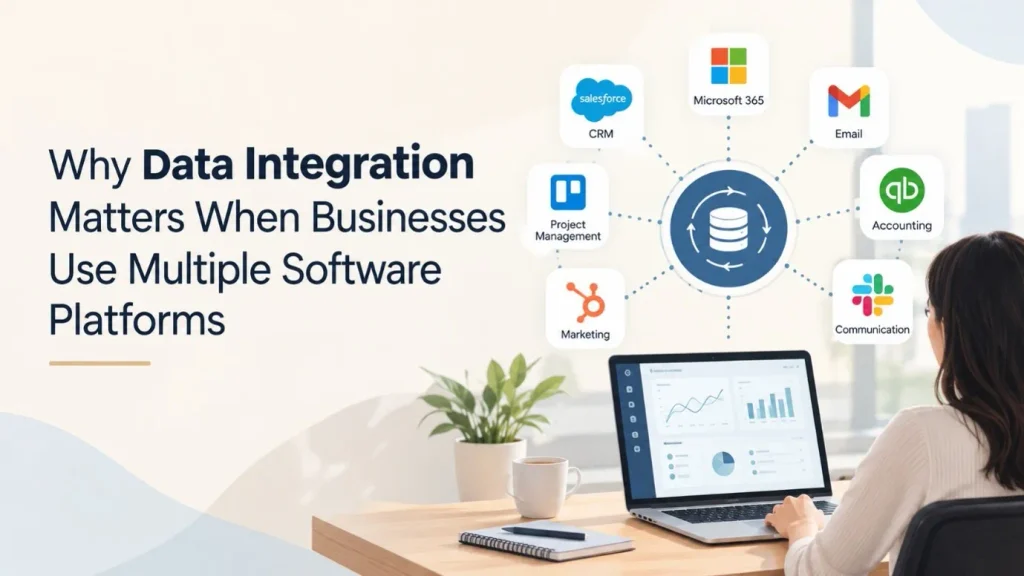
The contemporary businesses usually do not operate on a single platform that is used to organize company’s daily activities. The firms utilize various software platforms for the management of the relations with customers, accounting operations, human resources, marketing, sales, inventory, projects, and communication, etc. Although such platforms offer certain advantages to companies in terms of specialized tasks that can be completed with their help, they may also present difficulties with the exchange of information between platforms.
The information that is collected by the firm in its different departments and that is stored in disconnected platforms may be hard to access, compare and keep up to date. The staff members might spend too much time transferring information manually, looking through various databases, and eliminating contradictions among platforms. Thus, the process of operations might be slowed down and mistakes might be made by people.
Data integration can help to solve the mentioned issue since it allows integrating different platforms and exchanging information among them. According to a Consegic Business Intelligence report, the Industrial Data Management Market is increasingly supported by data integration and storage solutions that enable seamless data flow across IT and operational environments, highlighting the growing importance of connected and centralized data management for modern businesses.
What Is Data Integration and Why Does It Matter?
Data integration is a process that involves linking the data from various computer programs, databases, software applications, or online platforms to ensure its accessibility and usefulness. Rather than making the personnel extract data from various sources manually, the integrated data systems enable automatic data sharing. For instance, data stored in a customer relationship management system can be transferred to a marketing automation system or billing application.
This ensures a smooth data flow in the organization. Data integration is critical due to the fact that organizations rely on several different pieces of technology to accomplish everyday tasks. The lack of integration means that different tools will work independently leading to the fragmentation of information and repeated tasks.
A proper integration strategy allows organizations to save time spent on entering the same data several times, make data easily accessible and more consistent. Employees will find it easier to work with up-to-date data without frequently switching between applications. Since the adoption of cloud applications, automation systems, analytics platforms and specialized software is continuously increasing, data integration becomes crucial for businesses.
Breaking Down Data Silos Across Business Departments
A data silo means isolation of vital information in a certain department or in an application or system used by a department in the organization. In this scenario, the sales department may be using a different application to keep customer information, the support department will be using a different application to maintain the information, and the finance department will be using yet another application to store billing information. If there is no proper communication between these systems, then employees may have partial access to vital information in the business.
Integration of information ensures that there is less isolation of information since it integrates the relevant systems and ensures effective flow of information between departments. Teams will have access to the information that they need without having to request the information from other employees several times. Access to relevant information can also enhance the collaboration process between teams. Marketing teams can benefit from the insight on the customer gained from sales and support systems for marketing campaigns. Likewise, finance teams will have access to the most current sales information for managing invoices and revenue reports.
Improving Data Accuracy and Consistency
Ensuring the accuracy of information becomes more challenging with the presence of multiple independent software platforms within an enterprise. The same customer, product or transaction might be inputted into several databases; however, manual updating might lead to discrepancies between the different records. Even the smallest inconsistency might create problems in cases when an employee relies on the information for decision-making purposes.
Data integration is able to prevent some of these issues due to the possibility to transfer information automatically between integrated systems. If there are any changes in one database, the updated information might be reflected in other databases depending on the integration rules set by the organization. This eliminates the necessity for duplicate data entry and minimizes the risk of mistakes. In addition, integration is able to help with the process of standardizing the format of information as well as validating the data. Consistent data is vital for reporting, forecasting, customer service, inventory management and accounting functions. With the help of data integration, companies are able to spend less time searching for conflicts and use more time to work with reliable information.
Enabling Better Decision-Making With Connected Data
In business settings, the process of decision-making sometimes requires more information to be accessed not from one software program but from various departments. Management will have to study sales data along with customer behavior, marketing effectiveness, operational costs, and inventory numbers before choosing an approach. When the above data are available in several unrelated systems, gathering and comparing them takes a lot of time.
Data integration consolidates useful information, thus enabling people to create a comprehensive picture of their business. Integration of data can also be useful in analytics and reporting processes because it allows presenting information from various sources in a well-organized manner. The consolidation of sales and customer data can tell businesses which products result in repeat sales and what types of customers react to certain marketing campaigns. In the same way, the combination of inventory data and sales data provides more insight about demand and inventory levels. Data integration does not necessarily make decisions better but provides workers with more consistent and complete information.
Enhancing Workflow Efficiency and Business Productivity
Disconnected software solutions may lead to some inefficiency in employee-related activities. Employees might be required to transfer data from one solution to another, download spreadsheets, distribute files via e-mail, or constantly monitor multiple apps for any changes. All these actions waste time that could be spent on something more valuable.
Data integration could allow connected systems to share data based on pre-defined processes. Thus, when an order is placed by a customer, for example, integrated systems could update inventory, provide necessary financial data, and alert relevant teams without manual participation of employees. Integration would allow avoiding unnecessary routine and let employees concentrate on other, more interesting tasks. Moreover, integration would help to speed up the data flow through an organization.
Thus, when relevant teams receive their updates faster, they are able to react to operational needs and requirements of customers faster. All these factors may eventually result in increased productivity and efficient use of resources. Therefore, for organizations that have to manage several digital systems, connecting them might become a crucial step.
Strengthening Customer Experience Through Integrated Data
Customers can have interactions with companies using a variety of channels such as websites, mobile applications, email, social media, customer service, and physical stores. All those interactions are a source of valuable data related to customer preferences, purchase history, customer queries, and previous experiences. Having all this data distributed between separate databases might result in difficulties for employees in understanding the entire customer journey.
Integration can be used by companies to link together important customer data in order to be able to create a coherent picture of interactions. For instance, customer service agents can have access to customer’s purchase history and previous customer interactions without the need to ask customers to provide that information once again. Integrated data can also allow marketing departments to make their communication activities more precise and up-to-date. The combination of customer, inventory, orders, and customer service systems in e-commerce can allow businesses to provide better updates about order status and availability of products. Nevertheless, a company needs to ensure that integrated customer data will be processed securely and in compliance with all privacy regulations.
Reducing Operational Costs Through Connected Systems
The use of several software platforms will inevitably lead to increased costs because people will need to manually transfer information or correct the mistakes that occurred while moving information from one platform to another. It is hard to estimate how many resources such actions will take as these seemingly insignificant actions will multiply as the business will grow and large amounts of information will be processed daily.
Data integration can help businesses save money because all actions related to the sharing of information will be automated, and there won’t be a need for extra actions. For instance, through integration, order details will be transferred from e-commerce to inventory and accounting software automatically. As a result, it will not be necessary to enter information several times into different platforms manually.
Integration can also help to save the money that is spent on correction of duplicates and outdated information because people will have access to consistent information and won’t have to deal with the mistakes related to it. In addition, businesses will not need to spend additional money on tools needed to bridge the gaps between platforms that are already being used.
Supporting Automation Across Business Processes
Automated processes are far more effective when there is communication between various software solutions. A number of business processes include several actions executed by various applications, and disconnected applications can complicate the process of automation. Information integration enables connections between applications, through which data will flow and actions will be triggered. For instance, when a customer fills in a form on the company’s website, information will be transferred automatically to a CRM solution, and the sales team will be notified about the client’s presence in their database and the customer will be added to the communication process.
The similar process may be applied to employee onboarding, orders processing, invoicing, inventory update, and customer support. Integration can help companies to speed up their repetitive actions due to reduced manual intervention and allow their employees to focus on creative, analytical, communicative, or decision-making activities. Organizations should understand, however, that some processes do not need automation, and they need to be identified prior to any integration of their business processes. Correct workflows, proper permissions, and accurate data are necessary in order not to make mistakes during automatic execution of the process.
Improving Real-Time Visibility Across Business Operations
Companies frequently require information in a timely fashion to know how things are going in their organizations. However, when the data is scattered across multiple systems, it may be hard to get a current picture of the company. Staff members might be required to collect the necessary information from various dashboards, spreadsheets, and databases to comprehend the current situation. Integrating data would enable employees to collect the data coming from different relevant systems and then present them through a centralized dashboard or reporting tool.
For instance, one might integrate the sales data, inventory data, customer service information, and financial data to track the significant operational metrics through one environment. Real-time or near-real-time information would enable people to detect any changes faster and react properly. Managers might spot decreasing sales figures, insufficient inventory levels, delays in services, and any other irregularities in the transactions, all without having to wait for the corresponding department to prepare reports. Real-time visibility is determined by the chosen integration architecture and data sources and by how frequent the updates are. Yet, linking the systems makes the business information easier to track.
Strengthening Data Security and Governance
While connecting different software platforms may increase accessibility and effectiveness of processes, it is essential to remember about such factors as data governance and security. Companies should realize the location of the data, its transmission between different applications, as well as the individuals or systems that are supposed to have access to it. Proper integration process may provide companies with an opportunity to develop certain rules and regulations regarding data access, validation, monitoring, and retention.
The company may specify what kind of data needs to be transferred between different applications, as well as minimize unnecessary data transfer. In addition, access control will help ensure that all individuals and applications have access only to necessary data. Finally, data monitoring will allow companies to detect any abnormalities. When integrating different applications, companies should also take care of encryption, authentication, audit log management, and other aspects related to the issue of security, especially when dealing with financial, personal, or customer data. However, integration does not automatically mean better security of the data; improperly connected applications may increase security risks even further.
Conclusion: Building a More Connected and Efficient Business
There is an increasing trend among companies today whereby there are numerous software platforms used by them to coordinate various aspects of the operations. This means that it is becoming imperative for businesses to develop proper data integration in order to benefit from all of these software platforms. Data integration would allow companies to cut down the number of siloed data, increase accuracy, automate operations, simplify workflows, enhance visibility into operations and many more other advantages.
It will even assist companies to improve customer experience, lower operating expenses and also give information to employees for making the right decisions. It is important for companies to plan for security, access, data governance and scalability issues in order to have effective data integration strategy.

Chris Mcdonald has been the lead news writer at complete connection. His passion for helping people in all aspects of online marketing flows through in the expert industry coverage he provides. Chris is also an author of tech blog Area19delegate. He likes spending his time with family, studying martial arts and plucking fat bass guitar strings.