

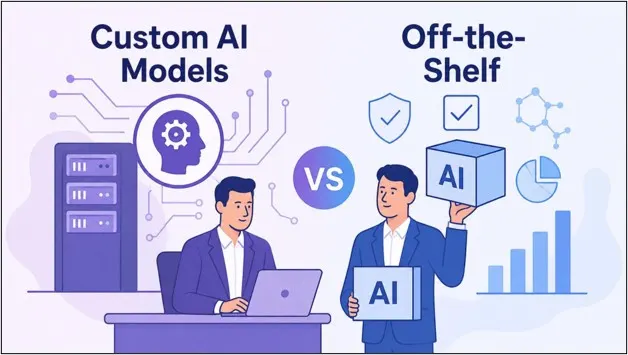
Not every company needs the same answers. A marketing team might just want help drafting emails, nothing fancy. A legal team needs a model that knows contract clauses cold. Give both teams the same generic chatbot, and one of them stops trusting it.
Your data gets in the way, too. Some of it is public and harmless. Some of it is a contract or a patient record, nothing outside eyes should see. Then there’s your own language: product codes and shorthand a general model has never seen. A smart setup accounts for all of that, instead of guessing.
That’s where custom LLM services come in. The team adapts a model to your documents, your terms, and your systems. It’s built for you, not for everyone. Then the model gives answers that fit your real business, and generic guesswork stops being the default.
What Is a Custom LLM, and How Is It Different?
A custom LLM is shaped around your business, not the general public.Custom LLM development services do this in a few ways. They fine-tune an existing model on your documents. They add retrieval so the model can look things up. Rarely, they train a model from scratch.
An off-the-shelf model like ChatGPT or Gemini already knows a huge amount. It’s reading the open internet. What it hasn’t read is your contracts, your support tickets, or your product codes. That gap is where custom AI development steps in.
| Approach | What Happens | Best For | Main Limitation |
| Off-the-shelf model | You use a general model through an app or API, as-is. | Common tasks like drafting emails or summarizing text. | It doesn’t know your private data or house style. |
| Prompt engineering | You write detailed instructions to steer a general model. | Quick wins with no development needed. | Results vary, and complex tasks need more than a good prompt. |
| Retrieval-augmented generation (RAG) | The model looks up your documents before answering. | Fast-changing knowledge, like policies or product data. | Answer quality depends on how well the documents are organized. |
| Fine-tuning | The model is retrained on examples from your business. | Consistent tone, format, or specialized judgment. | Needs clean training examples, and it can go stale as things change. |
| Training from scratch | A model is built and trained on your data alone. | Rare, deep-pocketed cases like BloombergGPT. | Very expensive, and the data pile is huge. |
Where Do Off-the-Shelf Models Fall Short?
Off-the-shelf models fall short on private data, niche terms, and sensitive workflows. They’re trained for everyone, so they default to generic answers. Ask about your return policy, and a general model will just guess.
Privacy is the sharper problem. Paste confidential data into a public chatbot, and you may lose control of it. In 2023, Samsung employees pasted proprietary source code into ChatGPT. Samsung banned the tool company-wide soon after.
That single incident pushed other firms to act too. JPMorgan Chase restricted employee ChatGPT use over similar worries about confidential data.
A few other gaps show up often:
- Jargon and internal terms. A general model won’t know your product codes or internal shorthand.
- Regulatory language. Legal, medical, and financial terms need precision a general model can miss.
- Tone and format. Off-the-shelf answers often don’t match your brand voice or required structure.
- Fresh knowledge. A general model may not know your latest prices, policies, or releases.
- Audit and control. Some industries need to show exactly what data trained the model.
How Do LLM Development Services Build a Custom Model?
LLM development services follow a set path. This holds whether it’s a small fine-tune or a full build. Skip steps here, and bad answers show up later. Here’s the order most teams follow, though real projects loop back as they learn.
- Define the job. Pick one use case, like contract review or support replies. Write down what success looks like.
- Audit your data. Gather documents, transcripts, and records. Clean out anything outdated, duplicated, or wrong.
- Choose the approach. Decide between RAG, fine-tuning, or a mix. Base scratch training is rare, so rule it out first.
- Pick a base model. Compare open models and commercial ones on cost, license terms, and performance on your task.
- Build and connect. Set up the pipeline, connect your data, and wire it into your tools.
- Test on real cases. Run past questions and edge cases through the model. Check for wrong or made-up answers.
- Launch and keep watching. Track accuracy and user feedback. Refresh the data as your business changes.
The BloombergGPT story is a useful outlier here. Bloomberg trained a 50-billion-parameter model from scratch on about 700 billion tokens. That took roughly 1.3 million GPU hours and about $2.7 million.
Years later, Bloomberg’s CTO said the firm now mixes its own models with outside providers. It routes each task to whichever model handles it best. Even a company with Bloomberg’s resources didn’t stick with training everything itself.
Custom AI Development Cost: Drivers and a Worked Estimate
Custom AI development cost swings hard depending on the approach. RAG setups cost far less than fine-tuning. Fine-tuning costs far less than training from scratch. Most enterprise AI solutions never need that last option.
Build cost covers data prep, integration, and testing. Running cost covers hosting, model calls, and upkeep. People tend to forget that second bucket, so budget for it too.
| Approach | Relative Cost | What Drives the Cost |
| Prompt engineering on an existing model | Lower | Time spent testing and refining prompts. No training involved. |
| RAG over your documents | Medium | Document volume, search quality, and how often content updates. |
| Fine-tuning a smaller open model | Medium to higher | Volume and quality of training examples, plus compute for training runs. |
| Fine-tuning a large commercial model | Higher | Provider fees, data prep, and ongoing evaluation. |
| Training a model from scratch | Very high | Massive data collection and compute, as in BloombergGPT. |
The cost tiers above are relative estimates for planning, not fixed prices.
Here’s a worked example for a support-focused fine-tune. These numbers are estimates built on stated assumptions:
- 5,000 support examples used to fine-tune a mid-size open model.
- Data cleanup and labeling take about 150 hours at $60 an hour.
- Compute for the fine-tuning run costs roughly $2,000.
- Ongoing hosting runs about $500 a month.
Labor comes to 150 × $60, or $9,000. Add the $2,000 compute cost, and the one-time build is about $11,000. Hosting adds $500 every month after that.
Compare that to Bloomberg’s $2.7 million scratch-trained model, and the gap is obvious. Most companies get most of the benefit from a much smaller project.
Risks and Trade-offs of Going Custom
Custom LLMs bring their own risks, and they’re worth naming before you commit budget. A model trained on stale data gives stale answers. A model trained on messy data gives messy answers.
The scale of the challenge is bigger than most teams expect, too. McKinsey’s 2025 survey found 78% of organizations use AI in at least one function. Yet only 5.5% report major profit impact from it. Adoption is easy. Getting real value back is the hard part.
The report also found 47% of organizations had experienced some negative consequence from generative AI. That’s a reminder that custom doesn’t mean risk-free.
- Data quality. Bad training data produces a model that repeats the same mistakes with confidence.
- Drift. Business changes, but a fine-tuned model doesn’t update itself. Plan for refreshes.
- Maintenance. Someone has to own the pipeline, the data, and the evaluation, indefinitely.
- Cost creep. Running costs can grow quietly as usage scales up.
- Talent. Fine-tuning and evaluation need real ML skill, in-house or from a vendor.
When Off-the-Shelf Is the Smarter Call
Off-the-shelf is the smarter call in a few common cases. The task is routine. The data isn’t sensitive. Speed matters more than precision. Custom AI development takes time, money, and upkeep. Don’t pay that price for a job a general model already handles well.
| Situation | Better Choice | Why |
| Drafting general emails or marketing copy | An off-the-shelf model | The task is common, and generic quality is good enough. |
| Public-facing FAQs with no private data | An off-the-shelf model with a good prompt | No sensitive data means no need for custom infrastructure. |
| A single team testing a new idea | Prompt engineering on an existing model | Fast to try, and you learn before you invest. |
| Fast-changing internal knowledge | RAG over your documents | Updating documents is easier than retraining a model. |
| Regulated, high-stakes decisions | A custom, evaluated model with human review | Precision and auditability matter more than speed or cost. |
Choosing Custom LLM Services: What to Ask
Choosing custom LLM services comes down to proof, not promises. Any vendor can say they build enterprise AI solutions. Fewer can show how they measure quality or protect your data.
Ask direct questions and expect direct answers. A vendor who gets vague about data handling is telling you something.
- Relevant experience. Ask for examples in your industry, and talk to a past client.
- Approach fit. Ask whether they’d recommend RAG, fine-tuning, or a mix, and why.
- Data handling. Ask where your data goes and who can see it. Ask if it trains anyone else’s model.
- Evaluation method. Ask how they test for wrong or made-up answers before launch.
- Cost structure. Get build cost and running cost as separate numbers.
- Ownership. Confirm who owns the fine-tuned model, the data, and the pipeline.
- Exit plan. Ask what happens to your data and model if you switch providers later.
Conclusion
So, what makes custom LLMs better? Not raw intelligence. Off-the-shelf models are plenty smart already. The advantage is fit. Your data, your terms, your workflows, handled by something that actually knows them.
That fit isn’t free, though. Custom LLM services take real time and money to build. BloombergGPT sits at the far end of that spectrum. It cost roughly $2.7 million to train from scratch. Most companies land much closer to the cheaper end, using RAG or fine-tuning instead.
Privacy is often the deciding factor. The Samsung ChatGPT incident showed what can go wrong with sensitive data. Custom AI development, built with proper data handling, avoids that exact risk.
McKinsey’s numbers are worth remembering too. Most organizations already use AI in some form. Very few see major profit impact from it yet. Adoption alone isn’t the goal. Fit and data quality are what turn a model into a real advantage.
If you’re weighing the decision, start small. Test an off-the-shelf model on your real data and workflows first. Bring in custom LLM services only when it clearly falls short. Ask any vendor for a written cost breakdown. Get a clear answer on where your data will live before you sign.
FAQs
What is a custom LLM?
A custom LLM is adapted to a specific business, usually through fine-tuning or retrieval. Training from scratch is rare. LLM development services shape the model around a company’s documents and terminology. This gives more relevant answers than a general model provides out of the box.
Is custom AI development always better than using ChatGPT or similar tools?
No. Off-the-shelf tools work well for common, low-stakes tasks with no sensitive data involved. Custom AI development earns its cost on private data, niche terms, or regulated decisions. Many companies use both: general tools for everyday writing, custom setups for specialized tasks.
How much do enterprise AI solutions cost to build?
Cost depends heavily on the approach. Prompt engineering costs little. Retrieval-augmented generation costs more, based on document volume. Fine-tuning costs more still. Training from scratch, like BloombergGPT, can run into the millions. Ask any vendor to separate build cost from running cost.
Do I need to train a model from scratch to get a custom LLM?
Almost never. Fine-tuning an existing model, or adding retrieval, gets most companies what they need. Training from scratch takes enormous data and compute. Bloomberg is one of the few companies that has actually gone that route.
What are the main risks of building a custom LLM?
Main risks include stale training data, model drift, and ongoing pipeline upkeep. McKinsey’s 2025 survey found 47% of organizations had faced some negative consequence from generative AI. Budget for evaluation and monitoring from the start.
How do custom LLM services protect sensitive company data?
Reputable custom LLM services keep client data in a private, permissioned environment. They don’t send it to a public consumer chatbot. This matters. Pasting confidential data into public tools has caused real leaks, as Samsung learned in 2023. Ask any vendor exactly where your data will live.

Chris Mcdonald has been the lead news writer at complete connection. His passion for helping people in all aspects of online marketing flows through in the expert industry coverage he provides. Chris is also an author of tech blog Area19delegate. He likes spending his time with family, studying martial arts and plucking fat bass guitar strings.