

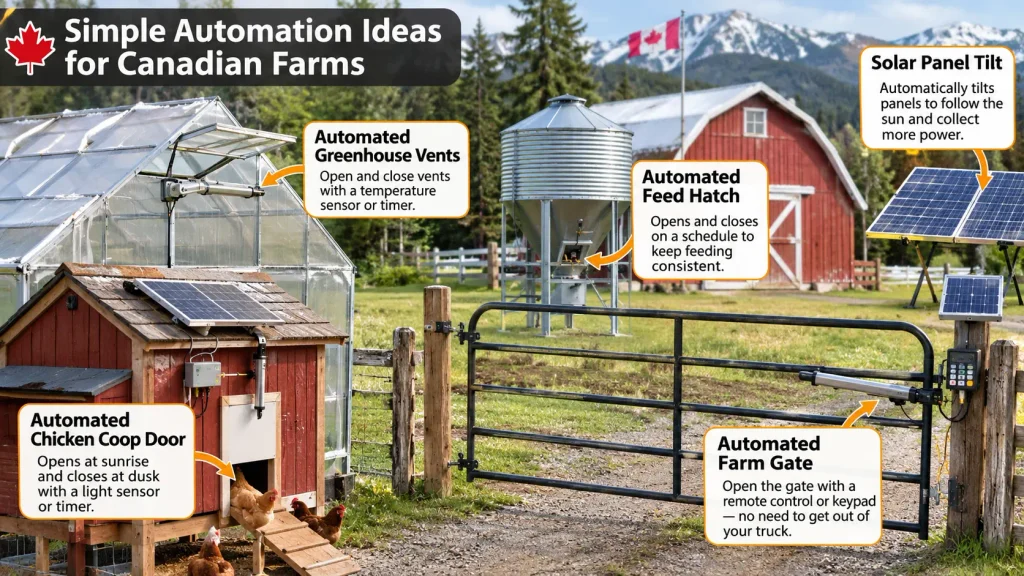
Simple farm automation means letting small electric motors handle repeated daily jobs, such as opening gates, greenhouse windows, coop doors and feed hatches. These projects are affordable, can often run on solar or battery power, and save Canadian farmers time and trips outside, especially during long, cold winters and busy seasons when help is hard to find.
Why are more Canadian farms turning to small automation projects?
More Canadian farms are turning to small automation projects because there are not enough workers to cover every daily task, and simple automated tools help fill the gap.
The labour shortage in Canadian agriculture is well documented. According to the Canadian Agricultural Human Resource Council (CAHRC):
- About 28,200 agriculture jobs went unfilled during peak season in 2022.
- Those unfilled jobs led to an estimated $3.5 billion in lost sales.
- More than 100,000 agriculture jobs could be vacant by 2030, partly because about 85,000 workers are expected to retire.
CAHRC’s own recommendations include adopting new technology and automation. For most farms, that does not mean robots. It means handing small, repetitive jobs to equipment that can do them on a timer, a sensor or the push of a button.
What farm tasks are easiest to automate?
The easiest farm tasks to automate are simple open-and-close or up-and-down motions that someone currently does by hand several times a day.
Most of these projects use a linear actuator. A linear actuator is a small device with an electric motor that creates a straight push or pull. It can open a door, lift a hatch or tilt a panel, then hold that position until it is told to move again.
How can I automate greenhouse windows?
Greenhouse windows can be automated by connecting an actuator to each vent and linking it to a temperature sensor or timer. When the greenhouse gets too warm, the vents open on their own; when it cools, they close. This protects plants from overheating on sunny spring days, even when nobody is around to open the windows.
How can I automate a chicken coop door?
A chicken coop door can be automated with an actuator and a light sensor or timer. The door opens at sunrise and closes at dusk, keeping birds safe from predators at night without anyone needing to go out early in the morning or after dark.
How can I automate a farm gate?
A farm gate can be automated with an actuator, a remote control or keypad, and a power source. Drivers can open the gate without getting out of the truck or tractor, which saves time and keeps people out of the cold, mud and snow.
How can I automate feed and grain hatches?
Feed and grain hatches can be automated by attaching an actuator that opens and closes the hatch on a schedule or at the press of a button. This makes feeding times more consistent and reduces climbing and lifting.
Can I automate solar panels to follow the sun?
Yes. Actuators can slowly tilt solar panels through the day so they face the sun more directly. This can help small off-grid systems collect more energy, which is useful for powering remote barns, pumps and workshops.
Which farm automation project should I start with?
The best first project is the job you do most often by hand, because that is where you save the most time.
Comparison of common farm automation projects
| Project | Main benefit | Typical trigger | Difficulty |
| Greenhouse vents | Protects plants from heat | Temperature sensor or timer | Easy to moderate |
| Chicken coop door | Protects birds, no early or late trips | Light sensor or timer | Easy |
| Farm gate | Saves stops and time in bad weather | Remote control or keypad | Moderate |
| Feed or grain hatch | More consistent feeding, less lifting | Timer or button | Easy to moderate |
| Solar panel tilt | More energy from small solar setups | Timer or sun tracker | Moderate |
How do I choose the right parts for a farm project?
Choosing the right parts comes down to three questions: how heavy the load is, how far it needs to move and where it will be used.
Before buying, write down the answers to these questions:
- How much weight or force is needed? A light coop door needs far less power than a heavy steel gate.
- How far does it need to move? Measure how far the door, window or hatch must travel to fully open.
- How fast should it move? Slow, steady movement is usually safer for gates and animals.
- Will it be outdoors? Look for parts sealed against dust, rain and snow, and check the temperature range for Canadian winters.
- How will it be powered? Many farm projects run on 12-volt batteries, which pair well with small solar panels in places without grid power.
If you’re unsure how to choose linear actuators for a specific job, matching these answers to each product’s listed force, travel length and protection rating is the simplest way to narrow down the options.
Real Life Example
Two chicken coop doors on the Progressive Automations blog show the two usual ways to run one of these projects: on a timer or on a light sensor.
On a timer. Gregory Kimbell, an engineer at Progressive Automations, automated a coop door with a PA-14 mini actuator, a relay and an AC-21 programmable timer. The timer can be set separately for each day of the week, so the door opens and closes at fixed times and nobody has to go out in the cold to do it. Because the actuator sits outdoors, he fitted it with an AC-05 rubber boot to keep moisture out.
On a light sensor. Woodworker April Wilkerson used a photocell instead. Her door opens when daylight reaches the sensor and closes as the light fades. She mounted the photocell facing west to catch the last of the evening light, so the door stays open until her hens have gone in for the night. She chose a small PA-07 micro actuator to fit a tight space, ran everything from a solar panel and battery, and put the electronics under the coop, out of the rain.
A timer is simpler to set up, but in Canada a light sensor has one advantage: sunset can move by several hours between June and December, and a photocell follows that change without anyone resetting it.
Frequently asked questions
Do automated farm gates and doors work in Canadian winters?
They can, as long as the parts are rated for low temperatures and sealed against moisture. Check each product’s operating temperature range, and keep tracks and hinges clear of ice so the motor is not working against a frozen door.
Can farm automation run without grid power?
Yes. Many small projects run on 12-volt batteries charged by a solar panel. This makes them a good fit for remote gates, coops and greenhouses far from the main buildings.
Do I need to be an electrician to set this up?
Not for battery-powered projects like a coop door. If a project connects to your house or barn wiring, then the right call would be to call an electrician.
Is farm automation expensive?
Small projects are usually affordable, especially compared with the cost of labour and lost time. Starting with one task and expanding later keeps the investment manageable.
What happens if the power goes out?
Battery-powered systems keep working during short outages. For important jobs like gates, it’s better to choose a setup that can also be opened by hand in an emergency.

Chris Mcdonald has been the lead news writer at complete connection. His passion for helping people in all aspects of online marketing flows through in the expert industry coverage he provides. Chris is also an author of tech blog Area19delegate. He likes spending his time with family, studying martial arts and plucking fat bass guitar strings.