

Canadian businesses continue to pour millions into Google Ads every month, chasing leads, sales, and growth in one of the most competitive digital markets in the world. From small retailers in Vancouver to professional service firms in Toronto and everything in between, PPC remains one of the fastest ways to get in front of high-intent customers. Yet many advertisers are quietly admitting the same frustrating truth: campaigns that worked brilliantly just two years ago are now delivering inconsistent results or burning through budgets faster than ever.
The rules of the game have shifted dramatically. What used to be a largely manual process of keywords, bids, and ad copy has evolved into a highly automated, AI-driven ecosystem where data, creative, and privacy compliance all play equally critical roles. Many Canadian companies are turning to specialized PPC Services Canada providers to navigate this new landscape and actually turn their Google Ads spend into consistent, measurable growth rather than expensive experiments.
The Current State of Google Ads in Canada Right Now
Google still dominates search advertising in Canada with roughly 87.5 percent market share as of late 2025. Digital ad spend across the country has maintained strong growth, with paid search continuing to capture a significant portion of total online advertising budgets. For most small and medium-sized businesses in Canada, a realistic starting monthly budget for Google Ads sits around one thousand dollars, though competitive industries in major markets like Toronto, Vancouver, and Calgary often require three thousand to ten thousand dollars or more to see meaningful traction.
Despite the platform’s dominance, many Canadian advertisers report the same challenges. Average cost per click continues to climb in high-value sectors, while conversion rates hover around six to eight percent across industries when campaigns are well managed. The gap between top-performing accounts and average ones has widened significantly, largely because of how quickly the platform has embraced automation and artificial intelligence.
Businesses that treat Google Ads as a set-it-and-forget-it channel are falling behind. Those that understand the new dynamics of AI bidding, asset-based creative, and privacy-first measurement are pulling ahead, often achieving better return on ad spend even as competition intensifies.
Performance Max: The Campaign Type That Changed Everything
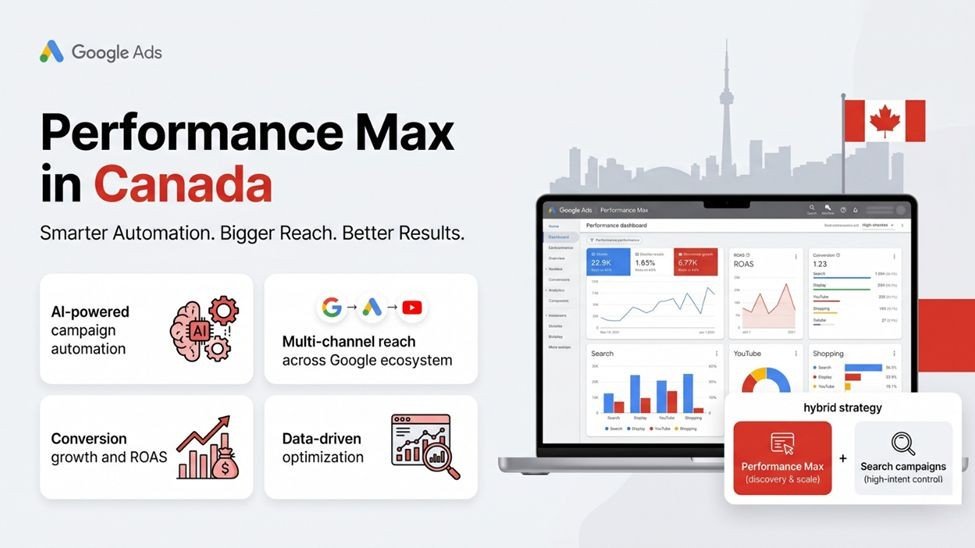
Performance Max has rapidly become the default campaign type for many Canadian advertisers in 2026. Instead of managing separate Search, Display, Shopping, and YouTube campaigns, businesses now feed Google a set of assets and let the machine learning system decide where and how to show ads across the entire Google ecosystem.
Early adopters in Canada have seen strong results when the campaigns are properly structured. Google has reported that Performance Max campaigns can drive significant lifts in conversions when paired with high-quality creative and clear audience signals. However, many businesses still struggle with the “black box” nature of these campaigns. Without proper asset libraries, feed optimization, and ongoing creative testing, Performance Max can spend budgets quickly on low-quality traffic.
The smartest Canadian advertisers are now using Performance Max as a powerful discovery engine while maintaining tighter control on high-intent Search campaigns. This hybrid approach lets the AI find new opportunities while human oversight protects brand reputation and return on investment in competitive markets like the Greater Toronto Area.
AI Is Running Most of Your Google Ads Campaigns
Artificial intelligence now handles the majority of bidding, targeting, and optimization decisions in Google Ads. Smart bidding strategies powered by machine learning analyze billions of signals in real time to decide when and where your ads should appear. For Canadian businesses, this means campaigns can react instantly to local events, weather patterns, or seasonal shopping behaviours that would have been impossible to manage manually.
The shift has been dramatic. Accounts that rely heavily on manual CPC bidding are increasingly rare among serious advertisers. Instead, the focus has moved to providing Google with the right data inputs: accurate conversion tracking, high-quality creative assets, and clear business goals. Businesses that feed the system clean, comprehensive data are seeing the biggest gains in efficiency and scale.
Yet this automation comes with a catch. When the AI lacks good signals, it makes suboptimal decisions. Canadian advertisers who invest time upfront in proper setup and ongoing creative refresh are the ones seeing the strongest performance in 2026.
Privacy Changes and the New Measurement Reality
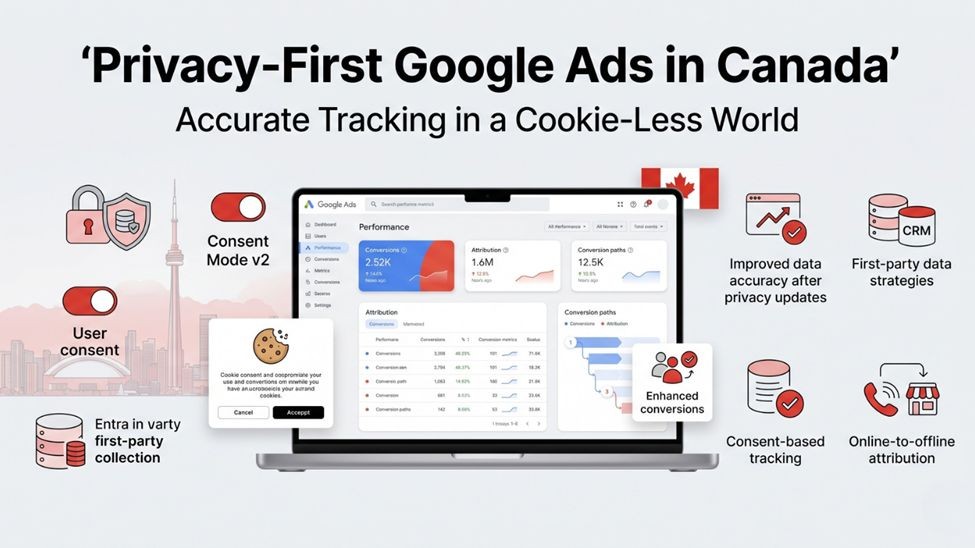
Canadian privacy regulations, combined with global shifts away from third-party cookies, have fundamentally changed how we measure Google Ads success. Consent Mode v2 and enhanced conversions have become essential rather than optional for serious advertisers. Businesses that have adapted are maintaining accurate attribution even as privacy protections tighten.
Many Canadian companies initially saw conversion tracking accuracy drop when these changes rolled out. Those who implemented first-party data strategies and proper consent flows quickly recovered and, in many cases, gained more reliable insights than they had before. The move toward privacy-first measurement has actually forced better data hygiene across the board.
For businesses operating in Canada, understanding how these changes affect local customer journeys is crucial. From e-commerce stores in Montreal to service providers in Calgary, the ability to connect online ads to offline outcomes or phone calls remains a competitive advantage when done correctly.
Creative Strategy Has Never Been More Important
One of the biggest shifts in 2026 is how much creative matters in Google Ads. Performance Max campaigns live or die based on the quality and variety of assets provided. Headlines, descriptions, images, videos, and logos all work together as signals that help the AI match ads to the right audience.
Canadian businesses that treat creative as an afterthought are leaving money on the table. The most successful accounts maintain large, regularly refreshed asset libraries that speak directly to different audience segments and buying stages. Testing new creative variations has become a core weekly activity rather than a quarterly project.
This emphasis on creative has levelled the playing field in some ways. A smaller Canadian brand with compelling, authentic messaging can now compete more effectively against larger competitors when their assets resonate better with local audiences.
Local and Hyper-Local Strategies That Work in Canada
Canadian geography and consumer behaviour create unique opportunities for localized Google Ads strategies. Businesses in Toronto, Vancouver, and other major centres are successfully using location extensions, local inventory ads, and hyper-local targeting to drive foot traffic and qualified leads.
Seasonal campaigns tied to Canadian realities continue to deliver strong results. Think winter tire promotions in prairie provinces, cottage season campaigns in Ontario and Quebec, or back-to-school pushes that align with provincial schedules. Smart advertisers layer these local insights on top of national campaigns for maximum relevance.
Many Toronto-based businesses, for example, combine broad Performance Max campaigns with tightly controlled Search campaigns focused on high-intent local keywords. This balanced approach captures both broad discovery and precise, ready-to-buy traffic in one of Canada’s most competitive markets.
Budgeting and ROI Realities for Canadian Businesses in 2026
Understanding realistic expectations around cost and return remains one of the biggest challenges for Canadian advertisers. Average cost per click varies significantly by industry and location, with competitive sectors in major cities seeing higher rates. Conversion rates of six to eight percent are common benchmarks when campaigns are properly optimized.
Businesses that set clear key performance indicators and track the full customer journey achieve the best results. Focusing solely on cost per click or cost per lead often misses the bigger picture of lifetime customer value and repeat business that many Canadian companies rely on for long-term profitability.
The most successful advertisers in 2026 treat Google Ads as an integrated part of their overall marketing ecosystem rather than a standalone channel. When aligned with strong organic presence, email marketing, and customer retention strategies, the return on PPC investment becomes significantly more attractive.
Common Mistakes Canadian Businesses Still Make with Google Ads
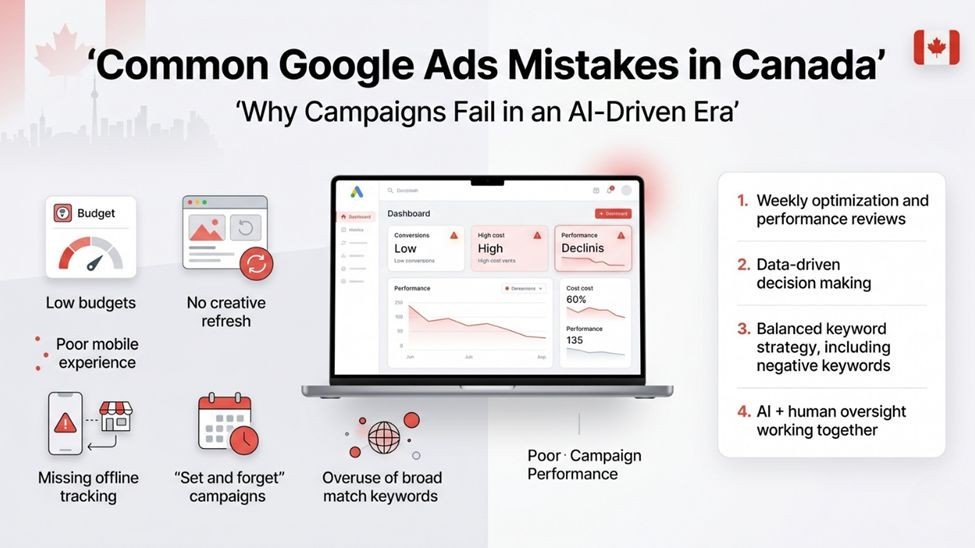
Despite all the changes, many Canadian companies continue to repeat the same costly errors. Running campaigns with insufficient budgets, neglecting creative refresh, ignoring mobile experience, and failing to properly track offline conversions all lead to disappointing results.
Another frequent issue is setting and forgetting campaigns. In today’s AI-driven environment, regular review and optimization remain essential even when automation handles much of the day-to-day work. Businesses that review performance weekly and make data-informed adjustments consistently outperform those that check in monthly or quarterly.
Over-reliance on broad match keywords without proper negative keyword management also continues to waste budgets for many advertisers. The most effective accounts maintain a disciplined approach to keyword strategy while letting AI handle scaling and discovery.
Building a Future-Proof Google Ads Strategy for Your Canadian Business
Success in 2026 and beyond requires a balanced approach that combines the power of AI with human oversight and strategic thinking. The best Canadian advertisers focus on three key areas: providing Google with rich, accurate data; maintaining high-quality, regularly updated creative assets; and aligning their PPC efforts with broader business goals and customer experience.
This means investing time in proper tracking setup, developing strong creative processes, and regularly testing new approaches rather than assuming yesterday’s tactics will continue to work. Businesses that embrace this mindset are not only protecting their advertising investment but positioning themselves to capitalize on new opportunities as the platform continues to evolve.
Wrapping It Up: The Opportunity Ahead for Canadian Advertisers
Google Ads in Canada has never been more powerful or more complex. The shift toward AI automation, Performance Max, and privacy-first measurement has created both challenges and unprecedented opportunities for businesses willing to adapt.
Those that invest in understanding the new realities, building proper foundations, and maintaining a test-and-learn mentality are seeing the strongest results. Canadian businesses have a unique advantage in this environment because local knowledge, cultural relevance, and authentic storytelling still matter tremendously even as technology advances.
The advertisers who will thrive in 2026 and beyond are not necessarily the ones spending the most money. They are the ones who approach Google Ads strategically, stay curious about new capabilities, and never lose sight of the real people behind the clicks and conversions.
Frequently Asked Questions
How much should a Canadian business budget for Google Ads in 2026?
For most small and medium businesses, a realistic starting point is around one thousand dollars per month. Competitive industries or larger markets like Toronto often require three thousand to ten thousand dollars monthly to achieve meaningful scale and consistent results. The key is starting with a budget that allows for proper testing and learning while aligning with your overall business goals.
Is Performance Max the right choice for every Canadian business?
Performance Max works extremely well for many advertisers when properly set up with strong creative assets and clear conversion tracking. However, businesses with very specific targeting needs or strict brand guidelines often benefit from a hybrid approach that combines Performance Max with traditional Search campaigns. Testing and ongoing optimization are essential regardless of campaign type.
How have privacy changes affected Google Ads measurement in Canada?
Privacy updates and Consent Mode have made accurate tracking more challenging but also more reliable when implemented correctly. Canadian businesses that have adopted enhanced conversions and first-party data strategies are often seeing more trustworthy attribution than they did under the old cookie-based system. Proper setup is critical for maintaining measurement accuracy.
What role does creative play in Google Ads success in 2026?
Creative has become one of the most important factors in campaign performance. Performance Max campaigns rely heavily on the quality and variety of assets provided. Businesses that treat creative development as an ongoing process rather than a one-time task are seeing significantly better results and higher return on ad spend across the platform.

Chris Mcdonald has been the lead news writer at complete connection. His passion for helping people in all aspects of online marketing flows through in the expert industry coverage he provides. Chris is also an author of tech blog Area19delegate. He likes spending his time with family, studying martial arts and plucking fat bass guitar strings.