
The look of Google and other search engines has changed a lot over the years, but perhaps the most radical change has come just within the last few months. If you’ve been on Google at all lately (and who hasn’t?), you’ve probably seen the change: nowadays, instead of immediate search results, you’re provided with an AI Overview generated by Google based on the best answers to your search query.
AI Overviews have drastically changed the way search engines work with the intent of making it easier for users to find accurate, helpful information. This is great for the user, but for businesses who once relied on SEO tactics and search rankings, this new change might seem like an upheaval of epic proportions.
Fortunately, the new landscape of AI-based SEO is one you can prepare for. Below, we’ll help you understand AI Overviews, how they have changed SEO, and what you can do to optimize your business for this new frontier of online visibility!
AI Overviews: How They Work and Why They Matter
Generative AI Overviews are a very new and fascinating element of online query searching. Because of how new this technology is, it’s natural to be confused by it or to want to understand how it works.
In brief, AI Overviews are condensed summaries of authoritative and informative search results that are auto-generated by an AI Assistant based on a user’s search query. These summaries appear at the top of your search results page, before any direct links, and they often include references, citations, or links to the content they cite.
AI Overviews compile their answers to your search query by using complex algorithms to crawl and search through returned results. They then determine which information is the most authoritative, summarize the key points in a digestible way, and present it to you.
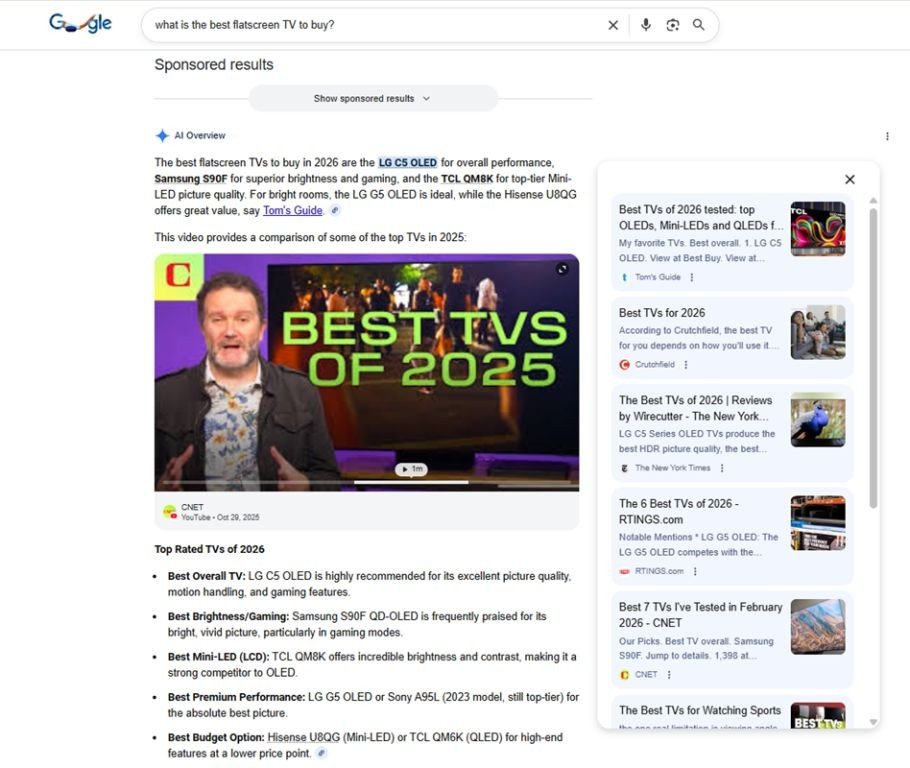
For example, let’s say you searched for the question “what is the best flatscreen TV to buy?” As you can see in the image above, upon submitting your query, the AI algorithm will look through all of the returned search results, compile data based on the most reputable sites, and present you with a summarized answer consisting of key data, such as popular flatscreen TV models, where they are sold, how much they cost, how many good reviews they have, and more. The AI summary will also provide you with links to the sites where it derived this information.
How Have AI Search Overviews Changed the SEO Landscape?
Click-Through Rates
AI Overviews have the potential to cause a decline in click-through rates, which were formerly one of the pillars of traditional SEO. In the past, search rankings and online visibility were largely determined by how many users clicked on a link or ad provided by your website, in comparison to how many simply viewed it (known as “impressions”). Websites with high click-through rates were considered to be more authoritative, as clicking through indicated that the user felt compelled to engage with the site.
With AI Overviews now in place, however, users no longer have to navigate through the same number of links as they did before. AI Overviews limit the amount of links users are exposed to upfront, and studies suggest that the presence of an AI Overview can cause a up to a 70% decrease in CTR for ranking sites. To address this, businesses have begun to practice Generative Engine Optimization (GEO) rather than SEO, focusing on attracting AI algorithms to their content.
Keywords
Alongside CTR, keywords were one of the most important elements of traditional SEO. Because search engine algorithms used to look for results based on how well they matched the keywords of a certain query, SEO strategies involved businesses writing content with deliberate keyword placement designed to match popular queries in the hopes of getting high rankings.
AI Overviews have greatly changed the way keywords affect rankings. Where businesses could once generate high rankings by incorporating a mix of generic and specific keywords into their content, they now need to retool their content to match the much more specific content of the search query that the AI algorithm is looking for. This means businesses will have to shift their content focus toward including longer, more specific tail phrases that signal relevance to the AI.
E-E-A-T
Many search engines, particularly Google, have stringent guidelines regarding the Experience, Expertise, Authoritativeness, and Trustworthiness (E-E-A-T) of the search results they display. These four benchmarks have become even more important in the age of AI Overviews. AI algorithms are geared to find critical information regarding a business’ experience (for example, real-life achievements), expertise (extensive knowledge of a topic), authority (level of respect and influence in a field), and trustworthiness (how honest, accurate, and reliable they are).
To make their content more likely to appear in an AI Overview, businesses are increasingly having to reframe their content to highlight their specific levels of E-E-A-T. This includes making direct references to business achievements, citing experience and longevity, and promoting connections they have in their field that boost their reputation and authority.
Schema
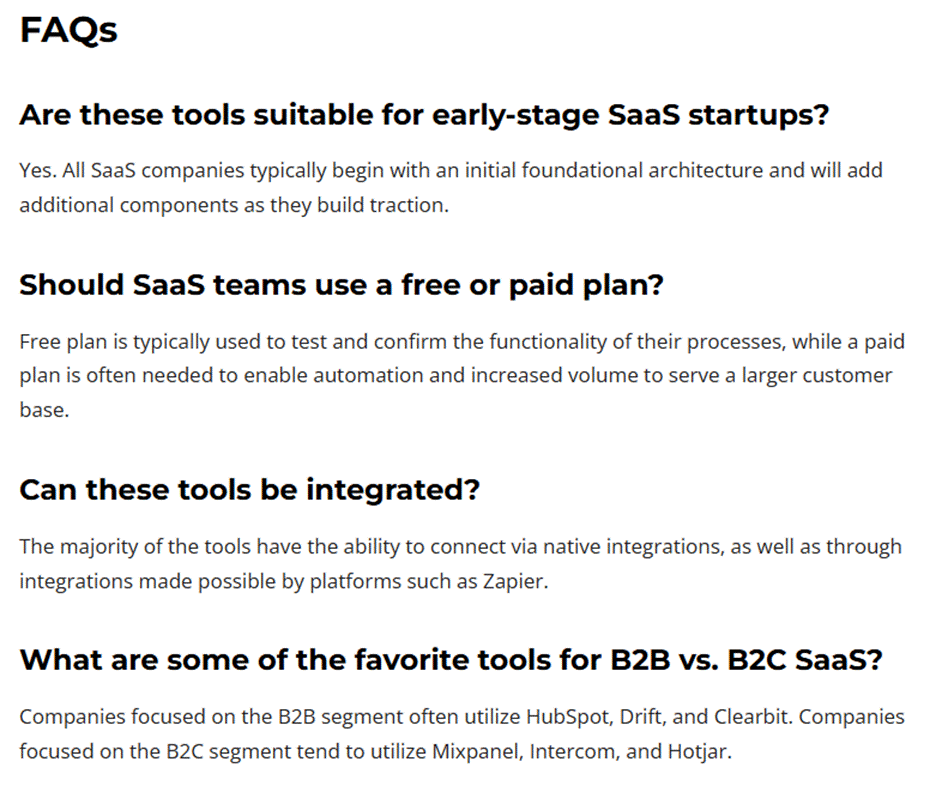
Another important facet of the changing landscape of search results is the elevated importance of schema. Schema has in many ways taken the place of keywords in AI SEO, and the term “schema” specifically refers to structured data that helps an AI Assistant immediately understand important information about your business, its reputation, and its relevance to the query topic.
Prime examples of schema in AI optimization include clearly-authored article and blog posting, product details such as prices, availability, reviews, and images, FAQs, contact information, location, and hours of operation. As you can see from the example above, from an article on the best SaaS marketing tools of 2026, clear and concise FAQs provide easily-crawlable information for an AI engine to capture. Including these important data points in a clear way throughout your content is the best way to attract AI engines.
How To Optimize Your Pages for AI Overviews
1. Front-Load Your Answers
The best way to accumulate AI citations of your content is by placing your query answers clearly and succinctly at the top of your pages. Front-load your information by placing a short summary of your main query and its answer (around 50-60 words) at the beginning of your content. This tactic was a key part of older SEO content writing principles, but is now even more important in light of AI search results, which deliberately seek out content that is clear, direct, and answer-forward.
2. Use Clear Structures
AI engines gravitate towards content that is well-structured, so be sure to format every page you publish with a clear, concise, and crawlable structure. Use concise headings and make sure to section out your content via the use of Heading 2s and Heading 3s, which provide clear visual and encoded section delineation. Additional data formats such as bullet points and tables will also attract AI engines, and make sure to keep your paragraphs short and easy for the AI to parse out and extract, as short snippets tend to be featured more than long passages.
3. Include Question-Based Headings
AI engines are looking explicitly for answers to a customer’s specific query, so to optimize your content effectively for AI, you must include specific questions in your content, particularly as headings. Headings stick out as section-signals to AI engines, so if your headings take the form of a specific, long-tail question that you want your content to answer, it is much more likely that you’ll appear as a cited source in an AI Overview.
4. Implement Schema Markup
As we stated above, schema is extremely important in gaining AI visibility. Certain types of content structures are much more effective at getting attention from AI than others. For example, you should prioritize implementing FAQPage, QAPage, or HowTo schema wherever possible. These schema markups help AI engines interpret your content by displaying it as rich results. Make sure you know the difference between how these types of schema markups work (i.e., FAQPage containing multiple Q&A pairs, QAPage containing one question with multiple answers, and HowTo focusing on a sequential, step-by-step process).
5. Use Multimedia
Including multiple forms of content is a great way to get AI engines interested in your pages. Multimedia content forms such as images, infographics, and videos supplement your written content and provide additional data that an AI engine can use to gauge the credibility, usefulness, and authority of your content. Content types switch as informative, research-based infographics, visual references, and videos also improve user experience, another key factor that attracts AI.
6. Update Constantly
AI models evolve rapidly and always have access to the latest data, so you need to keep abreast of the trends just as much as they do. Update your content constantly as new information comes out, keeping an “always-on” approach that reflects your commitment to maintaining your brand authority and accuracy. AI engines can see the frequency and recency of your updates, and active pages that are maintained regularly will attract much more attention than stagnant, ancient pages that are likely outdated. Constant updates help to gamify your site for AI retrieval.
Ways To Start Improving Your AI SEO
Consider Learning From AI Assistants
To understand AI, it’s important to learn from and study existing AI Assistants. Even if you don’t use AI writing and marketing tools like ChatGPT, QuillBot, and HubSpot, investigating them and understanding how they compile content can give you valuable insights into how search engine algorithms work when generating their AI summaries. These tools aren’t replacements for truly original content, but they can help you out when it comes to learning the process AI actually goes through to judge originality, accuracy, and relevance.
Track Key Metrics
Much like traditional SEO, AI SEO is fundamentally reliant on metrics and key performance indicators (KPIs). You can start looking at your business’ numbers and data in regards to these metrics to see where you need to improve. Important AI SEO metrics and KPIs include traditional SEO metrics like organic traffic, conversions, keyword rankings, backlinks, engagement, and core web vitals, but also include new metrics such as AI citations and mentions, share of voice (SoV), relevance score, chunk retrieval frequency, and AI attribution rate.
Consult an AI SEO Agency
There’s no doubt that all of this stuff can be complex. AI is a complicated form of technology, and you can easily be forgiven for not understanding it fully. To help you out in making an AI SEO strategy, you could consider consulting an AI SEO agency. Many different agencies are capable of formulating a comprehensive strategy for your business that can lead to measurable increases in AI visibility. These agencies will work collaboratively with you to create content libraries, optimize your content style, add schema, and improve your E-E-A-T so that you can start seeing results.
Real-World Results: Case Studies in AI SEO Success
Of course, none of this matters unless your use of AI SEO strategies produces real-world results. Fortunately, based on recent trends and case studies, it is clear that AI SEO is the way forward for gaining traffic, citations, and engagement via content optimization. Numerous case studies exist which showcase the effects AI SEO has had on the organic traffic and ROI for many major businesses.
One fascinating case study came from Xponent21, which revolutionized its AI visibility via a major SEO campaign designed to combat a large obscurity gap between their business successes and their online presence. Xponent21’s SEO push focused on publishing flagship articles that included schema such as glossaries and FAQs, publishing informative webinars, podcasts, and videos, engaging in social media and thought leadership, implementing structured data and technical SEO, and engaging in extensive cross-promotion and backlinking. The results were clear, as the campaign led to an astonishing 4,162% growth in traffic year-over-year.
Another, shorter-term case study that shows the value of AI integration is HubSpot’s use of AI SEO to increase their organic traffic by 50% in one month. Instead of trying to capitalize on as many different queries as possible, HubSpot used AI to identify key topic clusters that were relevant and high-traffic. They then published high-quality, interconnected webpages within each of these clusters, allowing AI engines like Google’s to understand the interrelatedness of their content and boosting their keyword and query rankings.
With the Rise of AI, SEO Must Evolve, Not Disappear!
AI is here to stay, and its algorithms are reshaping the ways we see information and find authoritative sources. Your business is in a prime position to capitalize on this growing trend, which will soon become our entire way of life in the online world.
By focusing on the tips and guidelines above, you can set your business on the path to success in the changing SEO landscape, not by forgetting SEO altogether, but rather by evolving your approach to take in account newer and better ways of attaining visibility!
FAQ
What is AI SEO?
AI SEO is the process of leveraging AI technologies and engines to optimize web content so that it is more likely to appear as a cited source in AI Overviews. AI SEO consists of using strategies such as keyword research, query optimization, and schema implementation to make content more likely to be retrieved by AI engines.
How do you optimize content for AI Overviews?
Optimizing content for AI Overviews involves focusing on E-E-A-T (Experience, Expertise, Authoritativeness, Trustworthiness), providing clear and direct answers to queries, and using structured content formats and schema to make pages more likely to be viewed and selected by AI engines.
What are some important KPIs for AI SEO?
There are a number of important KPIs to be aware of when practicing AI SEO, including:
- AI-Generated Visibility Rate (AIGVR)
- Citation/Attribution Frequency
- Share of Voice
- Topic Authority Score
- Conversational Engagement Rate (CER)
- Retrieval Rate
Do I still need traditional SEO?
Yes, traditional SEO is still necessary in the age of AI optimization. In particular, elements of technical SEO such as site optimization, user experience, and mobile-friendliness are increasingly important in attaining AI visibility.
How quickly does AI optimization start working?
AI optimization plans, especially those made in partnership with an AI SEO agency, can often start working in as little as one month. By 30 days, you should begin to see short-term results, while after 60 to 90 days, the foundations of long-term growth should begin to appear.

Chris Mcdonald has been the lead news writer at complete connection. His passion for helping people in all aspects of online marketing flows through in the expert industry coverage he provides. Chris is also an author of tech blog Area19delegate. He likes spending his time with family, studying martial arts and plucking fat bass guitar strings.