
Introduction
Most eCommerce PPC audits are still based around the old (and increasingly irrelevant) metrics of CTR (click-through rate), QS (quality score), CPA (cost per acquisition), and CPC (cost per click). They flag a couple of missing negative keywords. You fix them and call the account “healthy”. These metrics were once enough to reflect the efficacy of your eCommerce PPC strategies, but the profit-drawing levers have shifted now. Today, as tools like Google’s Performance Max (PMax) and Shopping automate much of the targeting, including bids and placements, the old manual controls and metrics-driven analyses are mostly gone.
Consequently, an audit built around these aspects can only partially inspect your campaign. This gap between what worked before and what now fails can be quite expensive because the inputs that determine eCommerce PPC profit now sit unexamined, quietly leaking budget every day.
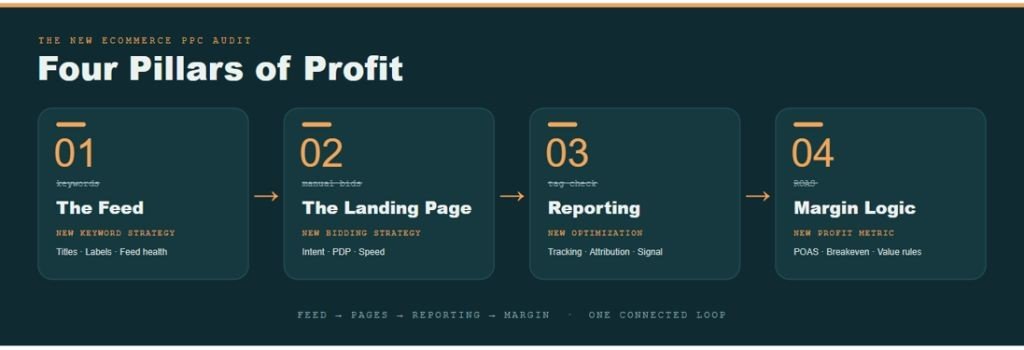
The modern eCommerce PPC audit looks somewhere else. It examines the four systems that actually drive results: your product feed, your landing pages, your reporting, and your margin logic. These sit mostly outside the ad platform. Yet they decide whether you spend the money or quietly lose it. This blog post walks through the new audit framework. Use it as a working PPC audit checklist for eCommerce, and apply each section to your own account as you read.
Why the Old eCommerce PPC Audit Has Stopped Working?
Traditional PPC audits for eCommerce were designed for manual workflows.
- Keywords were handpicked.
- Bids were set by experts.
- Ad copy and placements were decided manually.
Consequently, an eCommerce audit checked whether you did those things well, based on the key metrics elaborated in the introduction.
Smart bidding changed this scene altogether. Google’s algorithms now handle the moment-to-moment decisions, so you no longer tune bids keyword by keyword. You rather input the machine signals and goals, and it optimizes toward them.
This shift matters for one reason. If you only audit metrics like CTR and Quality Score, you audit the part of the system you no longer control. Meanwhile, the inputs you do control go unchecked. Safe to say, the old isn’t wrong. It’s just incomplete in today’s dynamic PPC space.
The New eCommerce PPC Audit
Let’s see how the modern eCommerce PPC management covers the above gaps.
Pillar #1: The Feed – Your New Keyword Strategy
In Shopping and PMax, the product feed does what keywords used to do. Algorithms read your product titles and attributes to decide which searches you appear for. So, a weak feed limits your reach, no matter how much you bid or what keywords you use.
A revamped eCommerce PPC audit should check the following related to the feed:
- Product Titles: Front-load them with the terms shoppers actually search. Brand, product type, and key attributes should appear early. Vague or branded-only titles can bury you in low-intent auctions.
- Feed Completeness: Missing GTINs, brands, or categories restrict where your items can show. Moreover, Google limits visibility for thin data, making many accounts leak impressions here without ever knowing it.
- Custom Labels: Tag products by margin tier, bestseller status, stock level, or season. This is how you inject business logic into automated campaigns.
- Product Type: This attribute controls how cleanly your catalog splits into campaign groups. Vague values make smart segmentation almost impossible later.
- Supplemental Feeds: Use them to override weak titles and fix gaps without touching the main feed. A short supplemental feed often beats a bid change.
- Images, Price, and Status: Check image quality, price competitiveness, and disapprovals. One limited status can pull a strong product out of rotation.
Custom labels deserve a closer look, because this is where most accounts fail quietly. Most feeds we review use none at all. Without them, every product looks the same to Google, apart from the revenue it earns. So the algorithm chases revenue by default, even on products that barely turn a profit. Custom labels are how you mark which products to favor: high-margin items, bestsellers, or in-stock lines. With none in place, that knowledge never reaches the algorithm.
Pillar #2: Landing Page – Your New Bidding Strategy
The old eCommerce PPC audit stopped at the click. It checked the ad, the keyword, and the cost per click, then went quiet. But the new audit keeps going because the landing page is where your ad spend finally converts or leaks away. It is also one of the few areas the algorithm has not taken over, meaning you still fully control it. So you need to look at your landing page differently and optimize it consciously. Two solid reasons to back this up:
- PMax and Shopping send traffic straight to your product pages, making the page part of the campaign.
- Smart Bidding optimizes toward conversion value. A page that converts better sends stronger signals to the algorithm.
A revamped eCommerce PPC audit should check the following related to the landing page:
- Query-to-Page Match: Does the click land on a page that matches intent? Traffic sent to the homepage instead of the right product page bleeds money.
- Product Detail Page Quality: Look for clear reviews, trust signals, and honest shipping and returns information. Make pricing and stock obvious. Shoppers abandon pages that hide the details they care about.
- Mobile Speed and Core Web Vitals: Most eCommerce traffic is mobile, and slow pages lose sales before they load.
- Page Type: Sometimes, a focused product page converts best. Other times, a curated collection page wins for broad searches. Match the page to the intent.
- Ad-to-Page Consistency: The promise in your ad must match that on the page. A discount in the ad should be visible on arrival. Broken promises raise bounce rates and waste qualified clicks.
Pillar #3: Conscious Reporting – Your New Optimization Strategy
The old PPC audit treated reporting as a setup task that checked that a conversion tag existed and trusted whatever number came back. If tracking was installed, the audit moved on. That assumption no longer holds. Privacy changes, cookie limits, and ad blockers now hide a large share of conversions from browser tracking. So a tag that fires can still report numbers that miss reality.
Hence, the new PPC audit for eCommerce brands must treat reporting as a measurement problem to be optimized. Ad platforms generally report the most flattering numbers they can, and they claim credit generously. This applies to Microsoft Ads as much as Google.
There is a sharper reason to care for this now. Smart bidding learns from the conversion data you feed it. This input steers where the algorithm spends its resources, ultimately impacting the whole system.
A revamped eCommerce PPC audit should cater to the following in your reporting strategy:
- Conversion Tracking Integrity: Confirm that tags fire correctly on every purchase. Check for duplicate conversions and inflated values. A tracking error here corrupts every decision downstream.
- GA4 and Attribution: Last-click attribution overcredits the final touch and ignores earlier demand. The true picture is almost always more blended than the platform shows.
- Signal Quality: Browser tracking now loses data to privacy changes and ad blockers. Server-side tracking, Enhanced Conversions, and the Conversion API recover much of that lost signal.
- First-Party and Offline Data: Offline conversion imports tell Google which orders were truly valuable. First-party data sharpens targeting as third-party signals fade.
- Reconciliation: Compare platform-reported revenue against your Shopify or back-end totals. Track blended metrics like MER (Marketing Efficiency Ratio) and new-customer CAC.
Pillar #4: ROAS Margin logic – Your New Revenue Metric, Not Profit
This is where most eCommerce PPC audits stop too early. ROAS measures revenue against ad spend. It says nothing about profit. Two products with the same ROAS can yield opposite outcomes once the costs are factored in. It isn’t still wrong to prioritize this metric, but there’s one issue with ROAS: it ignores margin. A product with thin margins needs a high ROAS just to break even. A product with fat margins stays profitable at a much lower ROAS. Thus, treating all ROAS as equal completely hides this.
Consider two products, each sold for $100.
Product A is low margin. After accounting for the cost of goods, shipping, and fees, it retains $17 in gross profit. It runs at a strong-looking 4x ROAS. That means $25 in ad spend (=$100 in product value). Subtract the spend from the $17 margin, and the product loses $8 on every sale.
Product B is high margin. After the same costs, it keeps $60 in gross profit. It runs at a weak-looking 2x ROAS. That means $50 in ad spend (=$100 in product value). Subtract the spend from the $60 margin, and the product earns $10 on every sale.
The headline ROAS pointed you to the wrong winner. The 4x product loses money. The 2x product makes it. This is the single most expensive blind spot in eCommerce advertising.
The fix is to think in terms of profit, not revenue. POAS, or profit on ad spend, measures the number that actually matters. It accounts for the cost of goods, shipping, fees, returns, and discounts. ROAS versus POAS is the difference between looking busy and being profitable. So weigh new-customer value alongside immediate margin. Do not let a flattering ROAS make the decision for you.
Then push that logic back into the account:
- Tag margin tiers as custom labels in your feed, so the algorithm can see them.
- Use value rules to bid more for your most profitable products.
- Set target ROAS by product group, not one blanket goal across the catalog.
- Calculate the breakeven ROAS for each product before scaling its spend.
How the Four Pillars Connect Within a Modern eCommerce PPC Strategy
These four pillars are not a checklist of separate fixes. They form one loop where each pillar feeds the next, and a break in one weakens the others. It works like this: your margin logic determines which products are worth spending on. Your feed carries that logic through custom labels. Your bidding then respects those margins instead of chasing raw revenue. Finally, your reporting measures profit (not revenue), so you can see if it worked. And your landing pages convert the traffic into the sales you actually wanted.
If this loop breaks at any point, the system leaks. Good margins with a broken feed never reach the algorithm. Clean feeds with bad reporting optimize toward fiction. Strong reporting with weak landing pages converts too little to matter.
This is why eCommerce PPC management today is about inspecting the overall system, not just the account. A real PPC audit, hence, traces value through the whole loop. It finds the gap, not just the symptom. It also tells you where to start. Fix the gap with the widest impact first.
Quick Self-Diagnostic: A PPC audit checklist for eCommerce Brands
If you’re struggling with your Google Ads audit for eCommerce, or are unable to break even on ROAS by product, here is an expert-validated PPC audit checklist for eCommerce. Run your account through these red flags. Each one points to a leak the old audit may have missed.
- Your product feed uses no custom labels, so the algorithm cannot see the margin.
- Your product titles lead with your brand instead of what people search for.
- Your ads send traffic to the homepage rather than the right product page.
- Your mobile pages load slowly and fail Core Web Vitals.
- You rely on browser tracking alone, with no server-side or Enhanced Conversions.
- You judge performance on last-click ROAS and never check blended numbers.
- You set one target ROAS across products with very different margins.
- You have never calculated a breakeven ROAS for your catalog.
If you checked three or more, your account is likely losing money on seemingly successful products. The metrics say healthy. But your bank account says otherwise.
The Takeaway
Ad platforms have automated away the old manual ways of tracking an eCommerce PPC campaign’s performance. Modern eCommerce PPC management is now more intuitive, less about the metrics and more about the direction. But that doesn’t take away the role you play in guiding campaign decisions. You would rather move upstream, to the systems you still control: strategy.
Feed, landing pages, reporting, and margin logic are where profit is won or lost today. None of these four lives is inside the ad account in the old sense. That is the whole point. The work that moves profit now sits in your feed, on your pages, in your data, and in your numbers. An audit that ignores them inspects a steering wheel the car no longer uses.
So change the question your audit asks. Stop asking whether the account looks healthy. Start by asking whether each dollar earns a profit (and not revenue) after accounting for all costs. Audit the four pillars, trace the loop between them, and fix the widest break first. That is how you move from optimizing revenue to protecting margin.

Ravi Kant is the Vice President of the eCommerce and Photo Editing Division at SunTec India. With over two decades of global experience, he spearheads large-scale digital commerce initiatives that drive operational excellence and measurable ROI for global businesses. His expertise spans eCommerce strategy, digital transformation, and data-driven performance optimization.