
A Fast Launch That Eventually Hit a Ceiling
All companies begin with a starting point, and for many businesses, that’s a page builder. It is fast, doesn’t need a developer, and can bring a website online in a few days. It was the same for a medium-sized “as-a-service” business that launched their initial location three years ago on a favored drag-and-drop platform.
The site did its job early on. It was good-looking, relatively easy to change, and not expensive to maintain. As the business expanded, new service lines were added, and search visibility was becoming a serious investment. First, let’s examine what went wrong, what the business changed, and why the decision to go with custom WordPress development proved to be a wise one.
Client Snapshot
It is a competitive service-based business with a number of business sites and increasing service lines. They had originally developed their site on a page builder platform, added a few high-quality plugins for contact forms, appointment booking and basic SEO settings. It functioned for some time. Then traffic started to grow, new pages piled up and the site started to age in many ways that were directly impacting the bottom line.
The Challenge: When a Page Builder Stops Being Enough
By year two, the internal team noticed a pattern. Page load times were creeping up. Every month, Google Search Console identifies Core Web Vitals problems. The layout blocks that the builder used were not following the rules for mobile, and thus new landing pages were taking longer to build. Any new plugin for a feature request would leave something else broken on the site.
Here is a breakdown of the specific problems the business ran into:
- Over-bloated code: The builder produced a lot of HTML, CSS and JavaScript that was not required to load any of the pages, causing the pages to load much more slowly.
- Mobile performance issues: Some layouts were working well on desktop, but not on mobile, which negatively affected user experience and ranking.
- Plugin conflicts: The site relied on the builder’s own plugin environment, and the plugins for booking, forms or analytics from outside parties often caused problems.
- Template ceiling: There were only the templates and blocks the builder provided that could be used for design changes, which meant it was difficult to differentiate from other templates on the same platform.
- SEO restrictions: The semantic code is important for the search engines and the builder’s output did not take this into account.
- Migration risk: The more they stay on the builder, the more they add to it in terms of content, plugins and custom tweaks, the more difficult and expensive it will be to migrate to a different platform in the future.
None of these issues were dealbreakers on their own. Together, they were quietly costing the business traffic, leads, and staff time.
Why the Business Looked Beyond Page Builders
The marketing team made the turning point when they contrasted the bounce rate and page speed data with a competitor who was deemed to have a custom-built site. The only distinction in load time was over 2 seconds. A few seconds is the time users have to make the crucial decision of whether they’ll stick with your page or move on to another one, and that was too much to take.
Leadership set three goals for whatever came next:
- A site fast enough to hold up under growing traffic without constant optimization patches.
- A design that reflected the brand instead of looking like every other business on the same builder.
- A foundation that would not need to be rebuilt again in another two years.
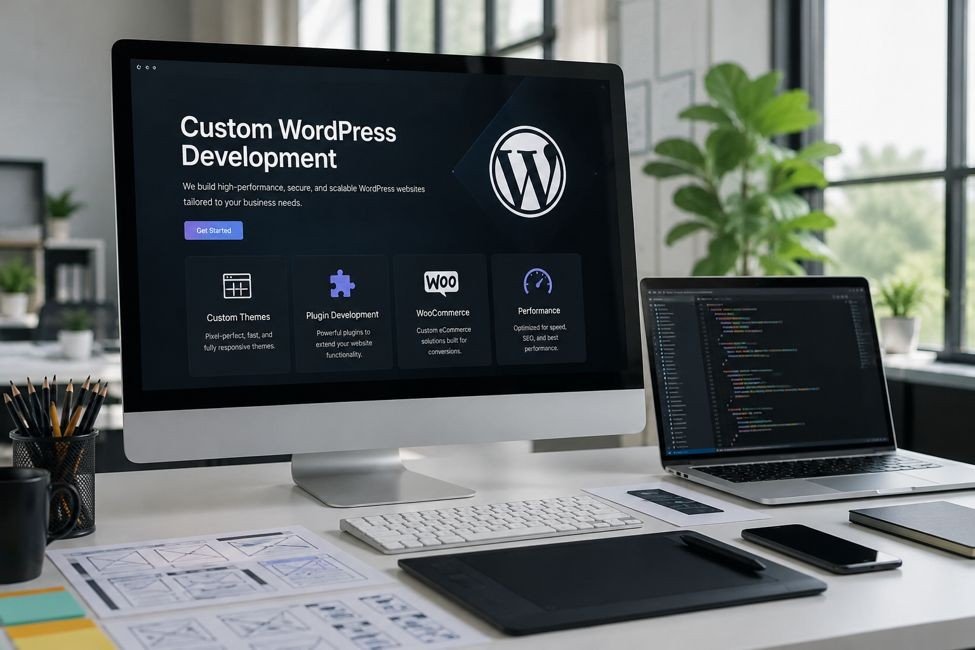
Those goals pointed toward one solution: working with a team that specializes in custom WordPress development rather than continuing to patch a platform that was never built for their scale.
The Solution: Partnering With a Custom WordPress Development Team
The business reviewed multiple agencies and selected the one that has a proven track record of creating custom WordPress websites for businesses in their growth phase. The project began by thoroughly assessing the current website, including its performance, plugins, content organization, and technical SEO.
Rebuilding for Performance First
The development team didn’t try to optimize the existing builder setup, but instead they started from scratch. All unnecessary scripts were stripped out. Images were compressed and served in modern formats. Components were removed from the database that are no longer used by previous plugins. The end product was a site that is built using light, efficient code rather than the multi-layered output that a builder produces as a default.
Designing Around the Actual Brand
In contrast to the design team developing page designs within pre-existing templates, custom page designs were created from the ground up. Navigation, service pages, and location pages were organized in a way that makes navigational sense for customers – not what the builder’s blocks permitted. This not only gave the business a look and feel of its brand, but also distinguished it from the masses of similar websites that are created by builders.
Cutting Plugin Dependency
The old site was built with a series of plugins for forms, bookings, and basic functionality, while the new build has custom-coded features wherever they were appropriate. Fewer plugins mean fewer points of failure, fewer conflicts, and less maintenance in the future.
Building SEO Into the Foundation
The development team worked from the ground up to code the site, headings, internal links, and page speed with search visibility in mind, instead of relying on the plugin settings. One of the most important benefits that custom WordPress development services in USA-based agencies usually provide over generic WordPress builder templates is that search engines love clean and well-structured code, which can only be created, not added on later.
Designing for Scale
Site architecture was planned from the outset to include new services pages and location pages as well as future features. The new foundation would be expandable without having to rebuild it each time the business launched a new offering, without disrupting the existing pages and rankings.
Strengthening Security
The rebuild also minimized the risks associated with common vulnerabilities found in widely used builder platforms. Less reliance on third-party software and components, and less time on emergency security patches.
Implementation: What the Rollout Looked Like
The project ran in phases over roughly ten weeks. The first phase focused on technical architecture and migrating existing content without losing any indexed pages or backlinks. The second phase involved creating new templates for the service pages, location pages and home page. The last portion comprised testing across devices, optimising speed and staging the launch to identify any problems before the site was launched.
As it went along, the business maintained a small internal team engaged in key decisions, especially the structure of the page and the priorities of the page with content, and the technical build was handled by the development team.
The Results
Within three months of launch, the business saw measurable improvement across the metrics that mattered most to leadership:
- Based on Core Web Vitals reporting, the page load time has improved from just under 6 seconds to under 2 seconds on mobile.
- Improved ranking on previously difficult-to-rank service pages contributed to an over 40% rise in the first quarter following the launch.
- Bounce rate dropped significantly on important pages, especially mobile – the old builder layouts were breaking.
- Internal staff hours were saved by the reduced need for support tickets for plug-in issues, which fell almost to zero.
- Lead submission grew, directly as a result of quicker load times and cleaner, more trustworthy page design.
None of these results happened overnight, and none of them came from a single change. They came from replacing a patchwork foundation with one built specifically around how the business operates and how its customers search.
The Long-Term Cost Picture
The page builder subscription had looked cheap monthly for years. However, when the business calculated the expenses of premium plugins, developer hours spent resolving conflicts and the ultimate expenses for the rebuild itself, it came out to be almost the same as a well-planned custom WordPress website development effort from the beginning. The one thing that the team learned was that the lowest launch cost is not necessarily the lowest cost over time.
What This Business Learned About Choosing a Development Partner
Looking back, the team pointed to a few factors that made the biggest difference in choosing the right agency:
- A real portfolio, not just polished mockups, showing actual live projects similar in scope.
- A clear process for discovery, design, development, and testing, laid out before any contract was signed.
- Demonstrated SEO knowledge, since a fast site with poor technical SEO still will not rank.
- Ongoing support after launch, since no website is truly finished the day it goes live.
- Transparent pricing, with no vague scope that could balloon costs mid-project.
These same criteria apply to any business evaluating WordPress development services in USA markets, where the number of agencies claiming expertise far outweighs the number that can actually back it up with results.
Conclusion
This business did not need a completely different strategy.It required a more solid base for its strategy. Switching from a page builder to custom WordPress development provided the site with the speed, flexibility, search performance and more that it could not have previously achieved.
For any growing business watching load times creep up, rankings stall, or plugin errors pile up, this case study is a reminder that the fix is rarely another patch. It is usually a foundation built the right way the first time.
Considering a similar move for your own site? A short technical audit can show exactly where a page builder is holding your business back and what a custom-built foundation would look like in comparison. Reach out to schedule one before your next big growth push.

Chris Mcdonald has been the lead news writer at complete connection. His passion for helping people in all aspects of online marketing flows through in the expert industry coverage he provides. Chris is also an author of tech blog Area19delegate. He likes spending his time with family, studying martial arts and plucking fat bass guitar strings.